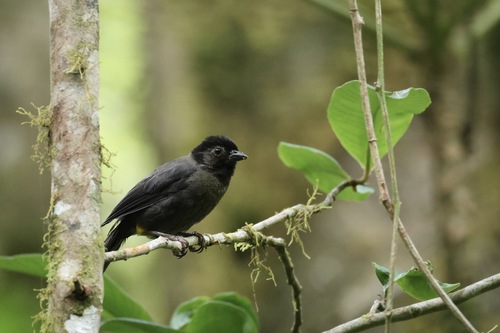
Cabanis's Ground-Sparrow

Cabanis's Ground-Sparrow

Melozone cabanisi

Silhouette: Edwin Price · PhyloPic

LCNTNear ThreatenedVUENCR Endemic
Daily sighting probability <5% · Rare
at Tapantí-Macizo de la Muerte National Park

In 3 days <5%

7 Verified sightings at Tapantí-Macizo de la Muerte National Park From 2019 to 2026
69 In all 2 parks
December Best month
☀️ Diurnal When it's spotted

About the Cabanis's Ground-Sparrow

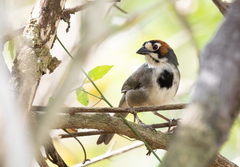
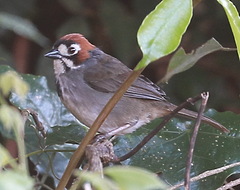
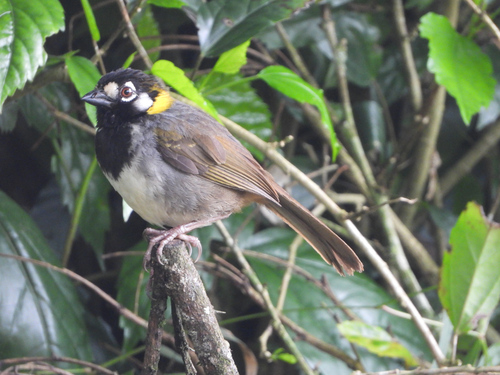
Cabanis's ground sparrow (Melozone cabanisi) or the Costa Rican ground sparrow is a Near Threatened species of bird in the family Passerellidae, the New World sparrows. It is endemic to Costa Rica. Cabanis's ground sparrow has a complicated taxonomic history. It was formally described by Philip Sclater and Osbert Salvin in 1868 with the binomial Pyrgisoma cabanisi. Some early twentieth century authors treated it as conspecific with the rusty-crowned ground sparrow (Melozone kieneri) and by late in the century most taxonomic systems treated it as a subspecies of Melozone biarcuata (Prevost's or white-faced ground sparrow). In 2012 the IOC again recognized it as a full species. Other systems slowly followed suit.

Cabanis's ground sparrow is monotypic. Cabanis's ground sparrow is about 15 cm (5.9 in) long. The sexes have the same plumage. Adults have a black forecrown. The rest of their crown and their ear coverts are chestnut or chestnut-rufous; the latter have a thin U-shaped black line around their bottom half. They have white lores, a white eye-ring, and white cheeks, chin, and throat with a thin black "moustache". Their back, scapulars... Wikipedia →

Sounds

Call0:10

Costa Rica · 2019

© Hans Matheve · XC517695 · CC BY-NC-ND 4.0

Song1:08

Costa Rica · 2017

© Juan D Astorga · XC371719 · CC BY-NC-SA 4.0

Song1:08

Costa Rica · 2017

© Juan Astorga · XC368223 · CC BY-NC-SA 4.0

Global Distribution

Parks Where Found

# Park Country Daily sighting probability
1 Monteverde Cloud Forest Reserve 🇨🇷 Costa Rica
<5%
2 Tapantí-Macizo de la Muerte National Park 🇨🇷 Costa Rica
<5%

Cities Where Found

# City Country Daily sighting probability
1 San José 🇨🇷 Costa Rica
<5%

Before you go

What are the chances of seeing a Cabanis's Ground-Sparrow in Tapantí-Macizo de la Muerte National Park?

Rare

Under 5% of wildlife watchers report a Cabanis's Ground-Sparrow sighting in Tapantí-Macizo de la Muerte National Park on a given day, based on 7 verified sightings from GBIF citizen-science data from 2019 to 2026. It is the 458th most-seen of the 467 birds we can rate there. Over three days the chance rises to under 5%, if each day is a fresh chance.

When is the best time to see a Cabanis's Ground-Sparrow in Tapantí-Macizo de la Muerte National Park?

Any time of year

In every month with enough records, under 5% of wildlife watchers report a Cabanis's Ground-Sparrow in Tapantí-Macizo de la Muerte National Park on a given day, so our monthly data shows no clear season.

What time of day is best to see a Cabanis's Ground-Sparrow?

Between 8 and 11 am

Across all the parks we cover, that three-hour window holds the most Cabanis's Ground-Sparrow sightings with a recorded time, and about 8 in 10 of them come between 6 am and 6 pm: it is a daytime animal.

Is Tapantí-Macizo de la Muerte National Park the best place to see a Cabanis's Ground-Sparrow?

Among the best

Of the 2 parks where we can rate Cabanis's Ground-Sparrow sightings, Tapantí-Macizo de la Muerte National Park ranks 2nd at under 5%, level with the leaders once rounded. The best odds are in Monteverde Cloud Forest Reserve (Costa Rica, under 5%).

Where does the Cabanis's Ground-Sparrow sighting chance come from?

GBIF citizen-science records

It is estimated from how often the Cabanis's Ground-Sparrow is recorded against all the birds logged in Tapantí-Macizo de la Muerte National Park (7 verified sightings from 2019 to 2026), calibrated against known sighting rates. Figures are rounded to the nearest 10% because citizen-science data supports honest approximations, not decimals, and months with records from fewer than five people show "—". How it works.

← Back to Tapantí-Macizo de la Muerte National Park