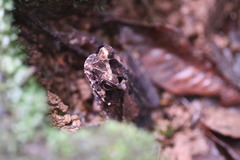

Wet Forest Toad

Wet Forest Toad

Incilius melanochlorus

Silhouette: Jose Carlos Arenas-Monroy · PhyloPic

LCLeast ConcernNTVUENCR
Daily sighting probability ~10% · With luck
at Tapantí-Macizo de la Muerte National Park

In 3 days ~20% in a week ~50%

13 Verified sightings at Tapantí-Macizo de la Muerte National Park From 2019 to 2026
103 In all 4 parks
April Best month
🌅 Crepuscular When it's spotted

About the Wet Forest Toad

Incilius melanochlorus, formerly Bufo melanochlorus, is a mid-sized species of toad with a crested head in the family Bufonidae. It is primarily distinguished by its very long first finger with respect to the other fingers. It is found in southern Nicaragua, in the northern Cordillera Central (central highlands) and on the Atlantic slopes of eastern Costa Rica, and in western Panama.

Frank and Ramus (1995) give it the common name dark green toad, Panamanian herpetologists Jaramillo and Ibáñez (2009) use wet forest toad or west forest toad according to Darrel R. Frost (likely a misspelling). A local Spanish name from Costa Rica specifically for this species is sapo Costaricense de la selva, but it also just known as sapo.

The first article about this species was published in 1875 by Edward Drinker Cope who wrote of the toad as a particular but unnamed variety of Bufo valliceps from eastern Costa Rica. It was described as a novel species in its own right in 1877 by Cope under the name B. melanochlorus. The holotype is a specimen (undesignated in Cope's original publication, but thought to be USNM30592) taken in Limón Province sometime before 1877... Wikipedia →

Sounds

Advertisement call0:24

Costa Rica · 2022

© Chris Harrison · XC893980 · CC BY-NC-SA 4.0

Recording0:19

Costa Rica · 2026

© Amaël Borzée · iNaturalist · CC BY-NC 4.0

Global Distribution

Parks Where Found

# Park Country Daily sighting probability
1 Arenal Volcano National Park 🇨🇷 Costa Rica
~20%
2 Tenorio Volcano National Park 🇨🇷 Costa Rica
~20%
3 Braulio Carrillo National Park 🇨🇷 Costa Rica
~10%
4 Tapantí-Macizo de la Muerte National Park 🇨🇷 Costa Rica
~10%

Before you go

What are the chances of seeing a Wet Forest Toad in Tapantí-Macizo de la Muerte National Park?

With luck

About 10% of wildlife watchers report a Wet Forest Toad sighting in Tapantí-Macizo de la Muerte National Park on a given day, based on 13 verified sightings from GBIF citizen-science data from 2019 to 2026. It is the 7th most-seen of the 17 amphibians we can rate there. Over three days the chance rises to about 20%, and over a week to about 50%, if each day is a fresh chance.

When is the best time to see a Wet Forest Toad in Tapantí-Macizo de la Muerte National Park?

April

In that month about 20% of wildlife watchers report a Wet Forest Toad in Tapantí-Macizo de la Muerte National Park on a given day, against under 5% in June–July, September–October and December, the lowest months.

What time of day is best to see a Wet Forest Toad?

Between 6 and 9 pm

Across all the parks we cover, that three-hour window holds the most Wet Forest Toad sightings with a recorded time, and about 6 in 10 of them come between 6 pm and 6 am: it is most active around dawn and dusk.

Where does the Wet Forest Toad sighting chance come from?

GBIF citizen-science records

It is estimated from how often the Wet Forest Toad is recorded against all the amphibians logged in Tapantí-Macizo de la Muerte National Park (13 verified sightings from 2019 to 2026), calibrated against known sighting rates. Figures are rounded to the nearest 10% because citizen-science data supports honest approximations, not decimals, and months with records from fewer than five people show "—". How it works.

← Back to Tapantí-Macizo de la Muerte National Park