
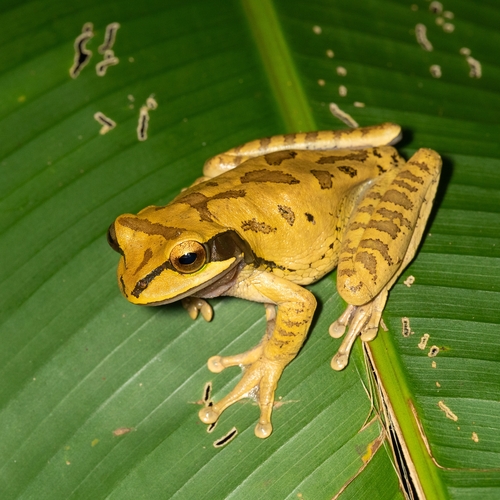
Giant Marine Toad

Giant Marine Toad

Rhinella horribilis

Silhouette: Dennis C. Murphy, after http://bit.ly/4q6IESe · PhyloPic

LCLeast ConcernNTVUENCR
Daily sighting probability ~10% · With luck
at Tapantí-Macizo de la Muerte National Park

In 3 days ~30% in a week ~50%

17 Verified sightings at Tapantí-Macizo de la Muerte National Park From 2019 to 2026
2,452 In all 40 parks
October Best month
🌅 Crepuscular When it's spotted

About the Giant Marine Toad

Rhinella horribilis is the scientific name used for populations of the cane toad or giant toad located in Mesoamerica and north-western South America when they are considered to be a separate species from Rhinella marina, a name which is then mostly restricted to Amazon basin populations. R. horribilis was originally described from Mexico as Bufo horribilis before later being considered a synonym of Bufo marina and later Rhinella marina. The specific epithet horribilis has now been revived after a 2016 study argued that these populations make up two separate species. Wikipedia →

Sounds

Advertisement call0:45

Colombia · 2026

© Sofía Vargas Gómez · XC1174526 · CC BY-NC-SA 4.0

Recording0:37

Costa Rica · 2022

© Brendan Sloan · XC747040 · CC BY-NC-ND 4.0

Advertisement call0:10

United States · 2017

© Chris Harrison · XC1050718 · CC BY-NC-SA 4.0

Global Distribution

Parks Where Found

# Park Country Daily sighting probability
1 Piedras Blancas National Park 🇨🇷 Costa Rica
~60%
2 Tayrona National Natural Park 🇨🇴 Colombia
~60%
3 Ostional Wildlife Refuge 🇨🇷 Costa Rica
~60%
4 Braulio Carrillo National Park 🇨🇷 Costa Rica
~50%
5 Cabo Blanco Absolute Nature Reserve 🇨🇷 Costa Rica
~50%
6 Rincón de la Vieja National Park 🇨🇷 Costa Rica
~50%
7 Santa Rosa National Park 🇨🇷 Costa Rica
~50%
8 Palo Verde National Park 🇨🇷 Costa Rica
~50%
9 Tortuguero National Park 🇨🇷 Costa Rica
~50%
10 Cockscomb Basin Wildlife Sanctuary 🇧🇿 Belize
~50%
11 Tenorio Volcano National Park 🇨🇷 Costa Rica
~40%
12 Pico Bonito National Park 🇭🇳 Honduras
~40%
13 Carara National Park 🇨🇷 Costa Rica
~40%
14 Corcovado National Park 🇨🇷 Costa Rica
~40%
15 Chagres National Park 🇵🇦 Panama
~40%
16 Arenal Volcano National Park 🇨🇷 Costa Rica
~40%
17 Bastimentos Island National Marine Park 🇵🇦 Panama
~40%
18 Soberanía National Park 🇵🇦 Panama
~40%
19 Gandoca-Manzanillo Wildlife Refuge 🇨🇷 Costa Rica
~40%
20 Marino Ballena National Park 🇨🇷 Costa Rica
~40%
21 Biotopo Cerro Cahuí 🇬🇹 Guatemala
~30%
22 Darién National Park 🇵🇦 Panama
~30%
23 Cerro Azul Meámbar National Park 🇭🇳 Honduras
~30%
24 Ría Lagartos Biosphere Reserve 🇲🇽 Mexico
~30%
25 Montes Azules Biosphere Reserve 🇲🇽 Mexico
~30%
26 Cahuita National Park 🇨🇷 Costa Rica
~30%
27 Tikal National Park 🇬🇹 Guatemala
~30%
28 La Amistad International Park (Panama) 🇵🇦 Panama
~20%
29 Manuel Antonio National Park 🇨🇷 Costa Rica
~20%
30 Calakmul Biosphere Reserve 🇲🇽 Mexico
~20%
31 Monteverde Cloud Forest Reserve 🇨🇷 Costa Rica
~20%
32 Chirripó National Park 🇨🇷 Costa Rica
~20%
33 Las Baulas Marine National Park 🇨🇷 Costa Rica
~20%
34 Parque Natural Metropolitano 🇵🇦 Panama
~20%
35 Volcán Barú National Park 🇵🇦 Panama
~20%
36 Lago de Yojoa 🇭🇳 Honduras
~20%
37 Farallones de Cali National Natural Park 🇨🇴 Colombia
~20%
38 Arrecifes de Cozumel National Park 🇲🇽 Mexico
~10%
39 Tapantí-Macizo de la Muerte National Park 🇨🇷 Costa Rica
~10%
40 Cumbres de Monterrey National Park 🇲🇽 Mexico
~10%

Cities Where Found

# City Country Daily sighting probability
1 Panama City 🇵🇦 Panama
~40%
2 San Pedro Sula 🇭🇳 Honduras
~30%
3 San José 🇨🇷 Costa Rica
~20%
4 Barranquilla 🇨🇴 Colombia
~20%
5 Cali 🇨🇴 Colombia
~20%
6 Tegucigalpa 🇭🇳 Honduras
~20%
7 Guatemala City 🇬🇹 Guatemala
~10%
8 Medellín 🇨🇴 Colombia
~10%
9 San Salvador 🇸🇻 El Salvador
~10%
10 Monterrey 🇲🇽 México
~10%

Zoos & Centres Where Found

# Zoo / Centre Country
1 Milwaukee County Zoo 🇺🇸 United States In captivity
2 Parque Municipal Summit 🇵🇦 Panama In captivity
3 La Paz Waterfall Gardens 🇨🇷 Costa Rica In captivity
4 Ménagerie du Jardin des Plantes 🇫🇷 France In captivity
5 Vancouver Aquarium 🇨🇦 Canada In captivity
6 Gran Acuario de Mazatlán "Mar de Cortés" 🇲🇽 Mexico In captivity
7 Arenal Eco Zoo 🇨🇷 Costa Rica In captivity
8 Monteverde Theme Park 🇨🇷 Costa Rica In captivity

Before you go

What are the chances of seeing a Giant Marine Toad in Tapantí-Macizo de la Muerte National Park?

With luck

About 10% of wildlife watchers report a Giant Marine Toad sighting in Tapantí-Macizo de la Muerte National Park on a given day, based on 17 verified sightings from GBIF citizen-science data from 2019 to 2026. It is the 6th most-seen of the 17 amphibians we can rate there. Over three days the chance rises to about 30%, and over a week to about 50%, if each day is a fresh chance.

When is the best time to see a Giant Marine Toad in Tapantí-Macizo de la Muerte National Park?

October

In that month about 30% of wildlife watchers report a Giant Marine Toad in Tapantí-Macizo de la Muerte National Park on a given day, against under 5% in November and December, the lowest months. That is one of Tapantí-Macizo de la Muerte National Park's wettest months, with about 570 mm of rain against 160 mm in February.

What time of day is best to see a Giant Marine Toad?

Between 6 and 9 pm

Across all the parks we cover, that three-hour window holds the most Giant Marine Toad sightings with a recorded time, and about 7 in 10 of them come between 6 pm and 6 am: it is most active around dawn and dusk.

Which relatives of the Giant Marine Toad live in Tapantí-Macizo de la Muerte National Park?

Same family: Bufonidae

The closest relatives of the Giant Marine Toad that you can see in Tapantí-Macizo de la Muerte National Park (family Bufonidae, True Toads) are Wet Forest Toad (about 10%), Leaf Litter Toad (about 10%) and Green Climbing Toad (about 10%), with each one's daily chance of a sighting.

Where does the Giant Marine Toad sighting chance come from?

GBIF citizen-science records

It is estimated from how often the Giant Marine Toad is recorded against all the amphibians logged in Tapantí-Macizo de la Muerte National Park (17 verified sightings from 2019 to 2026), calibrated against known sighting rates. Figures are rounded to the nearest 10% because citizen-science data supports honest approximations, not decimals, and months with records from fewer than five people show "—". How it works.

← Back to Tapantí-Macizo de la Muerte National Park