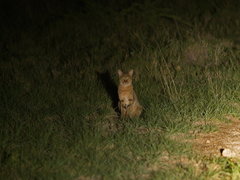
African Wildcat

African Wildcat

Felis lybica

Silhouette: Steven Traver · PhyloPic

LCLeast ConcernNTVUENCR
Daily sighting probability ~10% · With luck
at Tarangire National Park

In 3 days ~30% in a week ~50%

5 Verified sightings at Tarangire National Park From 2019 to 2026
136 In all 6 parks
July Best month
☀️🌙 Day & Night When it's spotted

About the African Wildcat

The African wildcat (Felis lybica) is a small wildcat species with sandy grey fur, pale vertical stripes on the sides and around the face. It is native to Africa, West and Central Asia, and is distributed to Rajasthan in India and Xinjiang in China. It inhabits a broad variety of landscapes ranging from deserts to savannas, shrublands and grasslands.

The African wildcat is the ancestor of the domestic cat (F. catus). Some African wildcats were domesticated about 10,000 years ago in the Near East. Interspecific hybrids between both species are common where their ranges overlap.

Felis lybica was the scientific name proposed in 1780 by Georg Forster who based his description on a specimen from Gafsa on the Barbary Coast that had the size of a domestic cat, but a reddish fur, short black tufts on the ears, and a ringed tail.

Between the late 18th and 20th centuries, several naturalists and curators of natural history museums described and proposed new names for wildcat holotypes from Africa and the Near East, including: Felis ocreata by Johann Friedrich Gmelin in 1791 was based on a description of a wildcat encountered in northern Ethiopia by James Bruce.

Felis cafra by... Wikipedia →

Global Distribution

Parks Where Found

# Park Country Daily sighting probability
1 Kgalagadi Transfrontier Park 🇿🇦 South Africa
~20%
2 Etosha National Park 🇳🇦 Namibia
~20%
3 Kruger National Park 🇿🇦 South Africa
~10%
4 Moremi Game Reserve 🇧🇼 Botswana
~10%
5 Tarangire National Park 🇹🇿 Tanzania
~10%
6 Namib-Naukluft National Park 🇳🇦 Namibia
~10%

Zoos & Centres Where Found

# Zoo / Centre Country
1 Parc des Félins 🇫🇷 France In captivity
2 Omaha’s Henry Doorly Zoo and Aquarium 🇺🇸 United States In captivity
3 Birmingham Zoo 🇺🇸 United States In captivity
4 Novosibirsk Zoo 🇷🇺 Russia In captivity
5 Yerevan Zoo 🇦🇲 Armenia In captivity
6 Bahawalpur Zoo 🇵🇰 Pakistan In captivity
7 Reserva Zoológica Oasys MiniHollywood 🇪🇸 Spain In captivity
8 Emdoneni Cheetah Project 🇿🇦 South Africa In captivity
9 Great Cats World Park 🇺🇸 United States In captivity
10 Zoo Koki (Parque zoológico y botánico) 🇪🇸 Spain In captivity
11 Jukani Wildlife Sanctuary 🇿🇦 South Africa In captivity

Before you go

What are the chances of seeing an African Wildcat in Tarangire National Park?

With luck

About 10% of wildlife watchers report an African Wildcat sighting in Tarangire National Park on a given day, based on 5 verified sightings from GBIF citizen-science data from 2019 to 2026. It is the 33rd most-seen of the 33 mammals we can rate there. Over three days the chance rises to about 30%, and over a week to about 50%, if each day is a fresh chance.

When is the best time to see an African Wildcat in Tarangire National Park?

March, July and October

In those months about 20% of wildlife watchers report an African Wildcat in Tarangire National Park on a given day, against under 5% in April–June, August–September and November–January, the lowest months.

What time of day is best to see an African Wildcat?

Between 6 and 9 pm

Across all the parks we cover, that three-hour window holds the most African Wildcat sightings with a recorded time, and about 6 in 10 of them come between 6 pm and 6 am: it is seen both by day and at night.

Is Tarangire National Park the best place to see an African Wildcat?

5th of 6

Of the 6 parks where we can rate African Wildcat sightings, Tarangire National Park ranks 5th at about 10%. The best odds are in Kgalagadi Transfrontier Park (South Africa, about 20%), Etosha National Park (Namibia, about 20%) and Kruger National Park (South Africa, about 10%).

Which relatives of the African Wildcat live in Tarangire National Park?

Same family: Felidae

The closest relatives of the African Wildcat that you can see in Tarangire National Park (family Felidae, Felids) are Lion (about 60%), Leopard (about 40%) and Cheetah (about 30%), with each one's daily chance of a sighting.

Where does the African Wildcat sighting chance come from?

GBIF citizen-science records

It is estimated from how often the African Wildcat is recorded against all the mammals logged in Tarangire National Park (5 verified sightings from 2019 to 2026), calibrated against known sighting rates. Figures are rounded to the nearest 10% because citizen-science data supports honest approximations, not decimals, and months with records from fewer than five people show "—". How it works.

← Back to Tarangire National Park