Ghost Moth

Ghost Moth

Hepialus humuli

Daily sighting probability ~10% · With luck
at Tatra National Park

In 3 days ~30% in a week ~50%

5 Verified sightings at Tatra National Park From 2019 to 2026
12 In all 2 parks
June Best month
☀️🌙 Day & Night When it's spotted

About the Ghost Moth

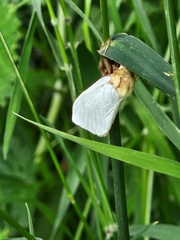
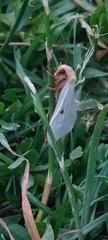
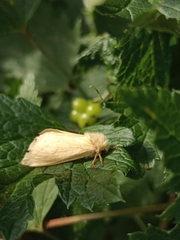
The ghost moth or ghost swift (Hepialus humuli) is a moth of the family Hepialidae. It is common throughout Europe, except for the far south-east. Female ghost moths are larger than males, and exhibit sexual dimorphism with their differences in size and wing color. The adults fly from June to August and are attracted to light. The species overwinters as a larva. The larva is whitish and maggot-like and feeds underground on the roots of a variety of wild and cultivated plants (see list below). The species can be an economically significant pest in forest nurseries.

The term ghost moth is sometimes used as a general term for all hepialids. The ghost moth gets its name from the hovering display flight of the male, sometimes slowly rising and falling, over open ground to attract females. In a suitable location, several males may display together in a lek.

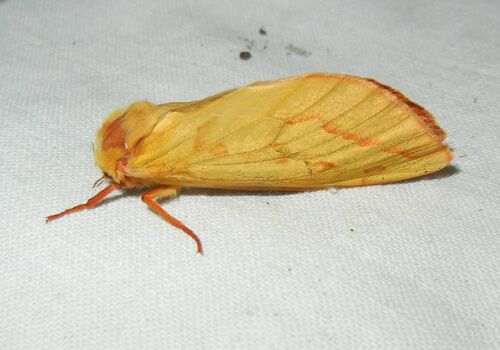
Female ghost moths have a wingspan of 50–70 mm. They have yellowish-buff forewings with darker linear markings and brown hindwings. Males are smaller, with a wingspan of 46–50 mm, and typically have white or silver wings. However, in H. h. thulensis, found in Shetland and the Faroe Islands, there are buff... Wikipedia →
Global Distribution

Parks Where Found

# Park Country Daily sighting probability
1 Tatra National Park 🇸🇰 Slovakia
~10%
2 Wadden Sea National Park 🇩🇪 Germany
<5%

Cities Where Found

# City Country Daily sighting probability
1 Liverpool 🇬🇧 United Kingdom
~10%
2 Manchester 🇬🇧 United Kingdom
<5%
3 Helsinki 🇫🇮 Finland
<5%
4 Birmingham 🇬🇧 United Kingdom
<5%
5 Saint Petersburg 🇷🇺 Russia
<5%
6 Moscow 🇷🇺 Russia
<5%

Before you go

What are the chances of seeing a Ghost Moth in Tatra National Park?

With luck

About 10% of wildlife watchers report a Ghost Moth sighting in Tatra National Park on a given day, based on 5 verified sightings from GBIF citizen-science data from 2019 to 2026. It is the 118th most-seen of the 142 insects we can rate there. Over three days the chance rises to about 30%, and over a week to about 50%, if each day is a fresh chance.

When is the best time to see a Ghost Moth in Tatra National Park?

June

In that month about 30% of wildlife watchers report a Ghost Moth in Tatra National Park on a given day, against under 5% in August to May, the lowest months.

What time of day is best to see a Ghost Moth?

Between 8 and 11 am

Across all the parks we cover, that three-hour window holds the most Ghost Moth sightings with a recorded time, and about 7 in 10 of them come between 6 am and 6 pm: it is seen both by day and at night.

Is Tatra National Park the best place to see a Ghost Moth?

Yes

Of the 2 parks where we can rate Ghost Moth sightings, Tatra National Park has the highest daily chance: about 10%. Next come Wadden Sea National Park (Germany, under 5%).

Which relatives of the Ghost Moth live in Tatra National Park?

Same order: Lepidoptera

The closest relatives of the Ghost Moth that you can see in Tatra National Park (order Lepidoptera, Butterflies and Moths) are European Peacock Butterfly (about 40%), Small Tortoiseshell (about 40%) and Oak Eggar (about 40%), with each one's daily chance of a sighting.

Where does the Ghost Moth sighting chance come from?

GBIF citizen-science records

It is estimated from how often the Ghost Moth is recorded against all the insects logged in Tatra National Park (5 verified sightings from 2019 to 2026), calibrated against known sighting rates. Figures are rounded to the nearest 10% because citizen-science data supports honest approximations, not decimals, and months with records from fewer than five people show "—". How it works.

← Back to Tatra National Park