Blue-knobbed Curassow

Blue-knobbed Curassow

Crax alberti

Silhouette: Sheatherius · PhyloPic

LCNTVUENCRCritically Endangered Endemic
Daily sighting probability ~10% · With luck
at Tayrona National Natural Park

In 3 days ~30% in a week ~60%

193 Verified sightings at Tayrona National Natural Park From 2019 to 2026
193 In 1 park
April Best month
☀️ Diurnal When it's spotted

About the Blue-knobbed Curassow

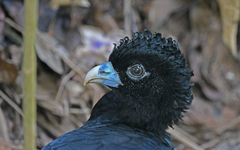
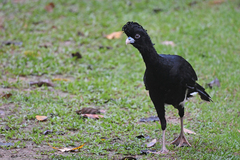
The blue-billed curassow (Crax alberti) is a species of bird in the family Cracidae, the chachalacas, guans, and curassows. It is endemic to Colombia. The blue-billed curassow is monotypic. However, it formerly included what is now the yellow-knobbed curassow (Crax daubentoni) as a subspecies. The holotype of putative species C. annulata has been determined to be a female blue-billed curassow.

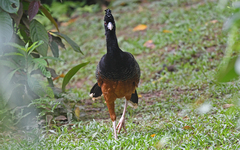
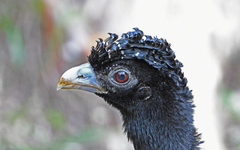
The blue-billed curassow is 82.5 to 92.5 cm (2.7 to 3.0 ft) long and weighs 3.2 to 3.6 kg (7.1 to 7.9 lb). It is the only curassow with a blue cere and wattle, the latter found only on the male. Males are mostly black with a white vent and tail tip. Females are also mostly black but their lower belly and vent are rufous. They have fine white barring on the wings and tail, and a rare "barred" morph also has barring on the breast and belly. Both sexes have an erectile crest, the male's black and the female's black and white.

The blue-billed curassow is found only in northern Colombia. Its range used to stretch 106,700-square-kilometers; it now has a highly fragmented range, with small populations between La Guajira and... Wikipedia →

Sounds

Alarm call1:06

Colombia · 2021

© Brayan Coral Jaramillo · XC713716 · CC BY-NC-SA 4.0

Song0:17

Colombia · 2019

© Iván Lau · XC543900 · CC BY-NC-SA 4.0

Call0:41

Colombia · 2016

© Alejandro Pinto-Gómez · XC335188 · CC BY-NC-SA 4.0

Global Distribution

Parks Where Found

# Park Country Daily sighting probability
1 Tayrona National Natural Park 🇨🇴 Colombia
~10%

More parks will be added in future updates.

Zoos & Centres Where Found

# Zoo / Centre Country
1 National Zoological Park 🇺🇸 United States In captivity
2 ZooParc de Beauval 🇫🇷 France In captivity
3 Zoo Miami 🇺🇸 United States In captivity
4 Bronx Zoo 🇺🇸 United States In captivity
5 Brookfield Zoo 🇺🇸 United States In captivity
6 Nashville Zoo at Grassmere 🇺🇸 United States In captivity
7 Phoenix Zoo 🇺🇸 United States In captivity
8 Jacksonville Zoo and Gardens 🇺🇸 United States In captivity
9 Assiniboine Park Zoo 🇨🇦 Canada In captivity
10 Ukumarí Biopark 🇨🇴 Colombia In captivity
11 Gramado Zoo 🇧🇷 Brazil In captivity
12 Tanganyika Wildlife Park 🇺🇸 United States In captivity
13 Riverbanks Zoo 🇺🇸 United States In captivity
14 Aviario Nacional de Colombia 🇨🇴 Colombia In captivity
15 The Living Planet Aquarium 🇺🇸 United States In captivity
16 Parque de la Conservación 🇨🇴 Colombia In captivity
17 Curiosity Farms 🇺🇸 United States In captivity
18 Tracy Aviary 🇺🇸 United States In captivity
19 Zoo Lagos 🇵🇹 Portugal In captivity
20 zoologico de barranquilla 🇨🇴 Colombia In captivity
21 Dantas 🇨🇴 Colombia In captivity
22 National Aviary 🇺🇸 United States In captivity
23 Zoo de Lourosa 🇵🇹 Portugal In captivity
24 Glen Echo Park Aquarium 🇺🇸 United States In captivity
25 Cali Zoo 🇨🇴 Colombia In captivity

Before you go

What are the chances of seeing a Blue-knobbed Curassow in Tayrona National Natural Park?

With luck

About 10% of wildlife watchers report a Blue-knobbed Curassow sighting in Tayrona National Natural Park on a given day, based on 193 verified sightings from GBIF citizen-science data from 2019 to 2026. It is the 72nd most-seen of the 285 birds we can rate there. Over three days the chance rises to about 30%, and over a week to about 60%, if each day is a fresh chance.

When is the best time to see a Blue-knobbed Curassow in Tayrona National Natural Park?

March and April

In those months about 30% of wildlife watchers report a Blue-knobbed Curassow in Tayrona National Natural Park on a given day, against under 5% in February and November, the lowest months. Those are among Tayrona National Natural Park's driest months, with about 25 mm of rain a month against 180 mm in October.

What time of day is best to see a Blue-knobbed Curassow?

Between 6 and 9 am

Across all the parks we cover, that three-hour window holds the most Blue-knobbed Curassow sightings with a recorded time, and about 9 in 10 of them come between 6 am and 6 pm: it is a daytime animal.

Where else can you see a Blue-knobbed Curassow?

Only Tayrona National Natural Park, in our data

Tayrona National Natural Park is the only park on Wallace's Line with enough records to rate Blue-knobbed Curassow sightings: about 10% of wildlife watchers there report one on a given day.

Where does the Blue-knobbed Curassow sighting chance come from?

GBIF citizen-science records

It is estimated from how often the Blue-knobbed Curassow is recorded against all the birds logged in Tayrona National Natural Park (193 verified sightings from 2019 to 2026), calibrated against known sighting rates. Figures are rounded to the nearest 10% because citizen-science data supports honest approximations, not decimals, and months with records from fewer than five people show "—". How it works.

← Back to Tayrona National Natural Park