Plain Swift

Plain Swift

Apus unicolor

LCLeast ConcernNTVUENCR
Daily sighting probability ~40% · Likely
at Teno-Rasca Marine Strip (Tenerife)

In 3 days ~80% in a week >90%

352 Verified sightings at Teno-Rasca Marine Strip (Tenerife) From 2019 to 2026
352 In 1 park
July Best month
☀️ Diurnal When it's spotted

About the Plain Swift

The plain swift (Apus unicolor) is a medium-sized swift. Although this bird is superficially similar to a barn swallow or house martin, it is not related to those passerine species. The resemblances between the groups are due to convergent evolution reflecting similar life styles.

Swifts have very short legs that they use only for clinging to vertical surfaces. They never settle voluntarily on the ground, and spend most of their lives in the air, feeding on insects that they catch in their beaks. They drink on the wing.

Plain swifts breed in colonies on cliffs, bridges and buildings on the Canary Islands and Madeira, laying two eggs in a saucer-shaped nest made of flowerheads glued with saliva. They are partially migratory, with many birds leaving to winter in mainland Africa. Until recently it was thought that the birds wintered on the African coast but recent studies suggest they travel much further to the equatorial forests of Liberia and Guinea, a distance of 2,600 kilometres. Small numbers are also believed to breed in Morocco between Agadir and Essaouira, where a colony was found on coastal cliffs and possibly also in Mauritania where there are frequent sightings. Small breeding colonies have recently been discovered in mainland Portugal, in Lisbon and Porto.

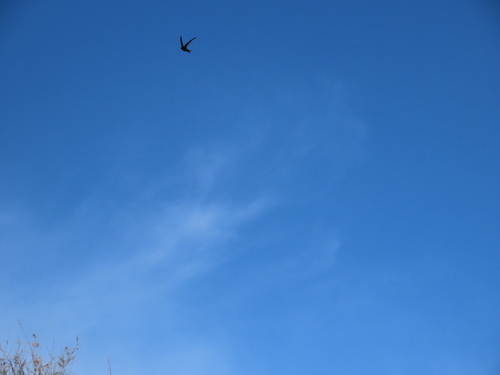
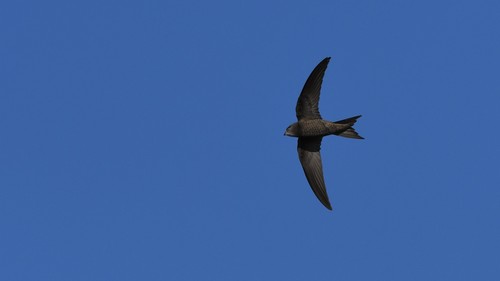
This 14–15 cm long species is very similar to the closely related common and pallid swifts, which also occur in the archipelagos, and separation is only possible with good views. Like its relatives, it has a short forked tail and very long swept-back wings that resemble a crescent or a boomerang.

It is entirely dark except for an indistinct pale throat patch. It is slimmer and more rakish than the pallid swift, and is darker than that species and lacks the obvious white throat. Distinguishing the plain swift from the similarly plumaged common swift is much more difficult, although juvenile common can be easily eliminated due to its white throat. The plain is slimmer and appears longer winged than the common, and has scaly underparts, difficult to see except with excellent views. The call is a loud dry scream similar to that of the common swift, though possibly higher pitched.
Wikipedia →

Global Distribution

Parks Where Found

# Park Country Daily sighting probability
1 Teno-Rasca Marine Strip (Tenerife) 🇪🇸 Spain
~40%

More parks will be added in future updates.

Cities Where Found

# City Country Daily sighting probability
1 Porto 🇵🇹 Portugal
<5%
2 Lisbon 🇵🇹 Portugal
<5%

Before you go

What are the chances of seeing a Plain Swift in Teno-Rasca Marine Strip (Tenerife)?

Likely

About 40% of wildlife watchers report a Plain Swift sighting in Teno-Rasca Marine Strip (Tenerife) on a given day, based on 352 verified sightings from GBIF citizen-science data from 2019 to 2026. It is the 8th most-seen of the 70 birds we can rate there. Over three days the chance rises to about 80%, and over a week to over 90%, if each day is a fresh chance.

When is the best time to see a Plain Swift in Teno-Rasca Marine Strip (Tenerife)?

July and August

In those months about 70% of wildlife watchers report a Plain Swift in Teno-Rasca Marine Strip (Tenerife) on a given day, against about 20% in November and December, the lowest months. Those are among Teno-Rasca Marine Strip (Tenerife)'s driest months, with about 5 mm of rain a month against 40 mm in February.

What time of day is best to see a Plain Swift?

Between 10 am and 1 pm

Across all the parks we cover, that three-hour window holds the most Plain Swift sightings with a recorded time, and about 9 in 10 of them come between 6 am and 6 pm: it is a daytime animal.

Where else can you see a Plain Swift?

Only Teno-Rasca Marine Strip (Tenerife), in our data

Teno-Rasca Marine Strip (Tenerife) is the only park on Wallace's Line with enough records to rate Plain Swift sightings: about 40% of wildlife watchers there report one on a given day.

Where does the Plain Swift sighting chance come from?

GBIF citizen-science records

It is estimated from how often the Plain Swift is recorded against all the birds logged in Teno-Rasca Marine Strip (Tenerife) (352 verified sightings from 2019 to 2026), calibrated against known sighting rates. Figures are rounded to the nearest 10% because citizen-science data supports honest approximations, not decimals, and months with records from fewer than five people show "—". How it works.

← Back to Teno-Rasca Marine Strip (Tenerife)