Island Canary

Island Canary

Serinus canaria

Silhouette: Sheatherius · PhyloPic

LCLeast ConcernNTVUENCR
Daily sighting probability ~60% · Likely
at Teno-Rasca Marine Strip (Tenerife)

In 3 days ~90% in a week >90%

534 Verified sightings at Teno-Rasca Marine Strip (Tenerife) From 2019 to 2026
2,189 In all 2 parks
May Best month
☀️ Diurnal When it's spotted

About the Island Canary

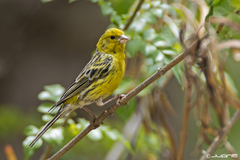
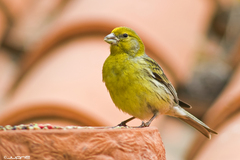
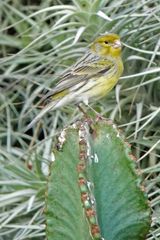
The Atlantic canary (Serinus canaria), known worldwide simply as the wild canary and also called the island canary, common canary, or canary, is a small passerine bird belonging to the genus Serinus in the true finch family, Fringillidae. It is native to the Canary Islands, the Azores, and Madeira. Wild birds are mostly yellow-green, with brownish streaking on the back. The species is common in captivity and a number of colour varieties have been bred.

This bird is the natural symbol of the Canary Islands, together with the Canary Island date palm. The Atlantic canary was formally described in 1758 by the Swedish naturalist Carl Linnaeus in the tenth edition of his Systema Naturae. He placed it with the finches in the genus Fringilla and coined the binomial name Fringilla canaria. In 1555 the Swiss naturalist Conrad Gessner had used the Latin name Canaria for the species in his book Historia animalium. The Atlantic canary is now one of eight species placed in the genus Serinus that was introduced in 1816 by the German naturalist Carl Ludwig Koch. The species is considered to be monotypic, with no subspecies being recognised; domesticated canaries are sometimes cited as...
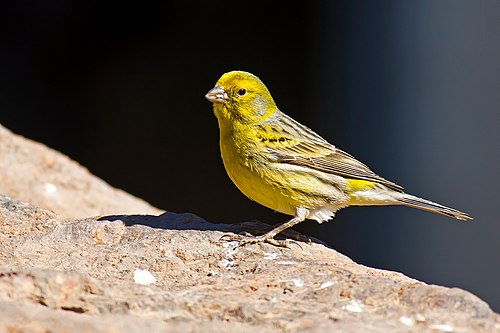
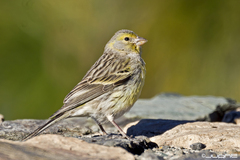
Wikipedia →

Sounds

Song0:06

Portugal · 2026

© Radek Grochowski · XC1156694 · CC BY-NC-SA 4.0

Call0:34

Portugal · 2023

© Mats Rellmar · XC831509 · CC BY-NC-SA 4.0

Call0:20

Spain · 2023

© Rubén Barone · XC782280 · CC BY-NC-SA 4.0

Global Distribution

Parks Where Found

# Park Country Daily sighting probability
1 Pico Island Natural Park (Azores) 🇵🇹 Portugal
~90%
2 Teno-Rasca Marine Strip (Tenerife) 🇪🇸 Spain
~60%

Zoos & Centres Where Found

# Zoo / Centre Country
1 Zoo Pilsen 🇨🇿 Czechia In captivity
2 Bronx Zoo 🇺🇸 United States In captivity
3 Wildpark Höllohe 🇩🇪 Germany In captivity
4 Kyiv Zoo 🇺🇦 Ukraine In captivity
5 Dyrehaven i Nørreskoven 🇩🇰 Denmark In captivity
6 Wildpark Gersfeld 🇩🇪 Germany In captivity
7 Tierwelt Herberstein 🇦🇹 Austria In captivity
8 Virginia Zoological Park 🇺🇸 United States In captivity
9 Surabaya Zoo 🇮🇩 Indonesia In captivity
10 Frankfurt Zoological Garden 🇩🇪 Germany In captivity
11 Affen- und Vogelpark Eckenhagen 🇩🇪 Germany In captivity
12 Cambridge Butterfly Conservatory 🇨🇦 Canada In captivity
13 Small Breeds Farm Park 🇬🇧 United Kingdom In captivity
14 Tierpark Bad Pyrmont 🇩🇪 Germany In captivity
15 Vogelpark Heiligenkirchen 🇩🇪 Germany In captivity
16 Zoologischer Garten Hof 🇩🇪 Germany In captivity
17 National Aviary 🇺🇸 United States In captivity
18 Stichting Dierenpark 🇳🇱 Netherlands In captivity
19 Akvario de Zella-Mehlis 🇩🇪 Germany In captivity
20 Bird Kingdom 🇨🇦 Canada In captivity
21 Key West Butterfly and Nature Conservatory 🇺🇸 United States In captivity
22 Stadtvolière Lindengut Winterthur 🇨🇭 Switzerland In captivity
23 Aquarium and Natural History Museum in Kraków 🇵🇱 Poland In captivity
24 Butterfly World 🇺🇸 United States In captivity
25 City Park Aquarium (Tehran) 🇮🇷 Iran In captivity
26 Idaho Aquarium 🇺🇸 United States In captivity
27 Oceanarium 🇺🇦 Ukraine In captivity
28 Ranger Red’s Zoo & Conservation Park 🇦🇺 Australia In captivity
29 Remstecken 🇩🇪 Germany In captivity
30 Zoológico La Era de las aves 🇪🇸 Spain In captivity

Before you go

What are the chances of seeing an Island Canary in Teno-Rasca Marine Strip (Tenerife)?

Likely

About 60% of wildlife watchers report an Island Canary sighting in Teno-Rasca Marine Strip (Tenerife) on a given day, based on 534 verified sightings from GBIF citizen-science data from 2019 to 2026. It is the 7th most-seen of the 70 birds we can rate there. Over three days the chance rises to about 90%, and over a week to over 90%, if each day is a fresh chance.

When is the best time to see an Island Canary in Teno-Rasca Marine Strip (Tenerife)?

May–June and September

In those months about 70% of wildlife watchers report an Island Canary in Teno-Rasca Marine Strip (Tenerife) on a given day, against about 50% in April, July–August and November, the lowest months.

What time of day is best to see an Island Canary?

Between 10 am and 1 pm

Across all the parks we cover, that three-hour window holds the most Island Canary sightings with a recorded time, and about 8 in 10 of them come between 6 am and 6 pm: it is a daytime animal.

Is Teno-Rasca Marine Strip (Tenerife) the best place to see an Island Canary?

2nd of 2

Of the 2 parks where we can rate Island Canary sightings, Teno-Rasca Marine Strip (Tenerife) ranks 2nd at about 60%. The best odds are in Pico Island Natural Park (Azores) (Portugal, about 90%).

Which relatives of the Island Canary live in Teno-Rasca Marine Strip (Tenerife)?

Same family: Fringillidae

The closest relatives of the Island Canary that you can see in Teno-Rasca Marine Strip (Tenerife) (family Fringillidae, Finches, Euphonias, and Allies) are Tenerife Blue Chaffinch (about 20%) and Eurasian Goldfinch (about 10%), with each one's daily chance of a sighting.

Where does the Island Canary sighting chance come from?

GBIF citizen-science records

It is estimated from how often the Island Canary is recorded against all the birds logged in Teno-Rasca Marine Strip (Tenerife) (534 verified sightings from 2019 to 2026), calibrated against known sighting rates. Figures are rounded to the nearest 10% because citizen-science data supports honest approximations, not decimals, and months with records from fewer than five people show "—". How it works.

← Back to Teno-Rasca Marine Strip (Tenerife)