Eurasian Collared-Dove

Eurasian Collared-Dove

Streptopelia decaocto

LCLeast ConcernNTVUENCR
Daily sighting probability ~80% · Very likely
at Teno-Rasca Marine Strip (Tenerife)

In 3 days >90%

914 Verified sightings at Teno-Rasca Marine Strip (Tenerife) From 2019 to 2026
19,157 In all 44 parks
August Best month
☀️ Diurnal When it's spotted

About the Eurasian Collared-Dove

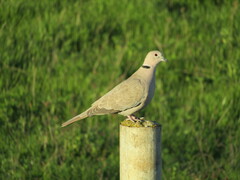
The Eurasian collared dove (Streptopelia decaocto), often called the collared dove, is a dove species from the genus Streptopelia. It is grey-buff to pinkish-grey, and has a black half-collar edged with white on its nape, alluding to the name. It is native to Europe, Asia, and North Africa. It has also been introduced to Japan, North and Central America, and select Caribbean islands.

The Hungarian naturalist Imre Frivaldszky first described the Eurasian collared dove with the scientific name Columba risoria varietas C. decaocto in 1838, considering it a wild variety of the domesticated barbary dove. The type locality is Plovdiv in Bulgaria. It is now placed in the genus Streptopelia that was described in 1855 by the French ornithologist Charles Lucien Bonaparte.

The Burmese collared dove (S. xanthocycla) was formerly considered a subspecies of the Eurasian collared dove, but was split as a distinct species by the IOC in 2021. The Eurasian collared dove is...

Wikipedia →

Global Distribution

Parks Where Found

# Park Country Daily sighting probability
1 Teno-Rasca Marine Strip (Tenerife) 🇪🇸 Spain
~80%
2 Sundarbans National Park 🇮🇳 India
~70%
3 Hortobágy National Park 🇭🇺 Hungary
~60%
4 Keoladeo National Park 🇮🇳 India
~60%
5 Doñana National Park 🇪🇸 Spain
~60%
6 Kiskunság National Park 🇭🇺 Hungary
~50%
7 Fertő-Hanság National Park 🇭🇺 Hungary
~50%
8 Monfragüe National Park 🇪🇸 Spain
~40%
9 Sierra Nevada National Park 🇪🇸 Spain
~40%
10 Chitwan National Park 🇳🇵 Nepal
~40%
11 Gir National Park 🇮🇳 India
~40%
12 Cévennes National Park 🇫🇷 France
~30%
13 Royal Bardia National Park 🇳🇵 Nepal
~30%
14 Corsica Regional Natural Park (Parc naturel régional de Corse) 🇫🇷 France
~30%
15 Ranthambore National Park 🇮🇳 India
~30%
16 Biebrza National Park 🇵🇱 Poland
~30%
17 Camargue 🇫🇷 France
~30%
18 Jim Corbett National Park 🇮🇳 India
~20%
19 Gobi Gurvansaikhan National Park 🇲🇳 Mongolia
~20%
20 Cairngorms National Park 🇬🇧 United Kingdom
~20%
21 Bandipur National Park 🇮🇳 India
~20%
22 Bandhavgarh National Park 🇮🇳 India
~20%
23 Pyrénées National Park 🇫🇷 France
~20%
24 Bavarian Forest National Park 🇩🇪 Germany
~20%
25 Mudumalai National Park 🇮🇳 India
~20%
26 Wadden Sea National Park 🇩🇪 Germany
~10%
27 Snowdonia National Park 🇬🇧 United Kingdom
~10%
28 Oosterschelde National Park 🇳🇱 Netherlands
~10%
29 Aigüestortes National Park 🇪🇸 Spain
~10%
30 Satpura National Park 🇮🇳 India
~10%
31 Sierra de Guadarrama National Park 🇪🇸 Spain
~10%
32 Vanoise National Park 🇫🇷 France
~10%
33 Nagarhole National Park 🇮🇳 India
~10%
34 Hohe Tauern National Park 🇦🇹 Austria
~10%
35 Manas National Park 🇮🇳 India
~10%
36 Tatra National Park 🇸🇰 Slovakia
~10%
37 Kaziranga National Park 🇮🇳 India
~10%
38 Triglav National Park 🇸🇮 Slovenia
~10%
39 Kanha National Park 🇮🇳 India
<5%
40 Białowieża National Park 🇵🇱 Poland
<5%
41 Plitvice Lakes National Park 🇭🇷 Croatia
<5%
42 Picos de Europa National Park 🇪🇸 Spain
<5%
43 Yala National Park 🇱🇰 Sri Lanka
<5%
44 Royal Manas National Park 🇧🇹 Bhutan
<5%

Cities Where Found

# City Country Daily sighting probability
1 Abu Dhabi 🇦🇪 United Arab Emirates
>90%
2 Doha 🇶🇦 Qatar
>90%
3 Ludhiana 🇮🇳 India
>90%
4 Jalandhar 🇮🇳 India
>90%
5 Dubai 🇦🇪 United Arab Emirates
~90%
6 Valencia 🇪🇸 Spain
~90%
7 Mashhad 🇮🇷 Iran
~90%
8 Athens 🇬🇷 Greece
~90%
9 Islamabad 🇵🇰 Pakistan
~90%
10 Marrakesh 🇲🇦 Morocco
~90%

Before you go

What are the chances of seeing a Eurasian Collared-Dove in Teno-Rasca Marine Strip (Tenerife)?

Very likely

About 80% of wildlife watchers report a Eurasian Collared-Dove sighting in Teno-Rasca Marine Strip (Tenerife) on a given day, based on 914 verified sightings from GBIF citizen-science data from 2019 to 2026. It is the 3rd most-seen of the 70 birds we can rate there. Over three days the chance rises to over 90%, if each day is a fresh chance.

When is the best time to see a Eurasian Collared-Dove in Teno-Rasca Marine Strip (Tenerife)?

April and August

In those months about 90% of wildlife watchers report a Eurasian Collared-Dove in Teno-Rasca Marine Strip (Tenerife) on a given day, against about 80% in May–July and September–March, the lowest months.

What time of day is best to see a Eurasian Collared-Dove?

Between 3 and 6 pm

Across all the parks we cover, that three-hour window holds the most Eurasian Collared-Dove sightings with a recorded time, and about 9 in 10 of them come between 6 am and 6 pm: it is a daytime animal.

Is Teno-Rasca Marine Strip (Tenerife) the best place to see a Eurasian Collared-Dove?

Yes

Of the 44 parks where we can rate Eurasian Collared-Dove sightings, Teno-Rasca Marine Strip (Tenerife) has the highest daily chance: about 80%. Next come Sundarbans National Park (India, about 70%) and Hortobágy National Park (Hungary, about 60%). All parks ranked.

Where does the Eurasian Collared-Dove sighting chance come from?

GBIF citizen-science records

It is estimated from how often the Eurasian Collared-Dove is recorded against all the birds logged in Teno-Rasca Marine Strip (Tenerife) (914 verified sightings from 2019 to 2026), calibrated against known sighting rates. Figures are rounded to the nearest 10% because citizen-science data supports honest approximations, not decimals, and months with records from fewer than five people show "—". How it works.

← Back to Teno-Rasca Marine Strip (Tenerife)