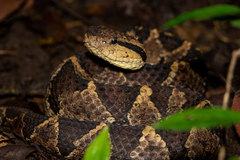
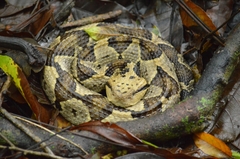
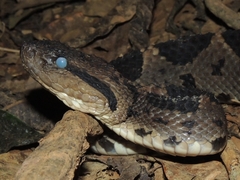

Central American Jumping Pit Viper

Central American Jumping Pit Viper

Metlapilcoatlus mexicanus

Silhouette: Steven Traver · PhyloPic

LCLeast ConcernNTVUENCR
Daily sighting probability ~20% · Possible
at Tenorio Volcano National Park

In 3 days ~40% in a week ~70%

11 Verified sightings at Tenorio Volcano National Park From 2019 to 2026
71 In all 4 parks
October Best month
☀️🌙 Day & Night When it's spotted

About the Central American Jumping Pit Viper

Common names: Central American jumping pit viper. Metlapilcoatlus mexicanus is a pit viper species endemic to Mexico and Central America. Adults grow to an average of 50–70 cm (about 20–28 inches) in total length. The maximum total length is 86.7 cm (34+1⁄8 in) for males and 97.9 cm (38+1⁄2 in) for females. The body is extremely stout.

Found in the Atlantic drainage from Mexico (in the Mexican states of Tabasco and Chiapas) south to the Canal Zone in Panama, both slopes of Costa Rica and Panama. Occurs at elevations of 40–1,600 m (130–5,250 ft). The type locality given is "Coban, capitale de la province de la Véra-Paz, (République de Guatemala, Amérique centrale)" (Cobán, Alta Verapaz, Guatemala).

Regarded as a full species, Metlapilcoatlus mexicanus, by Campbell and Lamar (2004). Metlapilcoatlus mexicanus at the Reptarium.cz Reptile Database. Accessed 1 August 2008. Wikipedia →

Global Distribution

Parks Where Found

# Park Country Daily sighting probability
1 Cusuco National Park 🇭🇳 Honduras
~30%
2 Pico Bonito National Park 🇭🇳 Honduras
~30%
3 Tenorio Volcano National Park 🇨🇷 Costa Rica
~20%
4 Arenal Volcano National Park 🇨🇷 Costa Rica
~20%

Zoos & Centres Where Found

# Zoo / Centre Country
1 Zoo Miami 🇺🇸 United States In captivity
2 ABQ BioPark Zoo 🇺🇸 United States In captivity
3 Cameron Park Zoo 🇺🇸 United States In captivity
4 La Paz Waterfall Gardens 🇨🇷 Costa Rica In captivity
5 Reptile Gardens 🇺🇸 United States In captivity
6 Zoológico Miguél Álvarez del Toro 🇲🇽 Mexico In captivity

Before you go

What are the chances of seeing a Central American Jumping Pit Viper in Tenorio Volcano National Park?

Possible

About 20% of wildlife watchers report a Central American Jumping Pit Viper sighting in Tenorio Volcano National Park on a given day, based on 11 verified sightings from GBIF citizen-science data from 2019 to 2026. It is the 24th most-seen of the 38 reptiles we can rate there. Over three days the chance rises to about 40%, and over a week to about 70%, if each day is a fresh chance.

When is the best time to see a Central American Jumping Pit Viper in Tenorio Volcano National Park?

October

In that month about 30% of wildlife watchers report a Central American Jumping Pit Viper in Tenorio Volcano National Park on a given day, against under 5% in February, April and September, the lowest months.

What time of day is best to see a Central American Jumping Pit Viper?

Between 8 and 11 am

Across all the parks we cover, that three-hour window holds the most Central American Jumping Pit Viper sightings with a recorded time, and about 7 in 10 of them come between 6 am and 6 pm: it is seen both by day and at night.

Is Tenorio Volcano National Park the best place to see a Central American Jumping Pit Viper?

3rd of 4

Of the 4 parks where we can rate Central American Jumping Pit Viper sightings, Tenorio Volcano National Park ranks 3rd at about 20%. The best odds are in Cusuco National Park (Honduras, about 30%) and Pico Bonito National Park (Honduras, about 30%).

Which relatives of the Central American Jumping Pit Viper live in Tenorio Volcano National Park?

Same family: Viperidae

The closest relatives of the Central American Jumping Pit Viper that you can see in Tenorio Volcano National Park (family Viperidae, Vipers) are Fer-de-lance (about 50%) and Rainforest Hog-nosed Viper (about 30%), with each one's daily chance of a sighting.

Where does the Central American Jumping Pit Viper sighting chance come from?

GBIF citizen-science records

It is estimated from how often the Central American Jumping Pit Viper is recorded against all the reptiles logged in Tenorio Volcano National Park (11 verified sightings from 2019 to 2026), calibrated against known sighting rates. Figures are rounded to the nearest 10% because citizen-science data supports honest approximations, not decimals, and months with records from fewer than five people show "—". How it works.

← Back to Tenorio Volcano National Park