Chilean Skua

Chilean Skua

Stercorarius chilensis

Silhouette: Liam Quinn (photo) and Albertonykus (silhouette) · PhyloPic

Daily sighting probability ~10% · With luck
at Tierra del Fuego National Park

In 3 days ~30% in a week ~60%

269 Verified sightings at Tierra del Fuego National Park From 2019 to 2026
269 In 1 park
March Best month
☀️ Diurnal When it's spotted

About the Chilean Skua

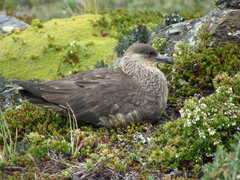
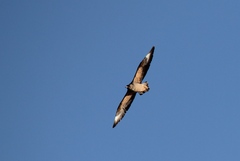
The Chilean skua, also known as the cinnamon skua (Stercorarius chilensis), is a large predatory seabird, which breeds in Argentina and Chile, but ranges as far north as Brazil and Peru when not breeding. A relatively distinctive skua, it has a dark cap that contrasts with its cinnamon throat and lower face. Hybrids with the Falkland skua are known from southern Argentina.

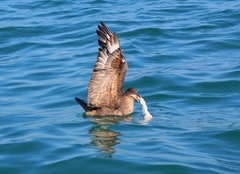
Chilean skuas feed on fish and other seabirds, as well as scraps, and carrion. They breed in colonies during the Southern Hemisphere summer. Overall, little is known about this South American species and what is known largely comes from descriptive studies scattered through time and concentrated at a few select breeding colonies.

The Chilean skua is part of Charadriiformes, a large order of seabirds that includes gulls, terns, jaegers, skuas, and auks. It is a member of the small Stercorariidae family, which comprises terns and skuas. There is some disagreement regarding the genus-level classification of this species. It was previously classified into Catharacta along with the Falkland skua and the south polar skua, but all skuas have now been merged into the larger Stercorarius genus.

There are some... Wikipedia →

Sounds

Call0:24

Argentina · 2008

© Bernabe Lopez-Lanus · XC45193 · CC BY-NC-SA 3.0

Call0:07

Argentina · 2020

© GABRIEL LEITE · XC521743 · CC BY-NC-SA 4.0

Global Distribution

Parks Where Found

# Park Country Daily sighting probability
1 Tierra del Fuego National Park 🇦🇷 Argentina
~10%

More parks will be added in future updates.

Cities Where Found

# City Country Daily sighting probability
1 Montevideo 🇺🇾 Uruguay
<5%
2 Lima 🇵🇪 Peru
<5%

Before you go

What are the chances of seeing a Chilean Skua in Tierra del Fuego National Park?

With luck

About 10% of wildlife watchers report a Chilean Skua sighting in Tierra del Fuego National Park on a given day, based on 269 verified sightings from GBIF citizen-science data from 2019 to 2026. It is the 43rd most-seen of the 78 birds we can rate there. Over three days the chance rises to about 30%, and over a week to about 60%, if each day is a fresh chance.

When is the best time to see a Chilean Skua in Tierra del Fuego National Park?

March

In that month about 30% of wildlife watchers report a Chilean Skua in Tierra del Fuego National Park on a given day, against under 5% in September, the lowest month. June has too few records to rate.

What time of day is best to see a Chilean Skua?

Between 3 and 6 pm

Across all the parks we cover, that three-hour window holds the most Chilean Skua sightings with a recorded time, and about 9 in 10 of them come between 6 am and 6 pm: it is a daytime animal.

Where else can you see a Chilean Skua?

Only Tierra del Fuego National Park, in our data

Tierra del Fuego National Park is the only park on Wallace's Line with enough records to rate Chilean Skua sightings: about 10% of wildlife watchers there report one on a given day.

Which relatives of the Chilean Skua live in Tierra del Fuego National Park?

Same order: Charadriiformes

The closest relatives of the Chilean Skua that you can see in Tierra del Fuego National Park (order Charadriiformes, Shorebirds and Allies) are Dominican Gull (about 70%), Southern Lapwing (about 30%) and South American Tern (about 30%), with each one's daily chance of a sighting.

Where does the Chilean Skua sighting chance come from?

GBIF citizen-science records

It is estimated from how often the Chilean Skua is recorded against all the birds logged in Tierra del Fuego National Park (269 verified sightings from 2019 to 2026), calibrated against known sighting rates. Figures are rounded to the nearest 10% because citizen-science data supports honest approximations, not decimals, and months with records from fewer than five people show "—". How it works.

← Back to Tierra del Fuego National Park