Brown-hooded Gull

Brown-hooded Gull

Chroicocephalus maculipennis

Silhouette: Michael Scroggie · PhyloPic

Daily sighting probability ~20% · Possible
at Torres del Paine National Park

In 3 days ~40% in a week ~70%

265 Verified sightings at Torres del Paine National Park From 2019 to 2026
458 In all 5 parks
December Best month
☀️ Diurnal When it's spotted

About the Brown-hooded Gull

The brown-hooded gull (Chroicocephalus maculipennis) is a species of gull, found in South America in Argentina, southeastern Brazil, Chile, Uruguay, and in the South Atlantic Ocean on the Falkland Islands. Its specific epithet, maculipennis, means 'spotted wings' (macula + penna). Like the other species of the genus Chroicocephalus, it was formerly included in a broad view of the genus Larus.

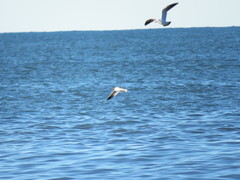
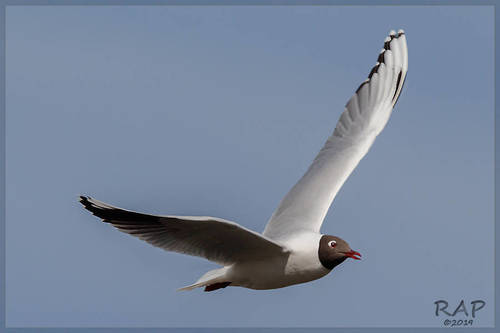
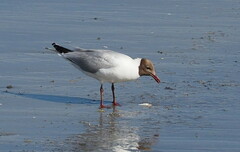
Adults in the breeding season have a dark brown head and throat with a white semicircle around the posterior of the eye, while the neck, chest and abdomen are white. In winter plumage, the brown hood is largely lost, retaining just a dark spot behind the eye and a dark smudge around the eye. The beak and legs are red, and the eye is dark brown. The outer primary flight feathers are white with black tips (the 'spots' of the scientific name) above and showing more extensively black from below, while the inner primaries and the secondaries and covert feathers are a silvery grey. There is no significant sexual dimorphism, but young birds are distinct, with the wings mottled pale brown, a black bar on the tip of the tail, paler orange-red legs and the bill orange-red with a dark tip... Wikipedia →
Sounds

Flight call0:18

Uruguay · 2024

© Guillermo Menéndez (gmmv80) · XC923766 · CC BY-NC-SA 4.0

Alarm call0:49

Argentina · 2005

© Meena Haribal · XC620391 · CC BY-NC-SA 4.0

Call0:26

Chile · 2018

© Peter Boesman · XC449868 · CC BY-NC-ND 4.0

Global Distribution

Parks Where Found

# Park Country Daily sighting probability
1 Península Valdés 🇦🇷 Argentina
~20%
2 Torres del Paine National Park 🇨🇱 Chile
~20%
3 Vicente Pérez Rosales National Park 🇨🇱 Chile
~10%
4 Tierra del Fuego National Park 🇦🇷 Argentina
<5%
5 Nahuel Huapi National Park 🇦🇷 Argentina
<5%

Cities Where Found

# City Country Daily sighting probability
1 Montevideo 🇺🇾 Uruguay
~30%
2 Buenos Aires 🇦🇷 Argentina
~10%
3 Rosario 🇦🇷 Argentina
~10%
4 Porto Alegre 🇧🇷 Brazil
<5%
5 Santiago 🇨🇱 Chile
<5%

Before you go

What are the chances of seeing a Brown-hooded Gull in Torres del Paine National Park?

Possible

About 20% of wildlife watchers report a Brown-hooded Gull sighting in Torres del Paine National Park on a given day, based on 265 verified sightings from GBIF citizen-science data from 2019 to 2026. It is the 41st most-seen of the 106 birds we can rate there. Over three days the chance rises to about 40%, and over a week to about 70%, if each day is a fresh chance.

When is the best time to see a Brown-hooded Gull in Torres del Paine National Park?

November and December

In those months about 30% of wildlife watchers report a Brown-hooded Gull in Torres del Paine National Park on a given day, against under 5% in February to April, the lowest months.

What time of day is best to see a Brown-hooded Gull?

Between 3 and 6 pm

Across all the parks we cover, that three-hour window holds the most Brown-hooded Gull sightings with a recorded time, and about 9 in 10 of them come between 6 am and 6 pm: it is a daytime animal.

Is Torres del Paine National Park the best place to see a Brown-hooded Gull?

Among the best

Of the 5 parks where we can rate Brown-hooded Gull sightings, Torres del Paine National Park ranks 2nd at about 20%, level with the leaders once rounded. The best odds are in Península Valdés (Argentina, about 20%).

Where does the Brown-hooded Gull sighting chance come from?

GBIF citizen-science records

It is estimated from how often the Brown-hooded Gull is recorded against all the birds logged in Torres del Paine National Park (265 verified sightings from 2019 to 2026), calibrated against known sighting rates. Figures are rounded to the nearest 10% because citizen-science data supports honest approximations, not decimals, and months with records from fewer than five people show "—". How it works.

← Back to Torres del Paine National Park