

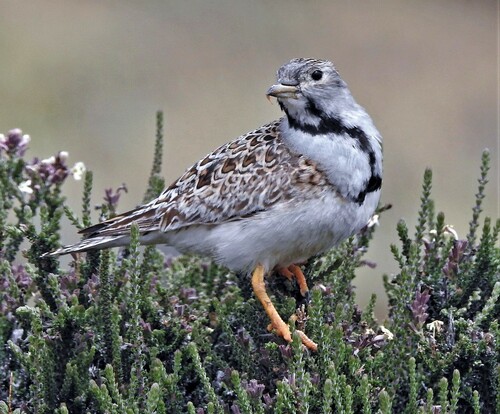
Hudsonian Godwit

Hudsonian Godwit

Limosa haemastica

Silhouette: Edwin Price · PhyloPic

LCNTVUVulnerableENCR
Daily sighting probability <5% · Rare
at Torres del Paine National Park

In 3 days <5% in a week ~10%

16 Verified sightings at Torres del Paine National Park From 2019 to 2026
120 In all 4 parks
February Best month
☀️ Diurnal When it's spotted

About the Hudsonian Godwit

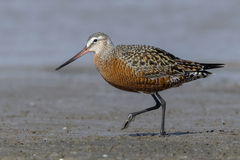
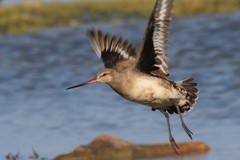
The Hudsonian godwit (Limosa haemastica) is a large shorebird in the sandpiper family, Scolopacidae. It is an extreme long-distance migrant, breeding at remote sites in Subarctic North America and flying nonstop in the fall to wintering sites in southern South America. Due to its remote breeding and wintering grounds and rapid, direct migration, it was a poorly-known species and was considered very rare until the mid-20th century, when major staging sites were discovered around James Bay and breeding sites were found around Churchill, Manitoba. Since then, the Hudsonian godwit has become the target of conservation attention due to its fragmented and localized distribution and small population, as well as an important scientific system for migration biology research.

The Hudsonian godwit was formally described in 1758 by the Swedish naturalist Carl Linnaeus in the tenth edition of his Systema Naturae. He placed it in the genus Scolopax and coined the binomial name Scolopax haemastica. Linnaeus based his entry on the "red-breasted godwit" that had been described and illustrated in 1750 by the English naturalist George Edwards in the third volume of his... Wikipedia →

Sounds

Call0:56

Chile · 2023

© Barry Edmonston · XC856368 · CC BY-NC-SA 4.0

Alarm call0:04

Brazil · 2020

© Robson Silva e Silva · XC596819 · CC BY-NC-SA 4.0

Call0:31

United States · 2014

© Garrett MacDonald · XC193665 · CC BY-NC-SA 4.0

Global Distribution

Parks Where Found

# Park Country Daily sighting probability
1 Katmai National Park 🇺🇸 United States
~10%
2 Lauca National Park 🇨🇱 Chile
~10%
3 Torres del Paine National Park 🇨🇱 Chile
<5%
4 Channel Islands National Park 🇺🇸 United States
<5%

Cities Where Found

# City Country Daily sighting probability
1 Anchorage 🇺🇸 United States
~20%
2 San Diego 🇺🇸 United States
<5%
3 Santa Cruz de la Sierra 🇧🇴 Bolivia
<5%
4 Lima 🇵🇪 Peru
<5%
5 Rio de Janeiro 🇧🇷 Brazil
<5%
6 Denver 🇺🇸 United States
<5%
7 Portland 🇺🇸 United States
<5%
8 Baltimore 🇺🇸 United States
<5%
9 Calgary 🇨🇦 Canada
<5%
10 New York City 🇺🇸 United States
<5%

Before you go

What are the chances of seeing a Hudsonian Godwit in Torres del Paine National Park?

Rare

Under 5% of wildlife watchers report a Hudsonian Godwit sighting in Torres del Paine National Park on a given day, based on 16 verified sightings from GBIF citizen-science data from 2019 to 2026. It is the 92nd most-seen of the 106 birds we can rate there. Over three days the chance rises to under 5%, and over a week to about 10%, if each day is a fresh chance.

When is the best time to see a Hudsonian Godwit in Torres del Paine National Park?

February

In that month about 10% of wildlife watchers report a Hudsonian Godwit in Torres del Paine National Park on a given day, against under 5% in March to January, the lowest months.

What time of day is best to see a Hudsonian Godwit?

Between 10 am and 1 pm

Across all the parks we cover, that three-hour window holds the most Hudsonian Godwit sightings with a recorded time, and about 8 in 10 of them come between 6 am and 6 pm: it is a daytime animal.

Is Torres del Paine National Park the best place to see a Hudsonian Godwit?

3rd of 4

Of the 4 parks where we can rate Hudsonian Godwit sightings, Torres del Paine National Park ranks 3rd at under 5%. The best odds are in Katmai National Park (United States, about 10%) and Lauca National Park (Chile, about 10%).

Where does the Hudsonian Godwit sighting chance come from?

GBIF citizen-science records

It is estimated from how often the Hudsonian Godwit is recorded against all the birds logged in Torres del Paine National Park (16 verified sightings from 2019 to 2026), calibrated against known sighting rates. Figures are rounded to the nearest 10% because citizen-science data supports honest approximations, not decimals, and months with records from fewer than five people show "—". How it works.

← Back to Torres del Paine National Park