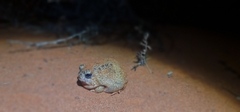
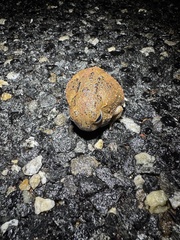
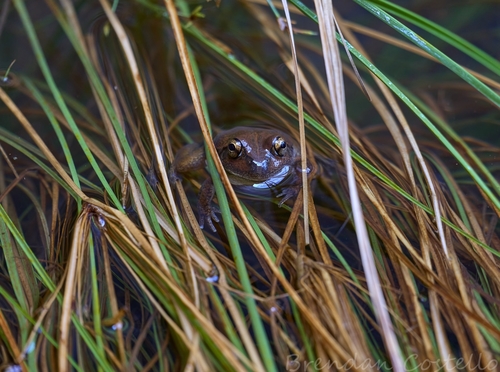
Desert Spadefoot Toad

Desert Spadefoot Toad

Notaden nichollsi

Silhouette: Dmitry Bogdanov (vectorized by T. Michael Keesey) · PhyloPic

LCLeast ConcernNTVUENCR Endemic
Daily sighting probability ~20% · Possible
at Uluru-Kata Tjuta National Park

In 3 days ~50% in a week ~80%

6 Verified sightings at Uluru-Kata Tjuta National Park From 2019 to 2026
6 In 1 park
November Best month
☀️ Diurnal When it's spotted

About the Desert Spadefoot Toad

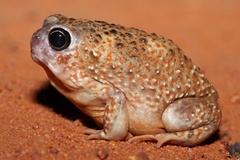
The desert spadefoot toad (Notaden nichollsi) is a species of frog in the family Limnodynastidae. It is endemic to Australia. Its natural habitats are subtropical or tropical dry shrubland, subtropical or tropical dry lowland grassland, intermittent freshwater marshes, hot deserts, and temperate desert.

This species will burrow communaly underground to survive the hot and arid climate of Australia to conserve energy and water. Notaden nichollsi is typically found sand dunes due to the water potential properties around the Southern Kimberly region of Western Australia, Northern Territory and into western Queensland. Notaden nichollsi was originally described by George Howard Parker in 1940 and is classified under the family Limnodynastidae, commonly known as Australian ground frogs. The genus Notaden, to which this species belongs, was established by Albert Günther in 1873 based on his early observations.

Notaden nichollsi undergo aestivation in burrows near the dune crests after rainfall during periods of water shortages. These burrows serve as shelters where the frogs can seek refuge during periods of extreme... Wikipedia →
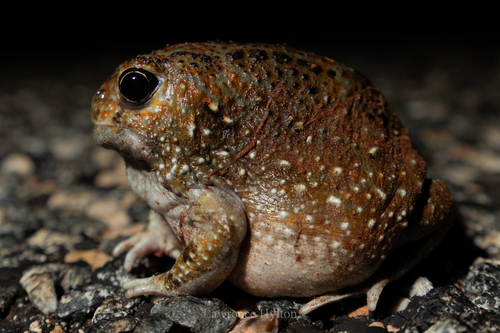
Global Distribution

Parks Where Found

# Park Country Daily sighting probability
1 Uluru-Kata Tjuta National Park 🇦🇺 Australia
~20%

More parks will be added in future updates.

Before you go

What are the chances of seeing a Desert Spadefoot Toad in Uluru-Kata Tjuta National Park?

Possible

About 20% of wildlife watchers report a Desert Spadefoot Toad sighting in Uluru-Kata Tjuta National Park on a given day, based on 6 verified sightings from GBIF citizen-science data from 2019 to 2026. Over three days the chance rises to about 50%, and over a week to about 80%, if each day is a fresh chance.

When is the best time to see a Desert Spadefoot Toad in Uluru-Kata Tjuta National Park?

November

In that month about 50% of wildlife watchers report a Desert Spadefoot Toad in Uluru-Kata Tjuta National Park on a given day, against under 5% in March–September and December–January, the lowest months.

What time of day is best to see a Desert Spadefoot Toad?

Between noon and 3 pm

Across all the parks we cover, that three-hour window holds the most Desert Spadefoot Toad sightings with a recorded time, and about 8 in 10 of them come between 6 am and 6 pm: it is a daytime animal.

Where else can you see a Desert Spadefoot Toad?

Only Uluru-Kata Tjuta National Park, in our data

Uluru-Kata Tjuta National Park is the only park on Wallace's Line with enough records to rate Desert Spadefoot Toad sightings: about 20% of wildlife watchers there report one on a given day.

Where does the Desert Spadefoot Toad sighting chance come from?

GBIF citizen-science records

It is estimated from how often the Desert Spadefoot Toad is recorded against all the amphibians logged in Uluru-Kata Tjuta National Park (6 verified sightings from 2019 to 2026), calibrated against known sighting rates. Figures are rounded to the nearest 10% because citizen-science data supports honest approximations, not decimals, and months with records from fewer than five people show "—". How it works.

← Back to Uluru-Kata Tjuta National Park