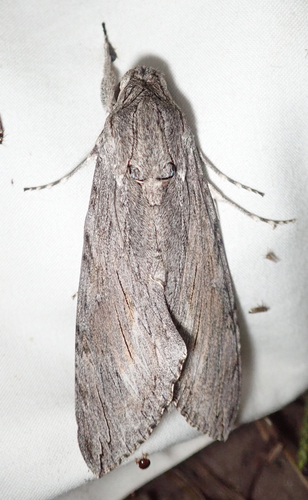
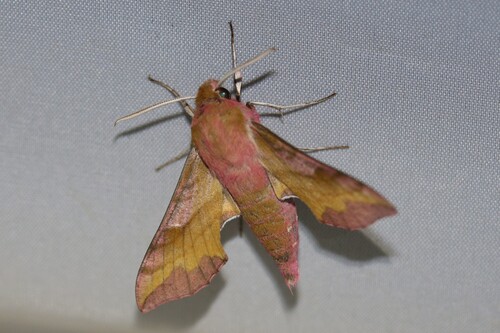
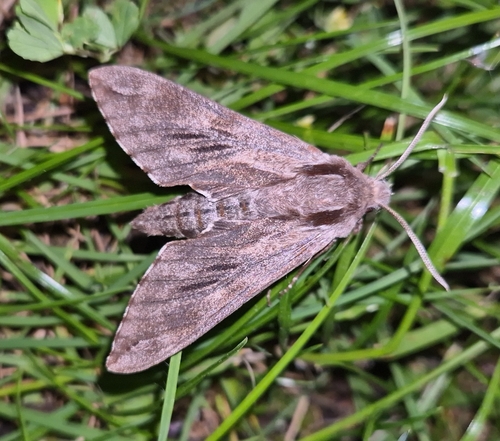
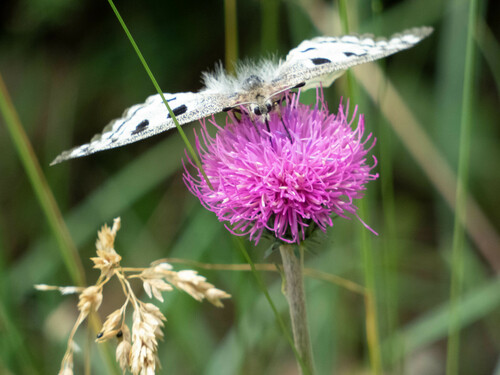
Narrow-Bordered Bee Hawkmoth

Narrow-Bordered Bee Hawkmoth

Hemaris tityus

Daily sighting probability ~10% · With luck
at Vanoise National Park

In 3 days ~30% in a week ~60%

7 Verified sightings at Vanoise National Park From 2019 to 2026
27 In all 3 parks
June Best month
☀️ Diurnal When it's spotted

About the Narrow-Bordered Bee Hawkmoth

Hemaris tityus, the narrow-bordered bee hawk-moth, is a moth of the family Sphingidae which is native to the Palearctic. It has a wide range, from Ireland across temperate Europe to the Ural Mountains, western Siberia, Novosibirsk and the Altai. It is also known from the Tian Shan eastwards across Mongolia to north-eastern China and southwards to Tibet. There is a separate population found from Turkey to northern Iran.

It appears in May and June and is a lively day-flier (unlike most other sphingids), generally active from mid-morning to mid-afternoon. It frequents marshy woodland and damp moorland, and has a wide distribution across temperate Europe and Western Asia, but is generally quite scarce. The larvae feed on devil's-bit scabious (Succisa pratensis) and field scabious (Knautia arvensis).

It is distinguished from H. fuciformis by the narrow band of scaling along the outer wing margin, and the forewing's undivided discal cell. It has a wingspan of 40–50 millimetres (1.6–2.0 in). It is one of two similar species of sphingid moth occurring in Britain that closely mimic a bumblebee. Wikipedia →
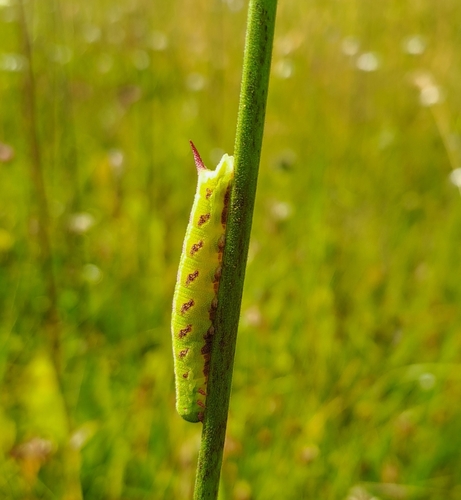
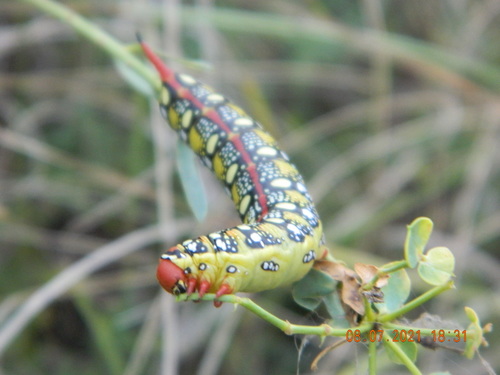
Global Distribution

Parks Where Found

# Park Country Daily sighting probability
1 Vanoise National Park 🇫🇷 France
~10%
2 Cairngorms National Park 🇬🇧 United Kingdom
~10%
3 Pyrénées National Park 🇫🇷 France
<5%

Cities Where Found

# City Country Daily sighting probability
1 Vienna 🇦🇹 Austria
<5%

Before you go

What are the chances of seeing a Narrow-Bordered Bee Hawkmoth in Vanoise National Park?

With luck

About 10% of wildlife watchers report a Narrow-Bordered Bee Hawkmoth sighting in Vanoise National Park on a given day, based on 7 verified sightings from GBIF citizen-science data from 2019 to 2026. It is the 196th most-seen of the 308 insects we can rate there. Over three days the chance rises to about 30%, and over a week to about 60%, if each day is a fresh chance.

When is the best time to see a Narrow-Bordered Bee Hawkmoth in Vanoise National Park?

June

In that month about 20% of wildlife watchers report a Narrow-Bordered Bee Hawkmoth in Vanoise National Park on a given day, against under 5% in September to May, the lowest months.

What time of day is best to see a Narrow-Bordered Bee Hawkmoth?

Between 11 am and 2 pm

Across all the parks we cover, that three-hour window holds the most Narrow-Bordered Bee Hawkmoth sightings with a recorded time, and nearly all of them come between 6 am and 6 pm: it is a daytime animal.

Is Vanoise National Park the best place to see a Narrow-Bordered Bee Hawkmoth?

Yes

Of the 3 parks where we can rate Narrow-Bordered Bee Hawkmoth sightings, Vanoise National Park has the highest daily chance: about 10%. Next come Cairngorms National Park (United Kingdom, about 10%) and Pyrénées National Park (France, under 5%).

Which relatives of the Narrow-Bordered Bee Hawkmoth live in Vanoise National Park?

Same family: Sphingidae

The closest relatives of the Narrow-Bordered Bee Hawkmoth that you can see in Vanoise National Park (family Sphingidae, Sphinx Moths) are Leafy Spurge Hawkmoth (about 40%), Bedstraw Hawkmoth (about 20%) and Convolvulus Hawkmoth (about 20%), with each one's daily chance of a sighting.

Where does the Narrow-Bordered Bee Hawkmoth sighting chance come from?

GBIF citizen-science records

It is estimated from how often the Narrow-Bordered Bee Hawkmoth is recorded against all the insects logged in Vanoise National Park (7 verified sightings from 2019 to 2026), calibrated against known sighting rates. Figures are rounded to the nearest 10% because citizen-science data supports honest approximations, not decimals, and months with records from fewer than five people show "—". How it works.

← Back to Vanoise National Park