Austral Pygmy-Owl

Austral Pygmy-Owl

Glaucidium nana

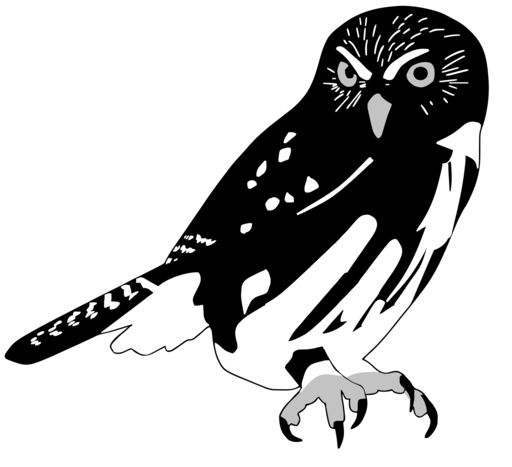
Silhouette: Edwin Price · PhyloPic

LCLeast ConcernNTVUENCR
Daily sighting probability ~10% · With luck
at Vicente Pérez Rosales National Park

In 3 days ~20% in a week ~40%

43 Verified sightings at Vicente Pérez Rosales National Park From 2019 to 2026
362 In all 4 parks
May Best month
☀️ Diurnal When it's spotted

About the Austral Pygmy-Owl

The austral pygmy owl (Glaucidium nana) is a species of owl in the family Strigidae. It is found mainly in central and southern Chile, but also in some parts of southern Argentina. The austral pygmy owl has sometimes been treated as a subspecies of ferruginous pygmy owl (Glaucidium brasilianum) but DNA studies and other data support its being a species in its own right. It is monotypic.

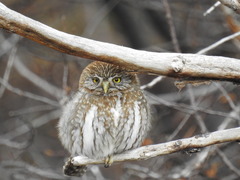
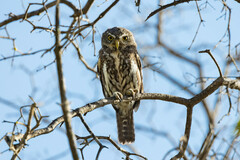
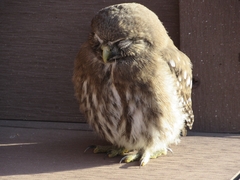
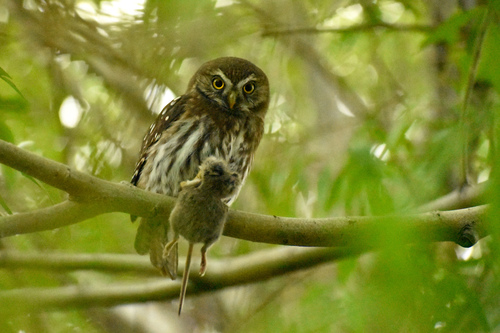
The austral pygmy owl is 17 to 21 cm (6.7 to 8.3 in) long. Males weigh 56 to 75 g (2.0 to 2.6 oz) and females 70 to 100 g (2.5 to 3.5 oz). It has gray-brown and red morphs and intergrades between them. Adults of both morphs have a pale grayish brown face with dark flecks, whitish "brows" over pale yellow eyes, and black "false eyes" on the nape. The gray-brown morph's upperparts are dark grayish brown with whitish dots of variable size and shape. The tail is also dark grayish brown with narrow buffy bars. The throat is white, the sides of the upper breast dark grayish brown, and the underparts off-white with dark grayish brown streaks. The red morph has a similar pattern but reddish brown replaces the dark grayish brown. Wikipedia →

Sounds

Call0:09

Chile · 2025

© Marc Anderson · XC1075439 · CC BY-NC-ND 4.0

Song0:36

Argentina · 2020

© GABRIEL LEITE · XC521632 · CC BY-NC-SA 4.0

Alarm call1:20

Chile · 2019

© Tomek Tumiel · XC515493 · CC BY-NC-SA 4.0

Global Distribution

Parks Where Found

# Park Country Daily sighting probability
1 Tierra del Fuego National Park 🇦🇷 Argentina
~10%
2 Torres del Paine National Park 🇨🇱 Chile
~10%
3 Vicente Pérez Rosales National Park 🇨🇱 Chile
~10%
4 Nahuel Huapi National Park 🇦🇷 Argentina
<5%

Cities Where Found

# City Country Daily sighting probability
1 Santiago 🇨🇱 Chile
<5%

Before you go

What are the chances of seeing an Austral Pygmy-Owl in Vicente Pérez Rosales National Park?

With luck

About 10% of wildlife watchers report an Austral Pygmy-Owl sighting in Vicente Pérez Rosales National Park on a given day, based on 43 verified sightings from GBIF citizen-science data from 2019 to 2026. It is the 51st most-seen of the 70 birds we can rate there. Over three days the chance rises to about 20%, and over a week to about 40%, if each day is a fresh chance.

When is the best time to see an Austral Pygmy-Owl in Vicente Pérez Rosales National Park?

May and October

In those months about 20% of wildlife watchers report an Austral Pygmy-Owl in Vicente Pérez Rosales National Park on a given day, against under 5% in April, June, September and November–February, the lowest months.

What time of day is best to see an Austral Pygmy-Owl?

Between 2 and 5 pm

Across all the parks we cover, that three-hour window holds the most Austral Pygmy-Owl sightings with a recorded time, and about 8 in 10 of them come between 6 am and 6 pm: it is a daytime animal.

Is Vicente Pérez Rosales National Park the best place to see an Austral Pygmy-Owl?

Among the best

Of the 4 parks where we can rate Austral Pygmy-Owl sightings, Vicente Pérez Rosales National Park ranks 3rd at about 10%, level with the leaders once rounded. The best odds are in Tierra del Fuego National Park (Argentina, about 10%) and Torres del Paine National Park (Chile, about 10%).

Where does the Austral Pygmy-Owl sighting chance come from?

GBIF citizen-science records

It is estimated from how often the Austral Pygmy-Owl is recorded against all the birds logged in Vicente Pérez Rosales National Park (43 verified sightings from 2019 to 2026), calibrated against known sighting rates. Figures are rounded to the nearest 10% because citizen-science data supports honest approximations, not decimals, and months with records from fewer than five people show "—". How it works.
← Back to Vicente Pérez Rosales National Park