Green-backed Firecrown

Green-backed Firecrown

Sephanoides sephaniodes

Silhouette: Ferran Sayol · PhyloPic

LCLeast ConcernNTVUENCR
Daily sighting probability ~80% · Very likely
at Vicente Pérez Rosales National Park

In 3 days >90%

521 Verified sightings at Vicente Pérez Rosales National Park From 2019 to 2026
960 In all 4 parks
May Best month
☀️ Diurnal When it's spotted

About the Green-backed Firecrown

The green-backed firecrown (Sephanoides sephaniodes) is a hummingbird in the "coquettes", tribe Lesbiini of subfamily Lesbiinae. It is found in Argentina, mainland Chile, and the Juan Fernández Islands. The green-backed firecrown is monotypic. It shares its genus only with the Juan Fernandez firecrown (S. fernandensis). The specific epithet sephaniodes is sometimes misspelled sephanoides to match the genus.

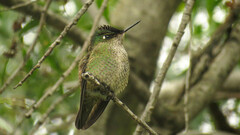
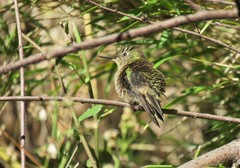
The green-backed firecrown is 10 to 10.5 cm (3.9 to 4.1 in) long. Males weigh about 5.5 g (0.19 oz) and females about 5 g (0.18 oz). The species is sexually dimorphic, with larger, short-billed males, and smaller, longer-billed females. Adults of both sexes have bronzy green upperparts, slaty green wings and tails, and pale buff underparts with black and green spots. Adult males have the eponymous iridescent red-yellow crown. Juveniles of both sexes have rusty feather edges on the head and their underparts have a cinnamon tone. Because the young are sexually monochromatic, it is difficult to assign a sex to them.

The green-backed firecrown is found in Chile from south of the Atacama Region all the way... Wikipedia →

Sounds

Call0:07

Chile · 2025

© Marc Anderson · XC1075701 · CC BY-NC-ND 4.0

Song0:34

Chile · 2021

© Andre Vielma · XC665427 · CC BY-NC-SA 4.0

Flight call0:20

Chile · 2020

© Cristian Pinto · XC551599 · CC BY-NC-SA 4.0

Global Distribution

Parks Where Found

# Park Country Daily sighting probability
1 Vicente Pérez Rosales National Park 🇨🇱 Chile
~80%
2 Nahuel Huapi National Park 🇦🇷 Argentina
~30%
3 Tierra del Fuego National Park 🇦🇷 Argentina
<5%
4 Torres del Paine National Park 🇨🇱 Chile
<5%

Cities Where Found

# City Country Daily sighting probability
1 Santiago 🇨🇱 Chile
~40%
2 Mendoza 🇦🇷 Argentina
~10%

Before you go

What are the chances of seeing a Green-backed Firecrown in Vicente Pérez Rosales National Park?

Very likely

About 80% of wildlife watchers report a Green-backed Firecrown sighting in Vicente Pérez Rosales National Park on a given day, based on 521 verified sightings from GBIF citizen-science data from 2019 to 2026. It is the most-seen of the 70 birds we can rate there. Over three days the chance rises to over 90%, if each day is a fresh chance.

When is the best time to see a Green-backed Firecrown in Vicente Pérez Rosales National Park?

March to May

In those months about 90% of wildlife watchers report a Green-backed Firecrown in Vicente Pérez Rosales National Park on a given day, against about 70% in June–July and November–January, the lowest months.

What time of day is best to see a Green-backed Firecrown?

Between 1 and 4 pm

Across all the parks we cover, that three-hour window holds the most Green-backed Firecrown sightings with a recorded time, and about 9 in 10 of them come between 6 am and 6 pm: it is a daytime animal.

Is Vicente Pérez Rosales National Park the best place to see a Green-backed Firecrown?

Yes

Of the 4 parks where we can rate Green-backed Firecrown sightings, Vicente Pérez Rosales National Park has the highest daily chance: about 80%. Next come Nahuel Huapi National Park (Argentina, about 30%) and Tierra del Fuego National Park (Argentina, under 5%).

Where does the Green-backed Firecrown sighting chance come from?

GBIF citizen-science records

It is estimated from how often the Green-backed Firecrown is recorded against all the birds logged in Vicente Pérez Rosales National Park (521 verified sightings from 2019 to 2026), calibrated against known sighting rates. Figures are rounded to the nearest 10% because citizen-science data supports honest approximations, not decimals, and months with records from fewer than five people show "—". How it works.

← Back to Vicente Pérez Rosales National Park