Güiña

Güiña

Leopardus guigna

Silhouette: Margot Michaud · PhyloPic

LCLeast ConcernNTVUENCR
Daily sighting probability ~30% · Possible
at Vicente Pérez Rosales National Park

In 3 days ~70% in a week ~90%

9 Verified sightings at Vicente Pérez Rosales National Park From 2019 to 2026
9 In 1 park
April Best month
☀️🌙 Day & Night When it's spotted

About the Güiña

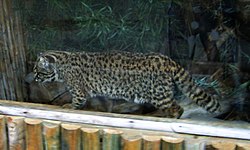
The kodkod (Leopardus guigna), also called güiña, is the smallest felid species native to the Americas. It lives primarily in central and southern Chile, as well as marginally in adjoining areas of Argentina. Between 1996 and 2002, it was listed as Vulnerable on the IUCN Red List as the total population was thought to be fewer than 10,000 mature individuals; it is threatened by persecution, habitat loss and prey base.

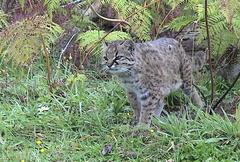
The kodkod's fur color ranges from brownish-yellow to grey-brown. It has dark spots, a pale underside and a ringed tail. The ears are black with a white spot, while the dark spots on the shoulders and neck almost merge to form a series of dotted streaks. Melanistic kodkods with spotted black coats are quite common. It has a small head, large feet, and a thick tail. Adult kodkods are 37 to 51 cm (15 to 20 in) in head to body length with a short 20–25 cm (7.9–9.8 in) tail and a shoulder height of about 25 cm (9.8 in). Weight ranges between 2 and 2.5 kg (4.4 and 5.5 lb).

The melanistic phenotype is caused by the deletion of a single cysteine amino acid at position 126 of Agouti-signaling protein. This disrupts one of the four... Wikipedia →

Sounds

Recording0:10

Chile · 2026

Ricardo Barrientos · iNaturalist · CC0

Recording0:16

Chile · 2023

© Munoz · iNaturalist · CC BY-NC 4.0

Global Distribution

Parks Where Found

# Park Country Daily sighting probability
1 Vicente Pérez Rosales National Park 🇨🇱 Chile
~30%

More parks will be added in future updates.

Before you go

What are the chances of seeing a Güiña in Vicente Pérez Rosales National Park?

Possible

About 30% of wildlife watchers report a Güiña sighting in Vicente Pérez Rosales National Park on a given day, based on 9 verified sightings from GBIF citizen-science data from 2019 to 2026. It is the 2nd most-seen of the 6 mammals we can rate there. Over three days the chance rises to about 70%, and over a week to about 90%, if each day is a fresh chance.

When is the best time to see a Güiña in Vicente Pérez Rosales National Park?

April–July and October

In those months about 50% of wildlife watchers report a Güiña in Vicente Pérez Rosales National Park on a given day, against under 5% in December and January, the lowest months.

What time of day is best to see a Güiña?

Between noon and 3 pm

Across all the parks we cover, that three-hour window holds the most Güiña sightings with a recorded time, and about 6 in 10 of them come between 6 am and 6 pm: it is seen both by day and at night.

Where else can you see a Güiña?

Only Vicente Pérez Rosales National Park, in our data

Vicente Pérez Rosales National Park is the only park on Wallace's Line with enough records to rate Güiña sightings: about 30% of wildlife watchers there report one on a given day.

Which relatives of the Güiña live in Vicente Pérez Rosales National Park?

Same order: Carnivora

The closest relatives of the Güiña that you can see in Vicente Pérez Rosales National Park (order Carnivora, Carnivorans) are Pampas Fox (about 90%), Culpeo (about 30%) and Southern River Otter (about 10%), with each one's daily chance of a sighting.

Where does the Güiña sighting chance come from?

GBIF citizen-science records

It is estimated from how often the Güiña is recorded against all the mammals logged in Vicente Pérez Rosales National Park (9 verified sightings from 2019 to 2026), calibrated against known sighting rates. Figures are rounded to the nearest 10% because citizen-science data supports honest approximations, not decimals, and months with records from fewer than five people show "—". How it works.

← Back to Vicente Pérez Rosales National Park