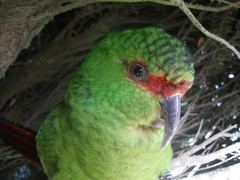
Slender-billed Parakeet

Slender-billed Parakeet

Enicognathus leptorhynchus

Silhouette: Edwin Price · PhyloPic

LCLeast ConcernNTVUENCR
Daily sighting probability ~30% · Possible
at Vicente Pérez Rosales National Park

In 3 days ~60% in a week ~90%

136 Verified sightings at Vicente Pérez Rosales National Park From 2019 to 2026
136 In 1 park
October Best month
☀️ Diurnal When it's spotted

About the Slender-billed Parakeet

The slender-billed parakeet (Enicognathus leptorhynchus) or choroy, is a species of bird in subfamily Arinae of the family Psittacidae, the African and New World parrots. It is endemic to Chile, where it is known by the local common name choroy.

The slender-billed parakeet has also been named Enicognathus byroni, but the current specific epithet leptorhynchus has priority. It shares its genus with the austral parakeet (E. ferrugineus) and is monotypic. The slender-billed parakeet is about 40 cm (16 in) long. The species' English name comes from its greatly elongated mandible. The sexes are the same. Adults have a red forehead and lores in an otherwise yellow-green face. Their upperparts are dull green. Their underparts are yellowish green with a reddish patch on the belly. Their tail is also reddish; their wings are mostly green with bluish green primaries. Immature birds are similar to adults but are a darker green and have whitish skin around the eye.

The slender-billed parakeet is endemic to central Chile between the Santiago Metropolitan Region and Los Lagos Region; it also occurs in the Aysén Region... Wikipedia →

Sounds

Call1:01

Chile · 2019

© Tomek Tumiel · XC596031 · CC BY-NC-SA 4.0

Flight call0:07

Chile · 2019

© Cristian Pinto · XC559037 · CC BY-NC-SA 4.0

Flight call0:25

Chile · 2020

© Dante Buzzetti · XC543498 · CC BY-NC-SA 4.0

Global Distribution

Parks Where Found

# Park Country Daily sighting probability
1 Vicente Pérez Rosales National Park 🇨🇱 Chile
~30%

More parks will be added in future updates.

Zoos & Centres Where Found

# Zoo / Centre Country
1 Prague Zoo 🇨🇿 Czechia In captivity
2 Walsrode World Bird Park 🇩🇪 Germany In captivity
3 Bioparque Educativo Quillón 🇨🇱 Chile In captivity
4 Buin Zoo 🇨🇱 Chile In captivity
5 Chilean National Zoo 🇨🇱 Chile In captivity
6 Parque Loro Sexi 🇪🇸 Spain In captivity
7 Rákosův pavilon 🇨🇿 Czechia In captivity
8 Velemlokárium 🇨🇿 Czechia In captivity
9 Acuario de Almuñécar 🇪🇸 Spain In captivity

Before you go

What are the chances of seeing a Slender-billed Parakeet in Vicente Pérez Rosales National Park?

Possible

About 30% of wildlife watchers report a Slender-billed Parakeet sighting in Vicente Pérez Rosales National Park on a given day, based on 136 verified sightings from GBIF citizen-science data from 2019 to 2026. It is the 25th most-seen of the 70 birds we can rate there. Over three days the chance rises to about 60%, and over a week to about 90%, if each day is a fresh chance.

When is the best time to see a Slender-billed Parakeet in Vicente Pérez Rosales National Park?

March and October

In those months about 40% of wildlife watchers report a Slender-billed Parakeet in Vicente Pérez Rosales National Park on a given day, against about 10% in April and September, the lowest months.

What time of day is best to see a Slender-billed Parakeet?

Between 4 and 7 pm

Across all the parks we cover, that three-hour window holds the most Slender-billed Parakeet sightings with a recorded time, and about 7 in 10 of them come between 6 am and 6 pm: it is a daytime animal.

Where else can you see a Slender-billed Parakeet?

Only Vicente Pérez Rosales National Park, in our data

Vicente Pérez Rosales National Park is the only park on Wallace's Line with enough records to rate Slender-billed Parakeet sightings: about 30% of wildlife watchers there report one on a given day.

Where does the Slender-billed Parakeet sighting chance come from?

GBIF citizen-science records

It is estimated from how often the Slender-billed Parakeet is recorded against all the birds logged in Vicente Pérez Rosales National Park (136 verified sightings from 2019 to 2026), calibrated against known sighting rates. Figures are rounded to the nearest 10% because citizen-science data supports honest approximations, not decimals, and months with records from fewer than five people show "—". How it works.

← Back to Vicente Pérez Rosales National Park