Bird's-Nest Moth

Bird's-Nest Moth

Tinea trinotella

Daily sighting probability <5% · Rare
at Wadden Sea National Park

In 3 days ~10% in a week ~30%

12 Verified sightings at Wadden Sea National Park From 2019 to 2026
17 In all 2 parks
July Best month
🌙 Nocturnal When it's spotted

About the Bird's-Nest Moth

Tinea trinotella is a species of tineoid moth. It belongs to the fungus moth family (Tineidae), and therein to the nominate subfamily Tineinae. It was once used as type species of a distinct genus Acedes, but this is synonymized today with Tinea, the type genus of Tineinae, Tineidae and the superfamily Tineoidea.

It is widespread and common in much of the western Palearctic; no records exist from Slovenia but as it is found in the surrounding countries, it may well have simply not been noticed yet. Its absence from Iceland seems to be genuine however. The nocturnal adults are on the wing about May to August, depending on the location, and are easily attracted to light sources. Two generations may occur each year at least in part of its range.

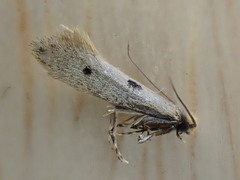
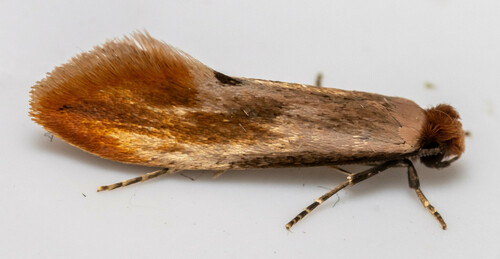
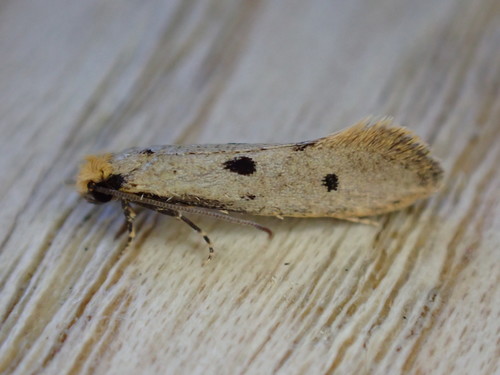
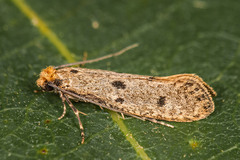
This small moth has a wingspan of 12–18 mm when adult. Their forewings are a plain greyish buff with a golden hue, and bear the one large, one medium and one small clear-cut black dots referenced in the specific name trinotella. On the head, they have a tuft of yellow or orange hairs.

The caterpillars live in small portable cases they build from debris held together with their own silk, just like those of the case... Wikipedia →
Global Distribution

Parks Where Found

# Park Country Daily sighting probability
1 Bavarian Forest National Park 🇩🇪 Germany
<5%
2 Wadden Sea National Park 🇩🇪 Germany
<5%

Cities Where Found

# City Country Daily sighting probability
1 Liverpool 🇬🇧 United Kingdom
<5%
2 London 🇬🇧 United Kingdom
<5%

Before you go

What are the chances of seeing a Bird's-Nest Moth in Wadden Sea National Park?

Rare

Under 5% of wildlife watchers report a Bird's-Nest Moth sighting in Wadden Sea National Park on a given day, based on 12 verified sightings from GBIF citizen-science data from 2019 to 2026. It is the 486th most-seen of the 818 insects we can rate there. Over three days the chance rises to about 10%, and over a week to about 30%, if each day is a fresh chance.

When is the best time to see a Bird's-Nest Moth in Wadden Sea National Park?

July and August

In those months about 10% of wildlife watchers report a Bird's-Nest Moth in Wadden Sea National Park on a given day, against under 5% in September to June, the lowest months.

What time of day is best to see a Bird's-Nest Moth?

Between 10 pm and 1 am

Across all the parks we cover, that three-hour window holds the most Bird's-Nest Moth sightings with a recorded time, and about 8 in 10 of them come between 6 pm and 6 am: it is mostly seen at night.

Is Wadden Sea National Park the best place to see a Bird's-Nest Moth?

Among the best

Of the 2 parks where we can rate Bird's-Nest Moth sightings, Wadden Sea National Park ranks 2nd at under 5%, level with the leaders once rounded. The best odds are in Bavarian Forest National Park (Germany, under 5%).

Where does the Bird's-Nest Moth sighting chance come from?

GBIF citizen-science records

It is estimated from how often the Bird's-Nest Moth is recorded against all the insects logged in Wadden Sea National Park (12 verified sightings from 2019 to 2026), calibrated against known sighting rates. Figures are rounded to the nearest 10% because citizen-science data supports honest approximations, not decimals, and months with records from fewer than five people show "—". How it works.

← Back to Wadden Sea National Park