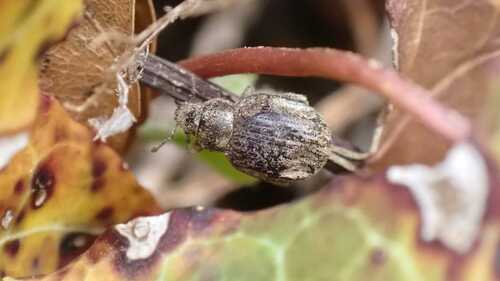
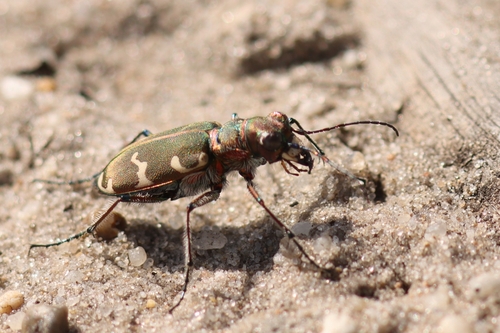
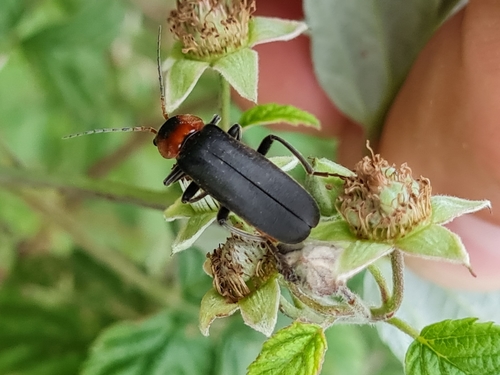
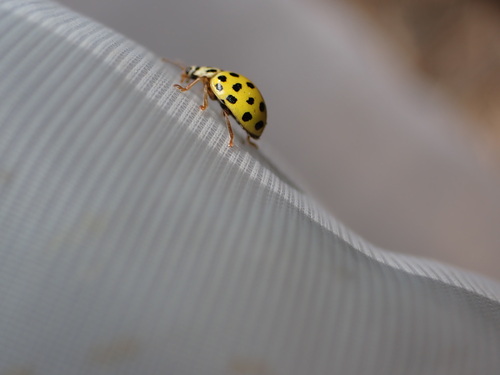
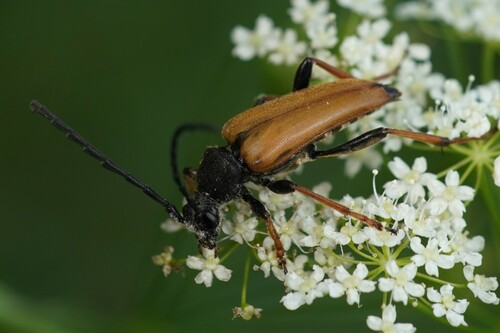
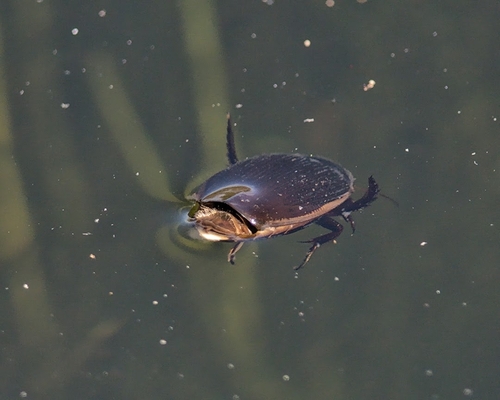
Black-Bellied Great Diving-Beetle

Black-Bellied Great Diving-Beetle

Dytiscus semisulcatus

Daily sighting probability <5% · Rare
at Wadden Sea National Park

In 3 days ~10% in a week ~30%

11 Verified sightings at Wadden Sea National Park From 2019 to 2026
11 In 1 park
November Best month
🌅 Crepuscular When it's spotted

About the Black-Bellied Great Diving-Beetle

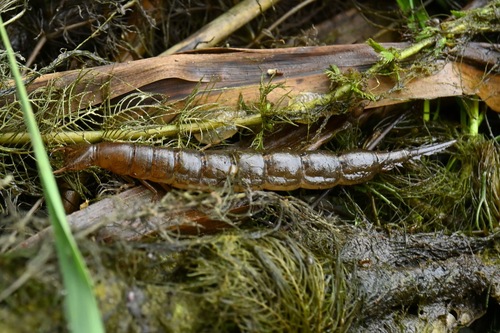
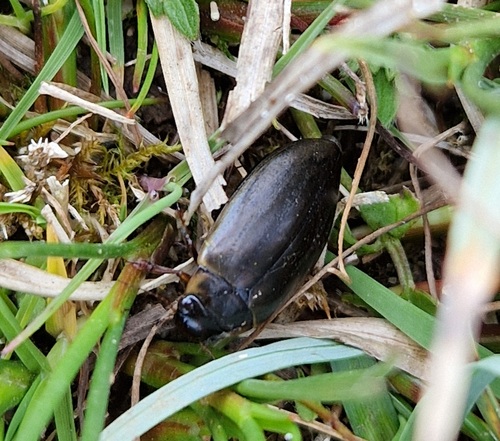
Dytiscus semisulcatus, the brown-bellied great diving beetle, is an aquatic diving beetle native to Europe and northern Asia, and is particularly common in England. It is a large dark red-brown or black beetle, that can fly and lives near water.

The specific epithet 'semisulcatus' comes from two Latin words. Semi-, numerical prefix meaning "half" and sulcatus meaning “grooved” or "furrowed", which is in reference to the parallel grooves underneath the body of the beetle.

It is commonly known as Brown-bellied Great Diving Beetle, or Black bellied Great Diving Beetle. This is due to the dark colour of the under bellies of the beetles. It was formerly known as Dytiscus punctulatus F. It is listed in the Catalogue of Life.

It is a rather large insect. The larvae can grow up to 18 millimetres (0.71 in) in length, while the adults are generally 22–32 millimetres (0.87–1.26 in). The basic anatomy of the D. semisulcatus is broken up into three separate functional body regions: the head, the thorax, and the abdomen. The entire body wall of the beetle is called the exoskeleton. The head houses the brain, eyes, antennae, and mouth parts. The eyes are compound... Wikipedia →
Global Distribution

Parks Where Found

# Park Country Daily sighting probability
1 Wadden Sea National Park 🇩🇪 Germany
<5%

More parks will be added in future updates.

Before you go

What are the chances of seeing a Black-Bellied Great Diving-Beetle in Wadden Sea National Park?

Rare

Under 5% of wildlife watchers report a Black-Bellied Great Diving-Beetle sighting in Wadden Sea National Park on a given day, based on 11 verified sightings from GBIF citizen-science data from 2019 to 2026. It is the 486th most-seen of the 818 insects we can rate there. Over three days the chance rises to about 10%, and over a week to about 30%, if each day is a fresh chance.

When is the best time to see a Black-Bellied Great Diving-Beetle in Wadden Sea National Park?

June and September–December

In those months about 10% of wildlife watchers report a Black-Bellied Great Diving-Beetle in Wadden Sea National Park on a given day, against under 5% in January–May and July–August, the lowest months.

What time of day is best to see a Black-Bellied Great Diving-Beetle?

Between 8 and 11 pm

Across all the parks we cover, that three-hour window holds the most Black-Bellied Great Diving-Beetle sightings with a recorded time, and about 6 in 10 of them come between 6 am and 6 pm: it is most active around dawn and dusk.

Where else can you see a Black-Bellied Great Diving-Beetle?

Only Wadden Sea National Park, in our data

Wadden Sea National Park is the only park on Wallace's Line with enough records to rate Black-Bellied Great Diving-Beetle sightings: under 5% of wildlife watchers there report one on a given day.

Where does the Black-Bellied Great Diving-Beetle sighting chance come from?

GBIF citizen-science records

It is estimated from how often the Black-Bellied Great Diving-Beetle is recorded against all the insects logged in Wadden Sea National Park (11 verified sightings from 2019 to 2026), calibrated against known sighting rates. Figures are rounded to the nearest 10% because citizen-science data supports honest approximations, not decimals, and months with records from fewer than five people show "—". How it works.

← Back to Wadden Sea National Park