Steller's Eider

Steller's Eider

Polysticta stelleri

Silhouette: Sheatherius · PhyloPic

LCNTVUVulnerableENCR
Daily sighting probability <5% · Rare
at Wadden Sea National Park

In 3 days <5%

30 Verified sightings at Wadden Sea National Park From 2019 to 2026
30 In 1 park
July Best month
☀️ Diurnal When it's spotted

About the Steller's Eider

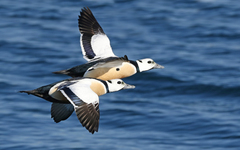
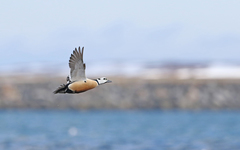
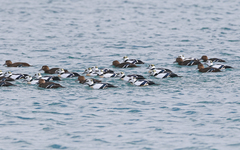
Steller's eider (Polysticta stelleri) is a migratory Arctic sea duck that breeds along the coastlines of Russia and Alaska, as well as in the Baltic Sea. It is the smallest, and fastest flying of the duck species known as eiders; it is closely related to the other species of eider in the genus Somateria, but sufficiently distinct to be given separate recognition as the only member of the genus Polysticta.

Due to the extensive contraction of its breeding range, the Alaska-breeding population of Steller's eider was listed as vulnerable in 1997 by the International Union for the Conservation of Nature (IUCN). The species is protected in Estonia, Finland, Norway, Russia and the United States, and is the subject of an ongoing recovery plan by the European Union and U.S. Fish and Wildlife Service.

Steller's eider was formally described and illustrated in 1769 by the German naturalist Peter Simon Pallas from a specimen collected on the Kamchatka Peninsula in Eastern Russia. He coined the binomial name Anas stelleri; the specific epithet was chosen to honour the German naturalist and explorer Georg Wilhelm Steller. Steller's eider is now the only species placed in the genus Polysticta... Wikipedia →

Sounds

Wing noise0:10

United States · 2014

© Andrew Spencer · XC203480 · CC BY-NC-SA 4.0

Call0:28

Russian Federation · 2018

© Ukolov Ilya · XC424292 · CC BY-NC-SA 4.0

Global Distribution

Parks Where Found

# Park Country Daily sighting probability
1 Wadden Sea National Park 🇩🇪 Germany
<5%

More parks will be added in future updates.

Cities Where Found

# City Country Daily sighting probability
1 Helsinki 🇫🇮 Finland
<5%

Zoos & Centres Where Found

# Zoo / Centre Country
1 Alaska SeaLife Center 🇺🇸 United States In captivity

Before you go

What are the chances of seeing a Steller's Eider in Wadden Sea National Park?

Rare

Under 5% of wildlife watchers report a Steller's Eider sighting in Wadden Sea National Park on a given day, based on 30 verified sightings from GBIF citizen-science data from 2019 to 2026. It is the 236th most-seen of the 285 birds we can rate there. Over three days the chance rises to under 5%, if each day is a fresh chance.

When is the best time to see a Steller's Eider in Wadden Sea National Park?

Any time of year

In every month with enough records, under 5% of wildlife watchers report a Steller's Eider in Wadden Sea National Park on a given day, so our monthly data shows no clear season.

What time of day is best to see a Steller's Eider?

Between 10 am and 1 pm

Across all the parks we cover, that three-hour window holds the most Steller's Eider sightings with a recorded time, and about 8 in 10 of them come between 6 am and 6 pm: it is a daytime animal.

Where else can you see a Steller's Eider?

Only Wadden Sea National Park, in our data

Wadden Sea National Park is the only park on Wallace's Line with enough records to rate Steller's Eider sightings: under 5% of wildlife watchers there report one on a given day.

Which relatives of the Steller's Eider live in Wadden Sea National Park?

Same family: Anatidae

The closest relatives of the Steller's Eider that you can see in Wadden Sea National Park (family Anatidae, Ducks, Geese, and Swans) are Mallard (about 60%), Greylag Goose (about 60%) and Common Shelduck (about 60%), with each one's daily chance of a sighting.

Where does the Steller's Eider sighting chance come from?

GBIF citizen-science records

It is estimated from how often the Steller's Eider is recorded against all the birds logged in Wadden Sea National Park (30 verified sightings from 2019 to 2026), calibrated against known sighting rates. Figures are rounded to the nearest 10% because citizen-science data supports honest approximations, not decimals, and months with records from fewer than five people show "—". How it works.

← Back to Wadden Sea National Park