Monteiro's Hornbill

Monteiro's Hornbill

Tockus monteiri

Silhouette: Andy Wilson · PhyloPic

LCLeast ConcernNTVUENCR
Daily sighting probability ~10% · With luck
at Waterberg Plateau Park

In 3 days ~30% in a week ~50%

24 Verified sightings at Waterberg Plateau Park From 2019 to 2026
100 In all 2 parks
January Best month
☀️ Diurnal When it's spotted

About the Monteiro's Hornbill

Monteiro's hornbill (Tockus monteiri) is a species of hornbill that is native to the dry woodlands of southwestern Africa. It is a common, near-endemic species in Namibia, with a total population estimated at 340,000 individuals.

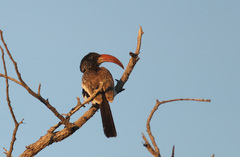
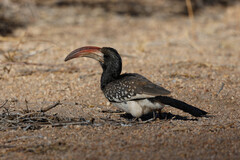
It is a medium-sized bird, 54–58 cm (21–23 in) in length. With a body mass of 210 to 400 g (7.4 to 14.1 oz), it appears to be the largest hornbill of the relatively diminutive Tockus genus. The species is characterized by a white belly, black back, with white spots on the wings and white secondary flight feathers. The outer feathers of the long tail are also white. Females are smaller than males and can be recognized by their turquoise facial skin. The eyes are black and the beak is red.

Its habitat is the savannah and dry thornveldt of northwestern Namibia and southwestern Angola. Unlike other hornbills, which are omnivorous, the Monteiro's hornbill feeds exclusively on insects and other small arthropods. In springtime, Monteiro's hornbills migrate to the southern Windhoek region to nest. They are adapted to the arid environment, and drinking is not a vital necessity for them. They breed at the end of... Wikipedia →

Sounds

Call0:10

Namibia · 2023

© Bram Vogels · XC892938 · CC BY-NC-SA 4.0

Song0:51

Namibia · 2016

© Peter Boesman · XC347106 · CC BY-NC-ND 4.0

Global Distribution

Parks Where Found

# Park Country Daily sighting probability
1 Waterberg Plateau Park 🇳🇦 Namibia
~10%
2 Etosha National Park 🇳🇦 Namibia
<5%

Before you go

What are the chances of seeing a Monteiro's Hornbill in Waterberg Plateau Park?

With luck

About 10% of wildlife watchers report a Monteiro's Hornbill sighting in Waterberg Plateau Park on a given day, based on 24 verified sightings from GBIF citizen-science data from 2019 to 2026. It is the 77th most-seen of the 118 birds we can rate there. Over three days the chance rises to about 30%, and over a week to about 50%, if each day is a fresh chance.

When is the best time to see a Monteiro's Hornbill in Waterberg Plateau Park?

January and November

In those months about 20% of wildlife watchers report a Monteiro's Hornbill in Waterberg Plateau Park on a given day, against under 5% in September, the lowest month. Those are among Waterberg Plateau Park's wettest months, with about 70 mm of rain a month against almost none in May. April and June have too few records to rate.

What time of day is best to see a Monteiro's Hornbill?

Between 7 and 10 am

Across all the parks we cover, that three-hour window holds the most Monteiro's Hornbill sightings with a recorded time, and about 8 in 10 of them come between 6 am and 6 pm: it is a daytime animal.

Is Waterberg Plateau Park the best place to see a Monteiro's Hornbill?

Yes

Of the 2 parks where we can rate Monteiro's Hornbill sightings, Waterberg Plateau Park has the highest daily chance: about 10%. Next come Etosha National Park (Namibia, under 5%).

Where does the Monteiro's Hornbill sighting chance come from?

GBIF citizen-science records

It is estimated from how often the Monteiro's Hornbill is recorded against all the birds logged in Waterberg Plateau Park (24 verified sightings from 2019 to 2026), calibrated against known sighting rates. Figures are rounded to the nearest 10% because citizen-science data supports honest approximations, not decimals, and months with records from fewer than five people show "—". How it works.

← Back to Waterberg Plateau Park