Ruben's Sand Lizard

Ruben's Sand Lizard

Pedioplanis rubens

Silhouette: Gustav Mützel · PhyloPic

LCLeast ConcernNTVUENCR Endemic
Daily sighting probability ~60% · Likely
at Waterberg Plateau Park

In 3 days ~90% in a week >90%

22 Verified sightings at Waterberg Plateau Park From 2019 to 2026
22 In 1 park
October Best month
☀️ Diurnal When it's spotted

About the Ruben's Sand Lizard

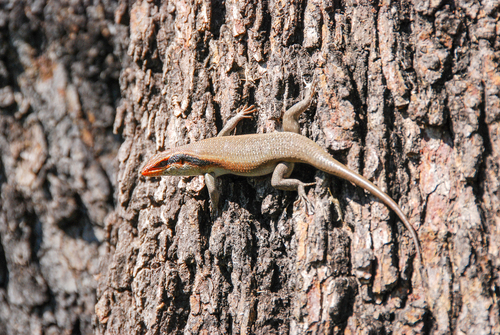
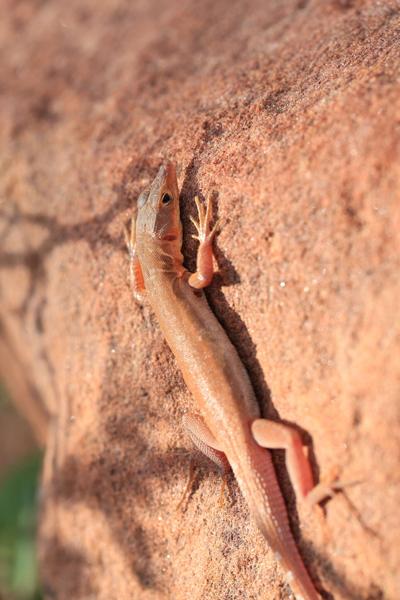
Pedioplanis rubens, called commonly the Waterberg sand lizard, reddish sand lizard, and (misleadingly) Ruben's sand lizard, is a species of lizard in the family Lacertidae. The species is endemic to Namibia. The specific name, rubens, which means "tinged with red" in Latin, is not in honor of any person named Ruben, but rather refers to the brick red color of the tail.

P. rubens is found atop the northern portion of the Waterberg Plateau in Namibia. The natural habitat of P. rubens is mopane savanna with red sandstone. P. rubens may attain a snout-to-vent length (SVL) of 5 cm (2.0 in). The tail is long, slightly more than twice SVL. Dorsally, the head and body are brown, and the tail is bright brick red. Ventrally, it is lighter-colored.

P. rubens is oviparous. Makokha JS, Bauer AM, Mayer W, Matthee CA (2007). "Nuclear and mtDNA-based phylogeny of southern African sand lizards, Pedioplanis (Sauria: Lacertidae)". Molecular Phylogenetics and Evolution 44 (2): 622–633. (Pedioplanis rubens, new status).

Mayer W (1989). "Comments on SZCZERBAK's (1975) catalogue... Wikipedia →
Global Distribution

Parks Where Found

# Park Country Daily sighting probability
1 Waterberg Plateau Park 🇳🇦 Namibia
~60%

More parks will be added in future updates.

Before you go

What are the chances of seeing a Ruben's Sand Lizard in Waterberg Plateau Park?

Likely

About 60% of wildlife watchers report a Ruben's Sand Lizard sighting in Waterberg Plateau Park on a given day, based on 22 verified sightings from GBIF citizen-science data from 2019 to 2026. It is the 2nd most-seen of the 7 reptiles we can rate there. Over three days the chance rises to about 90%, and over a week to over 90%, if each day is a fresh chance.

When is the best time to see a Ruben's Sand Lizard in Waterberg Plateau Park?

October to January

In those months about 70% of wildlife watchers report a Ruben's Sand Lizard in Waterberg Plateau Park on a given day, against about 10% in August, the lowest month. Those are among Waterberg Plateau Park's wettest months, with about 50 mm of rain a month against almost none in May.

What time of day is best to see a Ruben's Sand Lizard?

Between 8 and 11 am

Across all the parks we cover, that three-hour window holds the most Ruben's Sand Lizard sightings with a recorded time, and about 9 in 10 of them come between 6 am and 6 pm: it is a daytime animal.

Where else can you see a Ruben's Sand Lizard?

Only Waterberg Plateau Park, in our data

Waterberg Plateau Park is the only park on Wallace's Line with enough records to rate Ruben's Sand Lizard sightings: about 60% of wildlife watchers there report one on a given day.

Where does the Ruben's Sand Lizard sighting chance come from?

GBIF citizen-science records

It is estimated from how often the Ruben's Sand Lizard is recorded against all the reptiles logged in Waterberg Plateau Park (22 verified sightings from 2019 to 2026), calibrated against known sighting rates. Figures are rounded to the nearest 10% because citizen-science data supports honest approximations, not decimals, and months with records from fewer than five people show "—". How it works.

← Back to Waterberg Plateau Park