Black Harrier

Black Harrier

Circus maurus

Silhouette: Shyamal · PhyloPic

LCNTVUENEndangeredCR
Daily sighting probability ~60% · Likely
at West Coast National Park

In 3 days ~90% in a week >90%

802 Verified sightings at West Coast National Park From 2019 to 2026
915 In all 3 parks
October Best month
☀️ Diurnal When it's spotted

About the Black Harrier

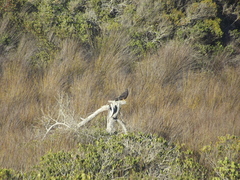
The black harrier (Circus maurus) is a medium-sized African harrier whose range extends from South Africa to Botswana and Namibia. It has a wingspan of 105–115 cm (41–45 in) and a body length of 44–50 cm (17–20 in). When perched, this bird appears all black. However, in flight, a white rump and flight feathers becomes visible. Its morphology is comparable to that of other harriers, with narrow wings, a slim body, and a long tail. Male and female plumages are similar, while juveniles have buff underparts and heavily spotted breasts.

In South Africa, the distribution of the black harrier is distinctly polarised in both the Western and Southern coastal plains. Nests are concentrated either along the coastal strip or inland in a more montane habitat. Nests are generally absent from transformed and cultivated lands. There is, however, some evidence from sightings and prey remains that the black harriers do forage in these environments even if they do not breed there.

Black harriers are migratory birds and their annual movements cover the southern half of the land surface of South Africa (including Lesotho) however, there is great individual variability. The... Wikipedia →

Sounds

Flight call0:23

South Africa · 2022

© Murray Christian · XC723680 · CC BY-NC-SA 4.0

Flight call0:29

South Africa · 2004

© Keith Blomerley · XC202625 · CC BY-NC-SA 4.0

Recording0:09

South Africa · 2025

© Sally Adam · iNaturalist · CC BY-NC 4.0

Global Distribution

Parks Where Found

# Park Country Daily sighting probability
1 West Coast National Park 🇿🇦 South Africa
~60%
2 De Hoop Nature Reserve 🇿🇦 South Africa
~20%
3 Addo Elephant National Park 🇿🇦 South Africa
<5%

Before you go

What are the chances of seeing a Black Harrier in West Coast National Park?

Likely

About 60% of wildlife watchers report a Black Harrier sighting in West Coast National Park on a given day, based on 802 verified sightings from GBIF citizen-science data from 2019 to 2026. It is the 30th most-seen of the 192 birds we can rate there. Over three days the chance rises to about 90%, and over a week to over 90%, if each day is a fresh chance.

When is the best time to see a Black Harrier in West Coast National Park?

October

In that month about 70% of wildlife watchers report a Black Harrier in West Coast National Park on a given day, against about 30% in May and June, the lowest months. That is one of West Coast National Park's driest months, with about 15 mm of rain against 70 mm in June.

What time of day is best to see a Black Harrier?

Between 8 and 11 am

Across all the parks we cover, that three-hour window holds the most Black Harrier sightings with a recorded time, and about 9 in 10 of them come between 6 am and 6 pm: it is a daytime animal.

Is West Coast National Park the best place to see a Black Harrier?

Yes

Of the 3 parks where we can rate Black Harrier sightings, West Coast National Park has the highest daily chance: about 60%. Next come De Hoop Nature Reserve (South Africa, about 20%) and Addo Elephant National Park (South Africa, under 5%).

Where does the Black Harrier sighting chance come from?

GBIF citizen-science records

It is estimated from how often the Black Harrier is recorded against all the birds logged in West Coast National Park (802 verified sightings from 2019 to 2026), calibrated against known sighting rates. Figures are rounded to the nearest 10% because citizen-science data supports honest approximations, not decimals, and months with records from fewer than five people show "—". How it works.

← Back to West Coast National Park