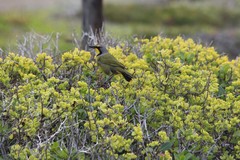
Bokmakierie

Bokmakierie

Telophorus zeylonus

Silhouette: Sheatherius · PhyloPic

LCLeast ConcernNTVUENCR
Daily sighting probability ~70% · Very likely
at West Coast National Park

In 3 days >90%

1,139 Verified sightings at West Coast National Park From 2019 to 2026
2,854 In all 9 parks
July Best month
☀️ Diurnal When it's spotted

About the Bokmakierie

The bokmakierie (Telophorus zeylonus) is a bushshrike. This family of passerine birds is closely related to the true shrikes in the family Laniidae, and was once included in that group. This species is endemic to southern Africa, mainly in South Africa and Namibia, with an isolated population in the mountains of eastern Zimbabwe and western Mozambique.

It is a species of open habitats, including karoo scrub, fynbos and parks and gardens in urban areas. The bulky cup nest is constructed in a hedge, scrub or tree fork. The 2–6, usually three, red-brown or lilac-blotched greenish-blue eggs are incubated by both sexes for about 16 days to hatching, with another 18 days to fledging.

The adult bokmakierie is a 22–23 cm long bird with olive-green upperparts and a conspicuous bright yellow tip to the black tail. The head is grey with a yellow supercilium, and the strong bill has a hooked upper mandible. The underparts are bright yellow with a broad black collar between the throat and breast, which continues up the neck sides through the eye to the bill. The legs and feet are blue-grey. The sexes are similar, but juveniles are a dull grey-green below, and lack the black gorget.

There are four subspecies, differing mainly in colour shade and size. Although the species as a whole is not threatened, the isolated dark subspecies restrictus in the Chimanimani Mountains numbers only about 400 birds. The bokmakierie has a range of loud whistles and calls, often given by a pair in antiphonal duet, but the most typical is the one that gives this species its name, bok-bok-mak-kik. Levaillant called it bacbakiri based on the local name derived from its call. The Dutch settlers called it bokmakierie.

Unlike the true shrikes, which perch conspicuously in the open, the bokmakierie is shy and skulking. This bird has a typical shrike diet of insects, small lizards, snakes, small birds and frogs. It is preyed upon itself by snakes, mongooses, and large shrikes like the northern fiscal and southern boubou. Wikipedia →

Sounds

Song0:23

South Africa · 2026

© JJSUN · XC1079088 · CC BY-NC-SA 4.0

Call0:14

South Africa · 2024

© Dawie de Swardt · XC915413 · CC BY-NC-SA 4.0

Duet0:05

South Africa · 2022

© Tim Cockcroft · XC714077 · CC BY-NC-SA 4.0

Global Distribution

Parks Where Found

# Park Country Daily sighting probability
1 West Coast National Park 🇿🇦 South Africa
~70%
2 De Hoop Nature Reserve 🇿🇦 South Africa
~70%
3 Addo Elephant National Park 🇿🇦 South Africa
~50%
4 Golden Gate Highlands National Park 🇿🇦 South Africa
~50%
5 Namib-Naukluft National Park 🇳🇦 Namibia
~10%
6 Table Mountain National Park 🇿🇦 South Africa
~10%
7 Hluhluwe-Imfolozi Park 🇿🇦 South Africa
<5%
8 Garden Route National Park 🇿🇦 South Africa
<5%
9 Kruger National Park 🇿🇦 South Africa
<5%

Cities Where Found

# City Country Daily sighting probability
1 Cape Town 🇿🇦 South Africa
<5%
2 Johannesburg 🇿🇦 South Africa
<5%
3 Pretoria 🇿🇦 South Africa
<5%

Before you go

What are the chances of seeing a Bokmakierie in West Coast National Park?

Very likely

About 70% of wildlife watchers report a Bokmakierie sighting in West Coast National Park on a given day, based on 1,139 verified sightings from GBIF citizen-science data from 2019 to 2026. It is the 10th most-seen of the 192 birds we can rate there. Over three days the chance rises to over 90%, if each day is a fresh chance.

When is the best time to see a Bokmakierie in West Coast National Park?

May–July and October

In those months about 80% of wildlife watchers report a Bokmakierie in West Coast National Park on a given day, against about 50% in January, the lowest month. Those are among West Coast National Park's wettest months, with about 45 mm of rain a month against 5 mm in February.

What time of day is best to see a Bokmakierie?

Between 8 and 11 am

Across all the parks we cover, that three-hour window holds the most Bokmakierie sightings with a recorded time, and nearly all of them come between 6 am and 6 pm: it is a daytime animal.

Where does the Bokmakierie sighting chance come from?

GBIF citizen-science records

It is estimated from how often the Bokmakierie is recorded against all the birds logged in West Coast National Park (1,139 verified sightings from 2019 to 2026), calibrated against known sighting rates. Figures are rounded to the nearest 10% because citizen-science data supports honest approximations, not decimals, and months with records from fewer than five people show "—". How it works.

← Back to West Coast National Park