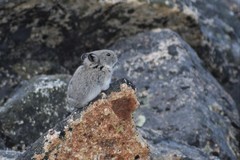
Collared Pika

Collared Pika

Ochotona collaris

Silhouette: Margot Michaud · PhyloPic

LCLeast ConcernNTVUENCR
Daily sighting probability ~30% · Possible
at Wrangell-St. Elias National Park

In 3 days ~70% in a week ~90%

6 Verified sightings at Wrangell-St. Elias National Park From 2019 to 2026
73 In all 2 parks
July Best month
☀️ Diurnal When it's spotted

About the Collared Pika

The collared pika (Ochotona collaris) is a species of mammal in the pika family, Ochotonidae, and part of the order Lagomorpha, which comprises rabbits, hares, and pikas. It is a small (about 160 g (5.6 oz)) alpine lagomorph that lives in boulder fields of central and southern Alaska (U.S.), and in parts of Canada, including northern British Columbia, Yukon, and western parts of the Northwest Territories. It is closely related to the American pika (O. princeps), but it is a monotypic form containing no recognized subspecies. The name comes from distinctive patches of grayish fur on its nape and shoulders that form a "collar." It is asocial, does not hibernate, and spends a large part of its time in the summer collecting vegetation that is stored under rocks ("haypiles") as a supply of food for the winter. Some individuals have been observed collecting and consuming dead birds as sources of fat and protein. Thousands of trips are made during July and August to collect vegetation for winter.

In 1973, within the Pleistocene deposits in central Alaska, preserved specimens of collared pika were found along with some dung pellets; the Yukon territory also contained some... Wikipedia →

Sounds

Recording0:09

United States · 2022

© caiawatha · iNaturalist · CC BY-NC 4.0

Recording0:11

Canada · 2022

© Tracy · iNaturalist · CC BY-NC 4.0

Global Distribution

Parks Where Found

# Park Country Daily sighting probability
1 Denali National Park 🇺🇸 United States
~40%
2 Wrangell-St. Elias National Park 🇺🇸 United States
~30%

Before you go

What are the chances of seeing a Collared Pika in Wrangell-St. Elias National Park?

Possible

About 30% of wildlife watchers report a Collared Pika sighting in Wrangell-St. Elias National Park on a given day, based on 6 verified sightings from GBIF citizen-science data from 2019 to 2026. It is the 7th most-seen of the 9 mammals we can rate there. Over three days the chance rises to about 70%, and over a week to about 90%, if each day is a fresh chance.

When is the best time to see a Collared Pika in Wrangell-St. Elias National Park?

July

In that month about 40% of wildlife watchers report a Collared Pika in Wrangell-St. Elias National Park on a given day, against under 5% in May and June, the lowest months. October to March have too few records to rate.

What time of day is best to see a Collared Pika?

Between 11 am and 2 pm

Across all the parks we cover, that three-hour window holds the most Collared Pika sightings with a recorded time, and about 8 in 10 of them come between 6 am and 6 pm: it is a daytime animal.

Is Wrangell-St. Elias National Park the best place to see a Collared Pika?

2nd of 2

Of the 2 parks where we can rate Collared Pika sightings, Wrangell-St. Elias National Park ranks 2nd at about 30%. The best odds are in Denali National Park (United States, about 40%).

Where does the Collared Pika sighting chance come from?

GBIF citizen-science records

It is estimated from how often the Collared Pika is recorded against all the mammals logged in Wrangell-St. Elias National Park (6 verified sightings from 2019 to 2026), calibrated against known sighting rates. Figures are rounded to the nearest 10% because citizen-science data supports honest approximations, not decimals, and months with records from fewer than five people show "—". How it works.

← Back to Wrangell-St. Elias National Park