
Cocha Antshrike

Cocha Antshrike

Thamnophilus praecox

Silhouette: Sheatherius · PhyloPic

LCNTNear ThreatenedVUENCR
Daily sighting probability <5% · Rare
at Yasuní National Park

In 3 days <5%

30 Verified sightings at Yasuní National Park From 2019 to 2026
30 In 1 park
January Best month
☀️ Diurnal When it's spotted

About the Cocha Antshrike

The cocha antshrike (Thamnophilus praecox) is a Near Threatened species of bird in subfamily Thamnophilinae of family Thamnophilidae, the "typical antbirds". It is found in Colombia, Ecuador, and Peru. The cocha antshrike is monotypic. It and the black antshrike (T. nigriceps) are sister species.

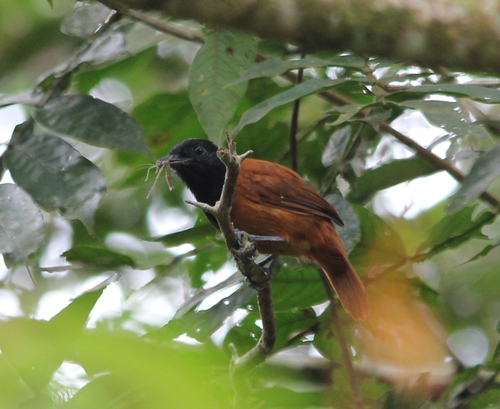
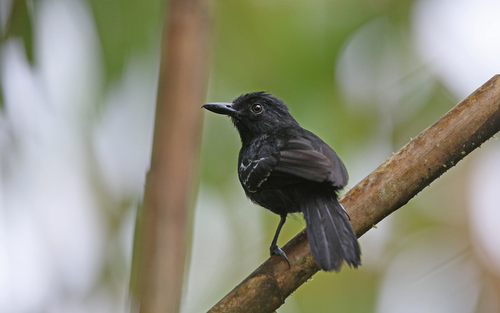
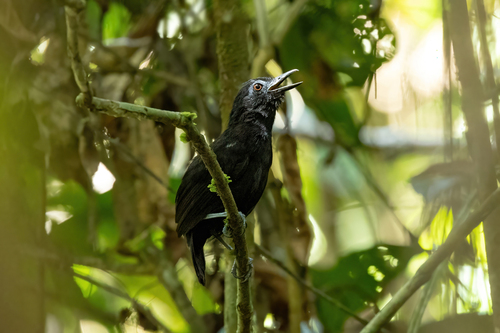
The cocha antshrike is about 16 cm (6.3 in) long. Members of genus Thamnophilus are largish members of the antbird family; all have stout bills with a hook like those of true shrikes. This species exhibits sexual dimorphism. Adult males are entirely black except that their underwing coverts are white, a feature that is seldom visible in the field. Adult females have a black head, throat, and upper breast. Some individuals have faint white streaks on their throat. The rest of their body, their wings, and their tail are cinnamon-rufous; their underparts are slightly paler than their back.

The cocha antshrike was long thought to be endemic to northeastern Ecuador, where it occurs locally along the Rio Napo and its tributaries. The International Ornithological Committee lists it that way. However, by 2021 the South... Wikipedia →

Sounds

Song0:31

Ecuador · 2023

© Barry Edmonston · XC817537 · CC BY-NC-SA 4.0

Duet1:01

Ecuador · 1995

© Patricio Mena Valenzuela · XC528982 · CC BY-NC-SA 4.0

Call0:13

Ecuador · 1991

© Robert S. Ridgely · XC275018 · CC BY-NC-SA 4.0

Global Distribution

Parks Where Found

# Park Country Daily sighting probability
1 Yasuní National Park 🇪🇨 Ecuador
<5%

More parks will be added in future updates.

Before you go

What are the chances of seeing a Cocha Antshrike in Yasuní National Park?

Rare

Under 5% of wildlife watchers report a Cocha Antshrike sighting in Yasuní National Park on a given day, based on 30 verified sightings from GBIF citizen-science data from 2019 to 2026. It is the 474th most-seen of the 533 birds we can rate there. Over three days the chance rises to under 5%, if each day is a fresh chance.

When is the best time to see a Cocha Antshrike in Yasuní National Park?

Any time of year

In every month with enough records, under 5% of wildlife watchers report a Cocha Antshrike in Yasuní National Park on a given day, so our monthly data shows no clear season.

What time of day is best to see a Cocha Antshrike?

Between 7 and 10 am

Across all the parks we cover, that three-hour window holds the most Cocha Antshrike sightings with a recorded time, and about 9 in 10 of them come between 6 am and 6 pm: it is a daytime animal.

Where else can you see a Cocha Antshrike?

Only Yasuní National Park, in our data

Yasuní National Park is the only park on Wallace's Line with enough records to rate Cocha Antshrike sightings: under 5% of wildlife watchers there report one on a given day.

Which relatives of the Cocha Antshrike live in Yasuní National Park?

Same genus: Thamnophilus

The closest relatives of the Cocha Antshrike that you can see in Yasuní National Park (genus Thamnophilus, Typical Antshrikes) are Mouse-colored Antshrike (about 20%) and Plain-winged Antshrike (about 10%), with each one's daily chance of a sighting.

Where does the Cocha Antshrike sighting chance come from?

GBIF citizen-science records

It is estimated from how often the Cocha Antshrike is recorded against all the birds logged in Yasuní National Park (30 verified sightings from 2019 to 2026), calibrated against known sighting rates. Figures are rounded to the nearest 10% because citizen-science data supports honest approximations, not decimals, and months with records from fewer than five people show "—". How it works.

← Back to Yasuní National Park