Short-billed Honeycreeper

Short-billed Honeycreeper

Cyanerpes nitidus

Silhouette: Sheatherius · PhyloPic

LCLeast ConcernNTVUENCR
Daily sighting probability <5% · Rare
at Yasuní National Park

In 3 days <5%

13 Verified sightings at Yasuní National Park From 2019 to 2026
13 In 1 park
December Best month
☀️ Diurnal When it's spotted

About the Short-billed Honeycreeper

The short-billed honeycreeper (Cyanerpes nitidus) is a species of bird in the family Thraupidae, the tanagers and allies. It is found in Bolivia, Brazil, Colombia, Ecuador, Guyana, Peru, Suriname, and Venezuela. The short-billed honeycreeper was formally described in 1847 with the binomial Coereba nitida, as a member of a genus now occupied solely by the bananaquit (C. flaveola). It now shares genus Cyanerpes with three other species. It is monotypic.

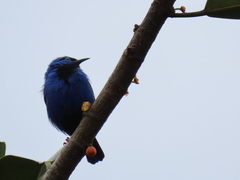
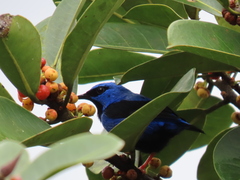
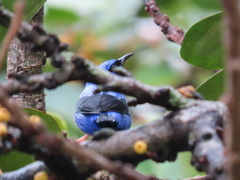
The short-billed honeycreeper is 9 cm (3.5 in) to 10.5 cm (4.1 in) long. It weighs about 9 g (0.32 oz). It is the smallest member of its genus and has a somewhat shorter and less decurved bill than the others. The species is sexually dimorphic. Adult males are mostly purplish blue. They have a small black mask from the lores to just past the eye, a black throat and upper breast, black upperwing coverts, and a short black tail. Adult females have a mostly bright green head and a bright green nape and upperparts. They have dusky lores, a turquoise-green supercilium, and a turquoise-green malar stripe. Their upperwing coverts are bright green and their flight feathers brownish black with wide... Wikipedia →

Sounds

Call0:08

Ecuador · 2024

© Manuel Sánchez-Nivicela · XC1157866 · CC BY-NC-ND 4.0

Call0:31

Peru · 2001

© Daniel F. Lane · XC257131 · CC BY-NC-SA 4.0

Call0:24

Brazil · 2009

© Andrew Spencer · XC38583 · CC BY-NC-ND 2.5

Global Distribution

Parks Where Found

# Park Country Daily sighting probability
1 Yasuní National Park 🇪🇨 Ecuador
<5%

More parks will be added in future updates.

Before you go

What are the chances of seeing a Short-billed Honeycreeper in Yasuní National Park?

Rare

Under 5% of wildlife watchers report a Short-billed Honeycreeper sighting in Yasuní National Park on a given day, based on 13 verified sightings from GBIF citizen-science data from 2019 to 2026. It is the 486th most-seen of the 533 birds we can rate there. Over three days the chance rises to under 5%, if each day is a fresh chance.

When is the best time to see a Short-billed Honeycreeper in Yasuní National Park?

Any time of year

In every month with enough records, under 5% of wildlife watchers report a Short-billed Honeycreeper in Yasuní National Park on a given day, so our monthly data shows no clear season.

What time of day is best to see a Short-billed Honeycreeper?

Between 6 and 9 am

Across all the parks we cover, that three-hour window holds the most Short-billed Honeycreeper sightings with a recorded time, and about 8 in 10 of them come between 6 am and 6 pm: it is a daytime animal.

Where else can you see a Short-billed Honeycreeper?

Only Yasuní National Park, in our data

Yasuní National Park is the only park on Wallace's Line with enough records to rate Short-billed Honeycreeper sightings: under 5% of wildlife watchers there report one on a given day.

Where does the Short-billed Honeycreeper sighting chance come from?

GBIF citizen-science records

It is estimated from how often the Short-billed Honeycreeper is recorded against all the birds logged in Yasuní National Park (13 verified sightings from 2019 to 2026), calibrated against known sighting rates. Figures are rounded to the nearest 10% because citizen-science data supports honest approximations, not decimals, and months with records from fewer than five people show "—". How it works.

← Back to Yasuní National Park