Boreal Owl

Boreal Owl

Aegolius funereus

Silhouette: Ferran Sayol · PhyloPic

LCLeast ConcernNTVUENCR
Daily sighting probability <5% · Rare
at Yellowstone National Park

In 3 days <5%

5 Verified sightings at Yellowstone National Park From 2019 to 2026
79 In all 4 parks
December Best month
☀️🌙 Day & Night When it's spotted

About the Boreal Owl

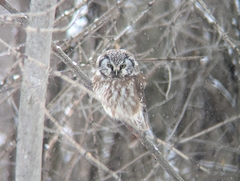
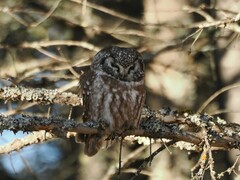
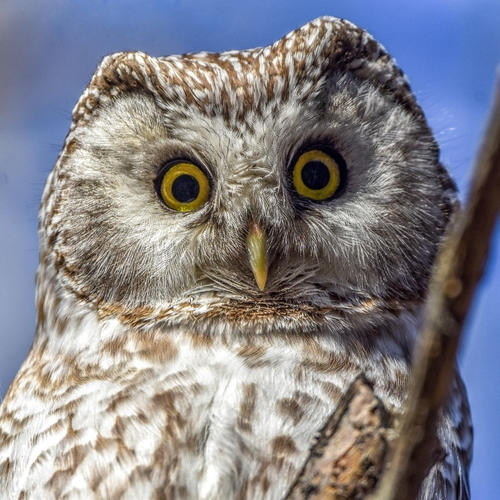
The boreal owl or Tengmalm's owl (Aegolius funereus) is a small owl in the "true owl" family Strigidae. It is known as the boreal owl or, more rarely, Richardson's owl after Sir John Richardson, in North America, and as Tengmalm's owl in Europe and Asia, after the Swedish naturalist Peter Gustaf Tengmalm.

Due to its nocturnal habits and preferred inaccessible taiga forest habitat, it is rarely seen by humans; when met with, it is often extremely confident, showing little or no fear of people, only flying off if approached to within 3–5 metres.

The boreal owl was formally described by the Swedish naturalist Carl Linnaeus in 1758 in the tenth edition of his Systema Naturae. Linnaeus placed it with all the other owls in the genus Strix and coined the binomial name Strix funerea.

Currently, seven subspecies are accepted, though there is no genetic basis for more than two subspecies, one (A. f. funereus, Tengmalm's owl) in the Old World, and one... Wikipedia →
Sounds

Song0:32

Sweden · 2026

© Johan Lundgren · XC1145038 · CC BY-NC-SA 4.0

Flight call0:07

Sweden · 2025

© Lars Edenius · XC1044997 · CC BY-NC-SA 4.0

Begging call0:34

Poland · 2022

© maciej sobieraj · XC728530 · CC BY-NC-SA 4.0

Global Distribution

Parks Where Found

# Park Country Daily sighting probability
1 Triglav National Park 🇸🇮 Slovenia
<5%
2 Pyrénées National Park 🇫🇷 France
<5%
3 Rocky Mountain National Park 🇺🇸 United States
<5%
4 Yellowstone National Park 🇺🇸 United States
<5%

Cities Where Found

# City Country Daily sighting probability
1 Novosibirsk 🇷🇺 Russia
~10%
2 Moscow 🇷🇺 Russia
<5%
3 Helsinki 🇫🇮 Finland
<5%
4 Calgary 🇨🇦 Canada
<5%

Zoos & Centres Where Found

# Zoo / Centre Country
1 Lusen National Park Centre 🇩🇪 Germany In captivity
2 Карельский зоопарк 🇷🇺 Russia In captivity
3 Birds of prey 🇨🇦 Canada In captivity
4 Asahiyama Zoo 🇯🇵 Japan In captivity
5 Tierpark Hexentanzplatz 🇩🇪 Germany In captivity
6 Zoologischer Garten Halle 🇩🇪 Germany In captivity
7 Zoopark Limpopo 🇷🇺 Russia In captivity
8 Small Breeds Farm Park 🇬🇧 United Kingdom In captivity
9 Chouette à voir! 🇨🇦 Canada In captivity
10 Karelian Zoo 🇷🇺 Russia In captivity

Before you go

What are the chances of seeing a Boreal Owl in Yellowstone National Park?

Rare

Under 5% of wildlife watchers report a Boreal Owl sighting in Yellowstone National Park on a given day, based on 5 verified sightings from GBIF citizen-science data from 2019 to 2026. It is the 192nd most-seen of the 197 birds we can rate there. Over three days the chance rises to under 5%, if each day is a fresh chance.

When is the best time to see a Boreal Owl in Yellowstone National Park?

December

In that month about 10% of wildlife watchers report a Boreal Owl in Yellowstone National Park on a given day, against under 5% in January to November, the lowest months.

What time of day is best to see a Boreal Owl?

Between 7 and 10 pm

Across all the parks we cover, that three-hour window holds the most Boreal Owl sightings with a recorded time, and about half of them come between 6 am and 6 pm: it is seen both by day and at night.

Is Yellowstone National Park the best place to see a Boreal Owl?

Among the best

Of the 4 parks where we can rate Boreal Owl sightings, Yellowstone National Park ranks 4th at under 5%, level with the leaders once rounded. The best odds are in Triglav National Park (Slovenia, under 5%), Pyrénées National Park (France, under 5%) and Rocky Mountain National Park (United States, under 5%).

Where does the Boreal Owl sighting chance come from?

GBIF citizen-science records

It is estimated from how often the Boreal Owl is recorded against all the birds logged in Yellowstone National Park (5 verified sightings from 2019 to 2026), calibrated against known sighting rates. Figures are rounded to the nearest 10% because citizen-science data supports honest approximations, not decimals, and months with records from fewer than five people show "—". How it works.

← Back to Yellowstone National Park