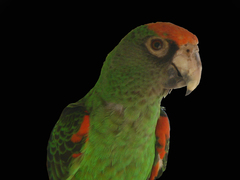
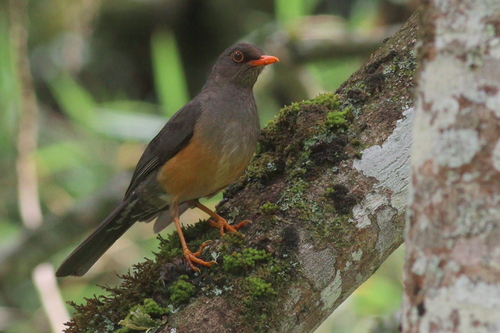
Red-fronted Parrot

Red-fronted Parrot

Poicephalus gulielmi

Silhouette: Sheatherius · PhyloPic

LCLeast ConcernNTVUENCR
Daily sighting probability ~30% · Possible
at Aberdare National Park

In 3 days ~60% in a week ~90%

108 Verified sightings at Aberdare National Park From 2019 to 2026
129 In all 4 parks
March Best month
☀️ Diurnal When it's spotted

About the Red-fronted Parrot

The red-fronted parrot (Poicephalus gulielmi), also known as Jardine's parrot, is a medium-sized mainly green parrot distributed across wide areas of Africa. It has three subspecies. The extent and shade of the red or orange plumage on its head, thighs, and bend of wings vary depending on the subspecies.

They are popular as pets, partly because of their ability to mimic speech and copy sounds. Trapping of wild birds for the pet trade is a potential threat to wild populations; however, they are protected by CITES (appendix II) making the trade, import and export of all wild-caught parrots illegal.

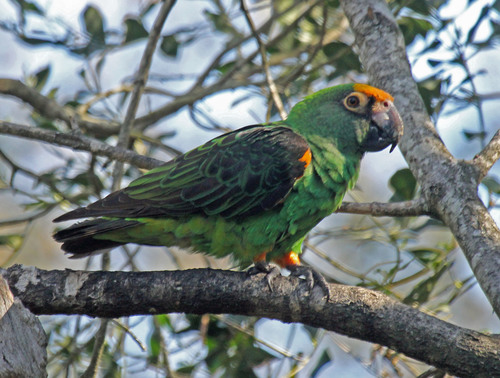
The red-fronted parrot is 28 cm (11 in) long. It is mostly green and has a short black squarish tail. Black feathers on the head, neck, back, and wings have lighter green edges giving a scalloped appearance. The lower mandible is dark grey and the upper mandible has a horn coloured base and a dark grey tip. The irises are red-orange, the eyerings are pinkish-grey, and the legs are grey-brown. The amount of red or orange on the forecrown, the bend of the wing, and thighs varies in the three subspecies but is absent in all young birds – juveniles having a dark smokey appearance... Wikipedia →
Sounds

Call0:28

Kenya · 2024

© Peter Boesman · XC948416 · CC BY-NC-ND 4.0

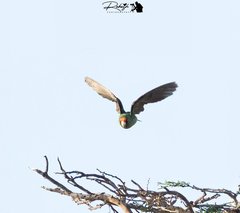
Flight call0:14

Tanzania · 2017

© Frank Lambert · XC430150 · CC BY-NC-ND 4.0

Call0:20

Ghana · 2023

© Alain Verneau · XC792361 · CC BY-NC-SA 4.0

Global Distribution

Parks Where Found

# Park Country Daily sighting probability
1 Aberdare National Park 🇰🇪 Kenya
~30%
2 Taï National Park 🇨🇮 Ivory Coast
~10%
3 Arusha National Park 🇹🇿 Tanzania
<5%
4 Tarangire National Park 🇹🇿 Tanzania
<5%

Zoos & Centres Where Found

# Zoo / Centre Country
1 Zoorasia 🇯🇵 Japan In captivity
2 Loro Parque 🇪🇸 Spain In captivity
3 Tier-Erlebnispark, Bell 🇩🇪 Germany In captivity
4 African Dawn Bird and Wildlife Sanctuary 🇿🇦 South Africa In captivity

Before you go

What are the chances of seeing a Red-fronted Parrot in Aberdare National Park?

Possible

About 30% of wildlife watchers report a Red-fronted Parrot sighting in Aberdare National Park on a given day, based on 108 verified sightings from GBIF citizen-science data from 2019 to 2026. It is the 39th most-seen of the 217 birds we can rate there. Over three days the chance rises to about 60%, and over a week to about 90%, if each day is a fresh chance.

When is the best time to see a Red-fronted Parrot in Aberdare National Park?

March

In that month about 60% of wildlife watchers report a Red-fronted Parrot in Aberdare National Park on a given day, against about 10% in February, June–July and September, the lowest months.

What time of day is best to see a Red-fronted Parrot?

Between 6 and 9 am

Across all the parks we cover, that three-hour window holds the most Red-fronted Parrot sightings with a recorded time, and about 8 in 10 of them come between 6 am and 6 pm: it is a daytime animal.

Is Aberdare National Park the best place to see a Red-fronted Parrot?

Yes

Of the 4 parks where we can rate Red-fronted Parrot sightings, Aberdare National Park has the highest daily chance: about 30%. Next come Taï National Park (Ivory Coast, about 10%) and Arusha National Park (Tanzania, under 5%).

Where does the Red-fronted Parrot sighting chance come from?

GBIF citizen-science records

It is estimated from how often the Red-fronted Parrot is recorded against all the birds logged in Aberdare National Park (108 verified sightings from 2019 to 2026), calibrated against known sighting rates. Figures are rounded to the nearest 10% because citizen-science data supports honest approximations, not decimals, and months with records from fewer than five people show "—". How it works.

← Back to Aberdare National Park