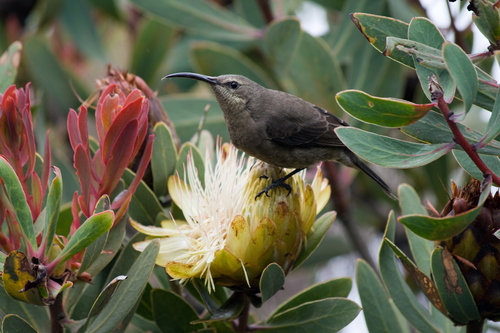

Red-tufted Sunbird

Red-tufted Sunbird

Nectarinia johnstoni

Silhouette: Sheatherius · PhyloPic

LCLeast ConcernNTVUENCR
Daily sighting probability ~10% · With luck
at Aberdare National Park

In 3 days ~20% in a week ~40%

33 Verified sightings at Aberdare National Park From 2019 to 2026
100 In all 3 parks
December Best month
☀️ Diurnal When it's spotted

About the Red-tufted Sunbird

The scarlet-tufted sunbird (Nectarinia johnstoni) is a species of bird in the Nectarinia of the family Nectariniidae. It is found in Democratic Republic of the Congo, Kenya, Malawi, Rwanda, Tanzania, Uganda, and Zambia. It is also known as the red-tufted sunbird and the scarlet-tufted malachite sunbird.

The scarlet-tufted sunbird is a large sunbird. Adult males have long tails, up to about 20 centimetres (7.9 in) in length, and scarlet pectoral tufts up to about 10 millimetres (0.39 in) wide. These tufts can be seen in flight and when the wings are rearranged, but not in perched birds. The head is black and the upper parts are metallic green, appearing almost black from a distance. The rump is bluish and the wings and tail black, the latter having elongated central feathers. The underparts are iridescent green, fading to bluish-violet on the upper belly and black on the lower belly. The female has brownish-grey upper parts, brownish-black wings and a dark brown tail. The underparts are whitish with dark mottling. The pectoral tufts are smaller than those of the male and may be rather more orangey-red. The juvenile is similar to the adult female but lacks the pectoral... Wikipedia →

Sounds

Call0:23

Tanzania · 2016

© David C. Moyer · XC336847 · CC BY-NC-SA 4.0

Call0:14

Uganda · 2023

© Brendan Sloan · XC840590 · CC BY-NC-ND 4.0

Call0:24

Uganda · 2005

© András Schmidt · XC702536 · CC BY-NC-SA 4.0

Global Distribution

Parks Where Found

# Park Country Daily sighting probability
1 Aberdare National Park 🇰🇪 Kenya
~10%
2 Virunga National Park 🇨🇩 Democratic Republic of the Congo
<5%
3 Volcanoes National Park 🇷🇼 Rwanda
<5%

Before you go

What are the chances of seeing a Red-tufted Sunbird in Aberdare National Park?

With luck

About 10% of wildlife watchers report a Red-tufted Sunbird sighting in Aberdare National Park on a given day, based on 33 verified sightings from GBIF citizen-science data from 2019 to 2026. It is the 100th most-seen of the 217 birds we can rate there. Over three days the chance rises to about 20%, and over a week to about 40%, if each day is a fresh chance.

When is the best time to see a Red-tufted Sunbird in Aberdare National Park?

April, October and December

In those months about 20% of wildlife watchers report a Red-tufted Sunbird in Aberdare National Park on a given day, against under 5% in January–February and June–September, the lowest months.

What time of day is best to see a Red-tufted Sunbird?

Between 9 am and noon

Across all the parks we cover, that three-hour window holds the most Red-tufted Sunbird sightings with a recorded time, and about 9 in 10 of them come between 6 am and 6 pm: it is a daytime animal.

Is Aberdare National Park the best place to see a Red-tufted Sunbird?

Yes

Of the 3 parks where we can rate Red-tufted Sunbird sightings, Aberdare National Park has the highest daily chance: about 10%. Next come Virunga National Park (Democratic Republic of the Congo, under 5%) and Volcanoes National Park (Rwanda, under 5%).

Which relatives of the Red-tufted Sunbird live in Aberdare National Park?

Same genus: Nectarinia

The closest relatives of the Red-tufted Sunbird that you can see in Aberdare National Park (genus Nectarinia, African Long-tailed Sunbirds) are Malachite Sunbird (about 30%), Tacazze Sunbird (about 20%) and Bronze Sunbird (about 20%), with each one's daily chance of a sighting.

Where does the Red-tufted Sunbird sighting chance come from?

GBIF citizen-science records

It is estimated from how often the Red-tufted Sunbird is recorded against all the birds logged in Aberdare National Park (33 verified sightings from 2019 to 2026), calibrated against known sighting rates. Figures are rounded to the nearest 10% because citizen-science data supports honest approximations, not decimals, and months with records from fewer than five people show "—". How it works.

← Back to Aberdare National Park