Maritime Earwig

Maritime Earwig

Anisolabis maritima

Daily sighting probability ~10% · With luck
at Acadia National Park

In 3 days ~20% in a week ~40%

15 Verified sightings at Acadia National Park From 2019 to 2026
29 In all 2 parks
July Best month
☀️🌙 Day & Night When it's spotted

About the Maritime Earwig

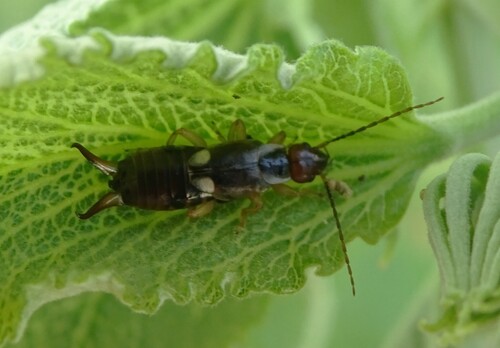
Anisolabis maritima, commonly known as the maritime earwig or the seaside earwig, is a species of earwig in the family Anisolabididae. Similar to the seashore earwig, this species can be found near the shore line, and is cosmopolitan. It can be found in almost all biogeographic realms. Scientists believe that these earwigs originally came from Asia. Since then, however, they have been introduced to North America, and have now spread around the world due to international commerce.

This earwig is approximately 2.5 to 3 cm (1.0–1.2 in) long, and is a grayish or blackish in color with light yellow legs. Unlike many other species of earwigs, it does not have any wings. Male maritime earwigs are known for their characteristically asymmetrical forceps, which they use for mating, for capturing prey, and for protecting themselves. These forceps have even been known to be strong enough to break human skin.

This species preys on many different small invertebrates, including fleas, crickets, ants, small beetles, sowbugs; it even exhibits cannibalistic tendencies. Because of their location on the beach, maritime earwigs are often found under seaweed and driftwood during the day. They prefer “dark, warm, humid places” to stay in.

In maritime earwigs in particular, evidence of filial cannibalism has been found. Filial cannibalism is the practice of a mother eating some of her offspring. Scientists believe that maritime earwigs practice this behavior in order to make their clutch maintain the size that best optimizes their investment. In this case, the mother will often eat the youngest child, which serves to shorten the total time she spends caring for the young. As she optimizes the childbearing process, the amount of energy she has to spend on her remaining children increases, as does their chance of survival. Wikipedia →
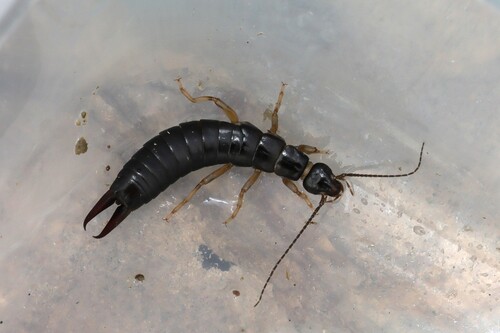
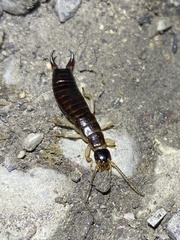
Global Distribution

Parks Where Found

# Park Country Daily sighting probability
1 Acadia National Park 🇺🇸 United States
~10%
2 Great Bear Rainforest 🇨🇦 Canada
~10%

Cities Where Found

# City Country Daily sighting probability
1 New York City 🇺🇸 United States
<5%
2 Seoul 🇰🇷 South Korea
<5%
3 Tokyo 🇯🇵 Japan
<5%
4 Baltimore 🇺🇸 United States
<5%
5 Vancouver 🇨🇦 Canada
<5%
6 Boston 🇺🇸 United States
<5%
7 Seattle 🇺🇸 United States
<5%
8 San Francisco 🇺🇸 United States
<5%
9 Los Angeles 🇺🇸 United States
<5%
10 Washington 🇺🇸 United States
<5%

Before you go

What are the chances of seeing a Maritime Earwig in Acadia National Park?

With luck

About 10% of wildlife watchers report a Maritime Earwig sighting in Acadia National Park on a given day, based on 15 verified sightings from GBIF citizen-science data from 2019 to 2026. It is the 164th most-seen of the 405 insects we can rate there. Over three days the chance rises to about 20%, and over a week to about 40%, if each day is a fresh chance.

When is the best time to see a Maritime Earwig in Acadia National Park?

May–August and October

In those months about 10% of wildlife watchers report a Maritime Earwig in Acadia National Park on a given day, against under 5% in September and November–April, the lowest months.

What time of day is best to see a Maritime Earwig?

Between 10 am and 1 pm

Across all the parks we cover, that three-hour window holds the most Maritime Earwig sightings with a recorded time, and about 7 in 10 of them come between 6 am and 6 pm: it is seen both by day and at night.

Is Acadia National Park the best place to see a Maritime Earwig?

Yes

Of the 2 parks where we can rate Maritime Earwig sightings, Acadia National Park has the highest daily chance: about 10%. Next come Great Bear Rainforest (Canada, about 10%).

Where does the Maritime Earwig sighting chance come from?

GBIF citizen-science records

It is estimated from how often the Maritime Earwig is recorded against all the insects logged in Acadia National Park (15 verified sightings from 2019 to 2026), calibrated against known sighting rates. Figures are rounded to the nearest 10% because citizen-science data supports honest approximations, not decimals, and months with records from fewer than five people show "—". How it works.

← Back to Acadia National Park