Japanese Beetle

Japanese Beetle

Popillia japonica

Daily sighting probability ~30% · Possible
at Acadia National Park

In 3 days ~60% in a week ~90%

154 Verified sightings at Acadia National Park From 2019 to 2026
422 In all 5 parks
August Best month
☀️ Diurnal When it's spotted

About the Japanese Beetle

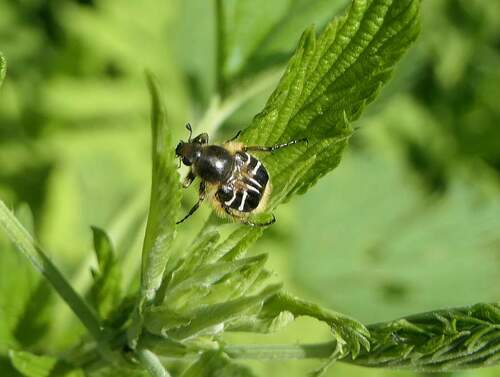
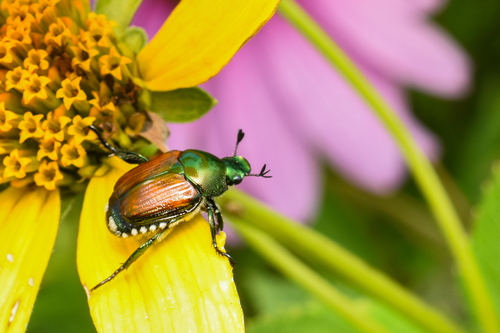
The Japanese beetle (Popillia japonica) is a species of scarab beetle. Due to the presence of natural predators, the Japanese beetle is not considered a pest in its native Japan. In North America and some regions of Europe, it is a noted pest to roughly 300 species of plants. Some of these plants include roses, grapes, hops, canna, crape myrtles, birch trees, linden trees, and others.

The adult beetles damage plants by skeletonizing the foliage (i.e., consuming only the material between a leaf's veins), as well as, at times, feeding on a plant's fruit. The subterranean larvae feed on the roots of grasses.

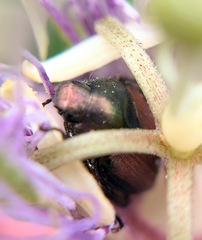
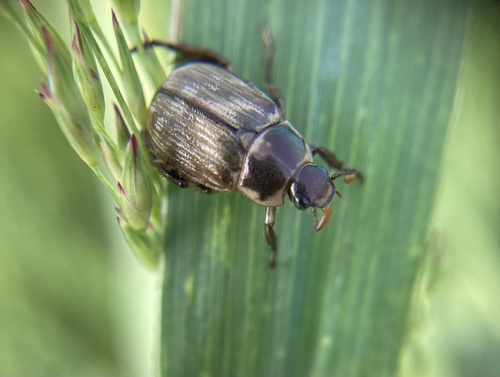
English entomologist Edward Newman described the Japanese beetle in 1841. Adults of P. japonica measure 15 mm (0.6 in) in length and 10 mm (0.4 in) in width, with iridescent, copper-colored elytra and a green thorax and head. A row of white tufts (spots) of hair projects from under the wing covers on each side of the body. Males are slightly smaller than females. Grubs are white and lie in curled positions. A mature grub is roughly 1 in (2.5 cm) long.

Popillia japonica is native to Japan, and is an invasive species in North America... Wikipedia →
Global Distribution

Parks Where Found

# Park Country Daily sighting probability
1 Acadia National Park 🇺🇸 United States
~30%
2 Great Smoky Mountains National Park 🇺🇸 United States
~20%
3 Shenandoah National Park 🇺🇸 United States
~20%
4 Congaree National Park 🇺🇸 United States
~10%
5 Point Pelee National Park 🇨🇦 Canada
~10%

Cities Where Found

# City Country Daily sighting probability
1 Turin 🇮🇹 Italy
~40%
2 Milan 🇮🇹 Italy
~30%
3 Denver 🇺🇸 United States
~30%
4 Montreal 🇨🇦 Canada
~30%
5 Toronto 🇨🇦 Canada
~20%
6 Detroit 🇺🇸 United States
~20%
7 Nagoya 🇯🇵 Japan
~20%
8 Minneapolis [Saint Paul] 🇺🇸 United States
~20%
9 Boston 🇺🇸 United States
~20%
10 Sendai 🇯🇵 Japan
~10%

Before you go

What are the chances of seeing a Japanese Beetle in Acadia National Park?

Possible

About 30% of wildlife watchers report a Japanese Beetle sighting in Acadia National Park on a given day, based on 154 verified sightings from GBIF citizen-science data from 2019 to 2026. It is the 6th most-seen of the 405 insects we can rate there. Over three days the chance rises to about 60%, and over a week to about 90%, if each day is a fresh chance.

When is the best time to see a Japanese Beetle in Acadia National Park?

July and August

In those months about 40% of wildlife watchers report a Japanese Beetle in Acadia National Park on a given day, against under 5% in November to June, the lowest months.

What time of day is best to see a Japanese Beetle?

Between 10 am and 1 pm

Across all the parks we cover, that three-hour window holds the most Japanese Beetle sightings with a recorded time, and about 9 in 10 of them come between 6 am and 6 pm: it is a daytime animal.

Is Acadia National Park the best place to see a Japanese Beetle?

Yes

Of the 5 parks where we can rate Japanese Beetle sightings, Acadia National Park has the highest daily chance: about 30%. Next come Great Smoky Mountains National Park (United States, about 20%) and Shenandoah National Park (United States, about 20%).

Which relatives of the Japanese Beetle live in Acadia National Park?

Same family: Scarabaeidae

The closest relatives of the Japanese Beetle that you can see in Acadia National Park (family Scarabaeidae, Scarabs) are Oriental Beetle (about 20%), Rough Hermit Beetle (about 10%) and Nipponoserica peregrina (about 10%), with each one's daily chance of a sighting.

Where does the Japanese Beetle sighting chance come from?

GBIF citizen-science records

It is estimated from how often the Japanese Beetle is recorded against all the insects logged in Acadia National Park (154 verified sightings from 2019 to 2026), calibrated against known sighting rates. Figures are rounded to the nearest 10% because citizen-science data supports honest approximations, not decimals, and months with records from fewer than five people show "—". How it works.

← Back to Acadia National Park