Northern Two-lined Salamander

Northern Two-lined Salamander

Eurycea bislineata

Silhouette: Andy Wilson · PhyloPic

LCLeast ConcernNTVUENCR
Daily sighting probability <5% · Rare
at Acadia National Park

In 3 days ~10% in a week ~30%

13 Verified sightings at Acadia National Park From 2019 to 2026
190 In all 2 parks
May Best month
☀️ Diurnal When it's spotted

About the Northern Two-lined Salamander

The northern two-lined salamander (Eurycea bislineata) is a species of salamander in the family Plethodontidae found in Canada and the United States. Its natural habitats are temperate forests, temperate shrubland, rivers, intermittent rivers, freshwater marshes, freshwater springs, arable land, and urban areas. It is more water-oriented than the related northern redback salamander, and can often be found in and around water such as rain puddles, streams, swamps, and damp stream beds, whereas the northern redback tends to be found in damp ground, but usually not near open water.

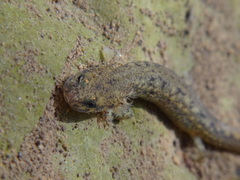
The northern two-lined salamander is a small salamander, with adults ranging from 65–120 mm in total length. This salamander is yellow or yellowish-brown, with two black stripes running down the back which tends to break up after the base of the tail. The flanks are mottled grayish or brown. The belly is pale yellowish, nearly transparent. There are four toes on the fore feet and five toes on the hind feet. On the side of the body are 14–16 costal grooves.

This species prefers small rocky streams or seeps in forests, but may occur in moist areas far from running... Wikipedia →

Global Distribution

Parks Where Found

# Park Country Daily sighting probability
1 Shenandoah National Park 🇺🇸 United States
~40%
2 Acadia National Park 🇺🇸 United States
<5%

Cities Where Found

# City Country Daily sighting probability
1 Washington 🇺🇸 United States
~10%
2 Philadelphia 🇺🇸 United States
~10%
3 Baltimore 🇺🇸 United States
~10%
4 Boston 🇺🇸 United States
~10%
5 New York City 🇺🇸 United States
<5%

Before you go

What are the chances of seeing a Northern Two-lined Salamander in Acadia National Park?

Rare

Under 5% of wildlife watchers report a Northern Two-lined Salamander sighting in Acadia National Park on a given day, based on 13 verified sightings from GBIF citizen-science data from 2019 to 2026. It is the 12th most-seen of the 12 amphibians we can rate there. Over three days the chance rises to about 10%, and over a week to about 30%, if each day is a fresh chance.

When is the best time to see a Northern Two-lined Salamander in Acadia National Park?

April and May

In those months about 10% of wildlife watchers report a Northern Two-lined Salamander in Acadia National Park on a given day, against under 5% in June to March, the lowest months.

What time of day is best to see a Northern Two-lined Salamander?

Between 1 and 4 pm

Across all the parks we cover, that three-hour window holds the most Northern Two-lined Salamander sightings with a recorded time, and about 8 in 10 of them come between 6 am and 6 pm: it is a daytime animal.

Is Acadia National Park the best place to see a Northern Two-lined Salamander?

2nd of 2

Of the 2 parks where we can rate Northern Two-lined Salamander sightings, Acadia National Park ranks 2nd at under 5%. The best odds are in Shenandoah National Park (United States, about 40%).

Which relatives of the Northern Two-lined Salamander live in Acadia National Park?

Same family: Plethodontidae

The closest relatives of the Northern Two-lined Salamander that you can see in Acadia National Park (family Plethodontidae, Lungless Salamanders) are Eastern Red-backed Salamander (about 40%) and Four-toed Salamander (about 10%), with each one's daily chance of a sighting.

Where does the Northern Two-lined Salamander sighting chance come from?

GBIF citizen-science records

It is estimated from how often the Northern Two-lined Salamander is recorded against all the amphibians logged in Acadia National Park (13 verified sightings from 2019 to 2026), calibrated against known sighting rates. Figures are rounded to the nearest 10% because citizen-science data supports honest approximations, not decimals, and months with records from fewer than five people show "—". How it works.

← Back to Acadia National Park