Cape Shoveler

Cape Shoveler

Spatula smithii

Silhouette: Sheatherius · PhyloPic

LCLeast ConcernNTVUENCR
Daily sighting probability <5% · Rare
at Addo Elephant National Park

In 3 days ~10%

21 Verified sightings at Addo Elephant National Park From 2019 to 2026
1,176 In all 9 parks
December Best month
☀️ Diurnal When it's spotted

About the Cape Shoveler

The Cape shoveler or Cape shoveller (Spatula smithii) is a species of dabbling duck of the genus Spatula. It is resident in South Africa, and uncommon further north in Namibia, Botswana, Zimbabwe, southern Angola, Lesotho, Mozambique, and Zambia.

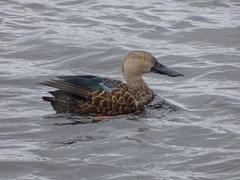
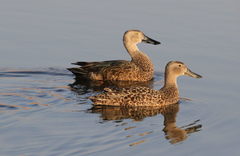
This 51–53 cm long duck is non-migratory, but undertakes some local seasonal movements. It is gregarious when not breeding, and may then form large flocks. This species has a large spatulate bill. Adults have speckled grey-brown plumage and dull orange legs. As with many southern hemisphere ducks, the sexes appear similar, but the male has a paler head than the female, a pale blue forewing separated from the green speculum by a white border, and yellow eyes. The female's forewing is grey.

Cape shoveler can only be confused with a vagrant female northern shoveler, but is much darker and stockier than that species. It is a bird of open wetlands, such as wet grassland or marshes with some emergent vegetation, and feeds by dabbling for plant food, often by swinging its bill from side to side to strain food from the water. This bird also eats molluscs and insects in the nesting season. The nest is a shallow depression on the ground, lined with plant material and down, and usually close to water.

This is a fairly quiet species. The male has rarr and cawick calls, whereas the female has a quack. The Cape shoveler was described by the German ornithologist Ernst Hartert in 1891 under the present binomial name Spatula smithii. The specific epithet commemorates the Scottish zoologist Andrew Smith.

The IUCN Red List sets the conservation status of the Cape shoveler as least concern. Wikipedia →

Sounds

Alarm call0:09

South Africa · 2024

© Nick Talbot · XC947441 · CC BY-NC-SA 4.0

Call0:12

South Africa · 2016

© Lynette Rudman · XC321261 · CC BY-NC-SA 4.0

Song0:49

South Africa · 2014

© David Winter · XC185517 · CC BY-NC-SA 4.0

Global Distribution

Parks Where Found

# Park Country Daily sighting probability
1 West Coast National Park 🇿🇦 South Africa
~30%
2 De Hoop Nature Reserve 🇿🇦 South Africa
~30%
3 Garden Route National Park 🇿🇦 South Africa
~10%
4 iSimangaliso Wetland Park 🇿🇦 South Africa
<5%
5 Table Mountain National Park 🇿🇦 South Africa
<5%
6 Addo Elephant National Park 🇿🇦 South Africa
<5%
7 Etosha National Park 🇳🇦 Namibia
<5%
8 Ngorongoro Conservation Area 🇹🇿 Tanzania
<5%
9 Kruger National Park 🇿🇦 South Africa
<5%

Cities Where Found

# City Country Daily sighting probability
1 Cape Town 🇿🇦 South Africa
~20%
2 Johannesburg 🇿🇦 South Africa
<5%
3 Pretoria 🇿🇦 South Africa
<5%

Zoos & Centres Where Found

# Zoo / Centre Country
1 World of Birds Wildlife Sanctuary and Monkey Park 🇿🇦 South Africa In captivity
2 Cologne Zoo Aquarium 🇩🇪 Germany In captivity

Before you go

What are the chances of seeing a Cape Shoveler in Addo Elephant National Park?

Rare

Under 5% of wildlife watchers report a Cape Shoveler sighting in Addo Elephant National Park on a given day, based on 21 verified sightings from GBIF citizen-science data from 2019 to 2026. It is the 200th most-seen of the 243 birds we can rate there. Over three days the chance rises to about 10%, if each day is a fresh chance.

When is the best time to see a Cape Shoveler in Addo Elephant National Park?

December

In that month about 10% of wildlife watchers report a Cape Shoveler in Addo Elephant National Park on a given day, against under 5% in January to November, the lowest months.

What time of day is best to see a Cape Shoveler?

Between 9 am and noon

Across all the parks we cover, that three-hour window holds the most Cape Shoveler sightings with a recorded time, and nearly all of them come between 6 am and 6 pm: it is a daytime animal.

Is Addo Elephant National Park the best place to see a Cape Shoveler?

6th of 9

Of the 9 parks where we can rate Cape Shoveler sightings, Addo Elephant National Park ranks 6th at under 5%. The best odds are in West Coast National Park (South Africa, about 30%), De Hoop Nature Reserve (South Africa, about 30%) and Garden Route National Park (South Africa, about 10%).

Which relatives of the Cape Shoveler live in Addo Elephant National Park?

Same family: Anatidae

The closest relatives of the Cape Shoveler that you can see in Addo Elephant National Park (family Anatidae, Ducks, Geese, and Swans) are Egyptian Goose (about 50%), South African Shelduck (about 20%) and Yellow-billed Duck (about 20%), with each one's daily chance of a sighting.

Where does the Cape Shoveler sighting chance come from?

GBIF citizen-science records

It is estimated from how often the Cape Shoveler is recorded against all the birds logged in Addo Elephant National Park (21 verified sightings from 2019 to 2026), calibrated against known sighting rates. Figures are rounded to the nearest 10% because citizen-science data supports honest approximations, not decimals, and months with records from fewer than five people show "—". How it works.

← Back to Addo Elephant National Park