
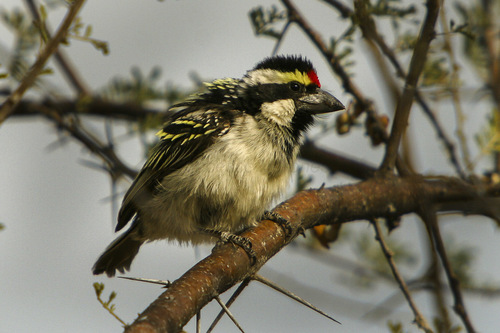
Knysna Woodpecker

Knysna Woodpecker

Campethera notata

Silhouette: Pepe Reigada · PhyloPic

LCNTNear ThreatenedVUENCR Endemic
Daily sighting probability ~10% · With luck
at Addo Elephant National Park

In 3 days ~20% in a week ~50%

80 Verified sightings at Addo Elephant National Park From 2019 to 2026
358 In all 3 parks
January Best month
☀️ Diurnal When it's spotted

About the Knysna Woodpecker

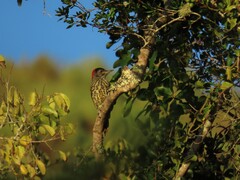
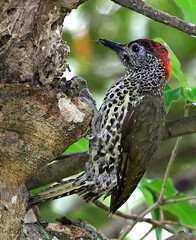
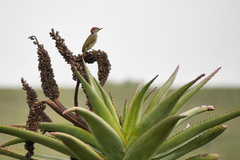
The Knysna woodpecker (Campethera notata) is a species of bird in the family Picidae. It is endemic to South Africa, where its natural habitats are subtropical or tropical moist lowland forests, moist savanna, and subtropical or tropical moist shrubland. It is threatened by habitat loss. It belongs to a species complex that includes the golden-tailed and Mombasa woodpeckers.

This species is distinguished from the other South African woodpeckers by its thickly spotted under-surface which is covered with black spots from the chin to the vent. Males and females differ slightly. Males have an olive-green color above with indistinct, small transverse bars and a few diamond-shaped sub-terminal spots that are a paler olive-yellow. The female Knysna woodpecker is similar to the male, but the black head is spotted with white and only the occiput is scarlet.

The quills are brown, except for near the base where they are externally olive. The secondary quills are olive-brown, duller than the back, and transversely barred with a yellow-tinged white. The primaries are externally spotted with yellow, notched on the inner web with white, and the shafts are brown. The tail is olive... Wikipedia →

Sounds

Begging call0:54

South Africa · 2025

© Niall Perrins · XC1064907 · CC BY-NC-SA 4.0

Call0:50

South Africa · 2019

© Frank Lambert · XC519821 · CC BY-NC-ND 4.0

Call0:43

South Africa · 2016

© Lynette Rudman · XC305433 · CC BY-NC-SA 4.0

Global Distribution

Parks Where Found

# Park Country Daily sighting probability
1 De Hoop Nature Reserve 🇿🇦 South Africa
~20%
2 Garden Route National Park 🇿🇦 South Africa
~10%
3 Addo Elephant National Park 🇿🇦 South Africa
~10%

Before you go

What are the chances of seeing a Knysna Woodpecker in Addo Elephant National Park?

With luck

About 10% of wildlife watchers report a Knysna Woodpecker sighting in Addo Elephant National Park on a given day, based on 80 verified sightings from GBIF citizen-science data from 2019 to 2026. It is the 95th most-seen of the 243 birds we can rate there. Over three days the chance rises to about 20%, and over a week to about 50%, if each day is a fresh chance.

When is the best time to see a Knysna Woodpecker in Addo Elephant National Park?

January and July

In those months about 20% of wildlife watchers report a Knysna Woodpecker in Addo Elephant National Park on a given day, against under 5% in February to June, the lowest months.

What time of day is best to see a Knysna Woodpecker?

Between 10 am and 1 pm

Across all the parks we cover, that three-hour window holds the most Knysna Woodpecker sightings with a recorded time, and about 9 in 10 of them come between 6 am and 6 pm: it is a daytime animal.

Is Addo Elephant National Park the best place to see a Knysna Woodpecker?

3rd of 3

Of the 3 parks where we can rate Knysna Woodpecker sightings, Addo Elephant National Park ranks 3rd at about 10%. The best odds are in De Hoop Nature Reserve (South Africa, about 20%) and Garden Route National Park (South Africa, about 10%).

Which relatives of the Knysna Woodpecker live in Addo Elephant National Park?

Same family: Picidae

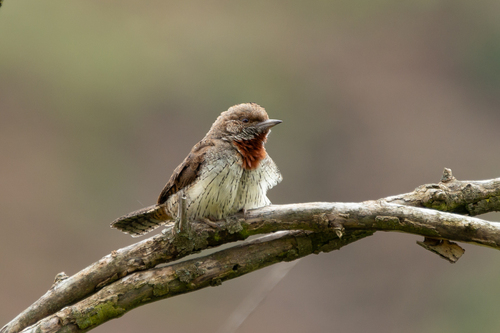
The closest relatives of the Knysna Woodpecker that you can see in Addo Elephant National Park (family Picidae, Woodpeckers) are Cardinal Woodpecker (about 10%), Rufous-necked Wryneck (about 10%) and Olive Woodpecker (about 10%), with each one's daily chance of a sighting.

Where does the Knysna Woodpecker sighting chance come from?

GBIF citizen-science records

It is estimated from how often the Knysna Woodpecker is recorded against all the birds logged in Addo Elephant National Park (80 verified sightings from 2019 to 2026), calibrated against known sighting rates. Figures are rounded to the nearest 10% because citizen-science data supports honest approximations, not decimals, and months with records from fewer than five people show "—". How it works.

← Back to Addo Elephant National Park