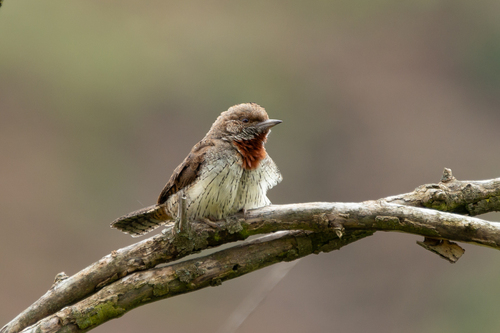
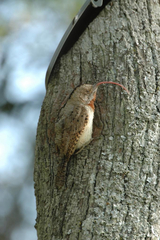
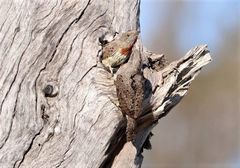
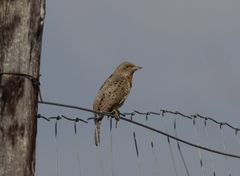
Rufous-necked Wryneck

Rufous-necked Wryneck

Jynx ruficollis

Silhouette: Pepe Reigada · PhyloPic

LCLeast ConcernNTVUENCR
Daily sighting probability ~10% · With luck
at Addo Elephant National Park

In 3 days ~20% in a week ~40%

58 Verified sightings at Addo Elephant National Park From 2019 to 2026
257 In all 10 parks
July Best month
☀️ Diurnal When it's spotted

About the Rufous-necked Wryneck

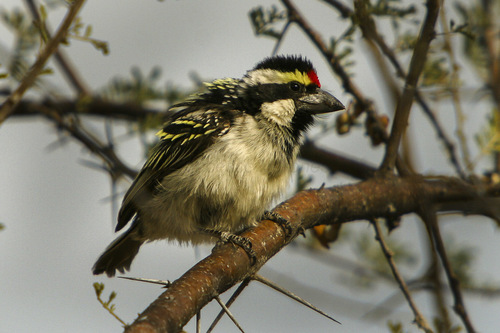
The red-throated wryneck (Jynx ruficollis), also known as the rufous-necked wryneck or red-breasted wryneck, is a species of wryneck in the woodpecker family closely related to the Eurasian wryneck. Its three subspecies are resident in much of sub-Saharan Africa in open habitats with some trees. It is a slim, elongated bird about 19 cm (7.5 in) in length, with a small head, fine bill, long fan-shaped tail and cryptic plumage intricately patterned in greys and browns. The sexes look similar, although males are slightly larger. The diet of the adults and young is almost entirely ants at all stages of their life cycles. The call of the red-throated wryneck is a series of repeated harsh, shrill notes. When threatened, a bird will twist its neck and head in a snake-like manner while making a hissing sound, presumably to deter predators.

The red-throated wryneck nests in pre-existing holes, usually in trees, preferring old barbet or woodpecker nests. The unlined nest cavity is usually 3–4 m (10–13 ft) above the ground, and the clutch is typically three or four white eggs, laid at one-day intervals. Both sexes incubate the eggs for 12–15 days until the blind, naked chicks hatch. The chicks are fed by both adults for 25–26 days until they fledge. There are usually two broods. The red-throated wryneck has a very extensive range, and its population is large and increasing. For this reason, it is evaluated as a species of least concern by the International Union for Conservation of Nature (IUCN). Wikipedia →

Sounds

Song0:06

South Africa · 2024

© Daan van der Hoeven · XC933194 · CC BY-NC-SA 4.0

Call0:27

Zambia · 2021

© Dries Van de Loock · XC745591 · CC BY-NC-SA 4.0

Uncertain0:55

South Africa · 2022

© Tim Cockcroft · XC703851 · CC BY-NC-SA 4.0

Global Distribution

Parks Where Found

# Park Country Daily sighting probability
1 Golden Gate Highlands National Park 🇿🇦 South Africa
~20%
2 Aberdare National Park 🇰🇪 Kenya
~10%
3 Addo Elephant National Park 🇿🇦 South Africa
~10%
4 Hluhluwe-Imfolozi Park 🇿🇦 South Africa
~10%
5 Mikumi National Park 🇹🇿 Tanzania
<5%
6 Kibale National Park 🇺🇬 Uganda
<5%
7 Masai Mara National Reserve 🇰🇪 Kenya
<5%
8 Bwindi Impenetrable National Park 🇺🇬 Uganda
<5%
9 Queen Elizabeth National Park 🇺🇬 Uganda
<5%
10 Kruger National Park 🇿🇦 South Africa
<5%

Cities Where Found

# City Country Daily sighting probability
1 Pretoria 🇿🇦 South Africa
~10%
2 Johannesburg 🇿🇦 South Africa
~10%

Before you go

What are the chances of seeing a Rufous-necked Wryneck in Addo Elephant National Park?

With luck

About 10% of wildlife watchers report a Rufous-necked Wryneck sighting in Addo Elephant National Park on a given day, based on 58 verified sightings from GBIF citizen-science data from 2019 to 2026. It is the 124th most-seen of the 243 birds we can rate there. Over three days the chance rises to about 20%, and over a week to about 40%, if each day is a fresh chance.

When is the best time to see a Rufous-necked Wryneck in Addo Elephant National Park?

April, July and September–February

In those months about 10% of wildlife watchers report a Rufous-necked Wryneck in Addo Elephant National Park on a given day, against under 5% in March, May–June and August, the lowest months.

What time of day is best to see a Rufous-necked Wryneck?

Between 7 and 10 am

Across all the parks we cover, that three-hour window holds the most Rufous-necked Wryneck sightings with a recorded time, and nearly all of them come between 6 am and 6 pm: it is a daytime animal.

Is Addo Elephant National Park the best place to see a Rufous-necked Wryneck?

3rd of 10

Of the 10 parks where we can rate Rufous-necked Wryneck sightings, Addo Elephant National Park ranks 3rd at about 10%. The best odds are in Golden Gate Highlands National Park (South Africa, about 20%) and Aberdare National Park (Kenya, about 10%).

Which relatives of the Rufous-necked Wryneck live in Addo Elephant National Park?

Same family: Picidae

The closest relatives of the Rufous-necked Wryneck that you can see in Addo Elephant National Park (family Picidae, Woodpeckers) are Knysna Woodpecker (about 10%), Cardinal Woodpecker (about 10%) and Olive Woodpecker (about 10%), with each one's daily chance of a sighting.

Where does the Rufous-necked Wryneck sighting chance come from?

GBIF citizen-science records

It is estimated from how often the Rufous-necked Wryneck is recorded against all the birds logged in Addo Elephant National Park (58 verified sightings from 2019 to 2026), calibrated against known sighting rates. Figures are rounded to the nearest 10% because citizen-science data supports honest approximations, not decimals, and months with records from fewer than five people show "—". How it works.

← Back to Addo Elephant National Park