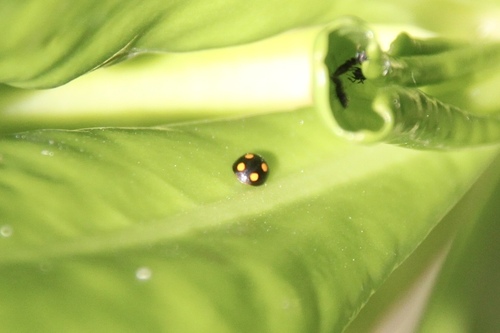
Spotted Maize Beetle

Spotted Maize Beetle

Astylus atromaculatus

Daily sighting probability ~10% · With luck
at Addo Elephant National Park

In 3 days ~10% in a week ~30%

5 Verified sightings at Addo Elephant National Park From 2019 to 2026
12 In all 2 parks
April Best month
☀️ Diurnal When it's spotted

About the Spotted Maize Beetle

Astylus atromaculatus is a species of beetle in the family Melyridae. It is variously known as the spotted maize beetle, or pollen beetle. It is indigenous to Argentina and neighbouring countries, but has been accidentally imported into the warmer regions of South Africa, where it has become invasive.

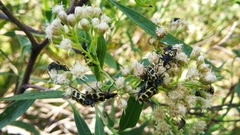
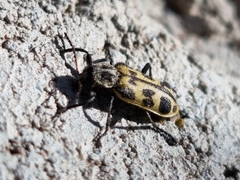
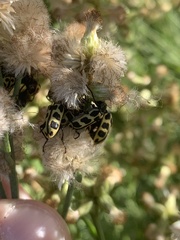
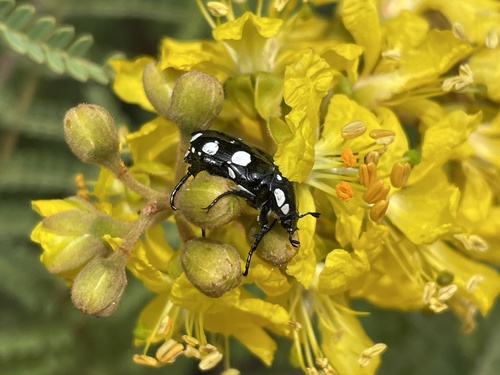
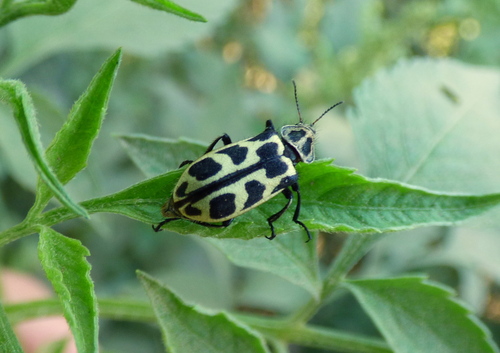
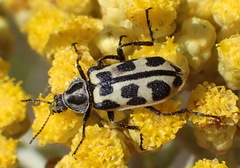
Adult Astylus atromaculatus are roughly oval in shape, slightly elongated, with parallel sides. They generally are slightly flat in shape, and like most Melyridae, tend to be soft and leathery in texture. They attain about 12 mm in bodily length by 5 mm wide. They are finely bristly with finely punctured elytra and upper surfaces. The body colour is generally black, but with pale hairs on the pronotum surrounding two large, eye-like dorsal black patches. However, the most conspicuous feature is the colour scheme of the elytra; they are yellow to orange with a black median stripe along their margins where the folded elytra meet. Two blotches on that median stripe form cross-marks, one about 2 mm from the anterior end of the line, and one about 1 mm from the posterior end. Each elytron has three much larger black blotches on its dorsolateral surface near its lateral margin... Wikipedia →
Global Distribution

Parks Where Found

# Park Country Daily sighting probability
1 Golden Gate Highlands National Park 🇿🇦 South Africa
~30%
2 Addo Elephant National Park 🇿🇦 South Africa
~10%

Cities Where Found

# City Country Daily sighting probability
1 Rosario 🇦🇷 Argentina
~30%
2 Cordoba 🇦🇷 Argentina
~20%
3 Mendoza 🇦🇷 Argentina
~20%
4 Buenos Aires 🇦🇷 Argentina
~20%
5 Pretoria 🇿🇦 South Africa
~10%
6 Johannesburg 🇿🇦 South Africa
~10%

Before you go

What are the chances of seeing a Spotted Maize Beetle in Addo Elephant National Park?

With luck

About 10% of wildlife watchers report a Spotted Maize Beetle sighting in Addo Elephant National Park on a given day, based on 5 verified sightings from GBIF citizen-science data from 2019 to 2026. It is the 164th most-seen of the 198 insects we can rate there. Over three days the chance rises to about 10%, and over a week to about 30%, if each day is a fresh chance.

When is the best time to see a Spotted Maize Beetle in Addo Elephant National Park?

March to May

In those months about 10% of wildlife watchers report a Spotted Maize Beetle in Addo Elephant National Park on a given day, against under 5% in June to February, the lowest months.

What time of day is best to see a Spotted Maize Beetle?

Between 11 am and 2 pm

Across all the parks we cover, that three-hour window holds the most Spotted Maize Beetle sightings with a recorded time, and about 9 in 10 of them come between 6 am and 6 pm: it is a daytime animal.

Is Addo Elephant National Park the best place to see a Spotted Maize Beetle?

2nd of 2

Of the 2 parks where we can rate Spotted Maize Beetle sightings, Addo Elephant National Park ranks 2nd at about 10%. The best odds are in Golden Gate Highlands National Park (South Africa, about 30%).

Which relatives of the Spotted Maize Beetle live in Addo Elephant National Park?

Same order: Coleoptera

The closest relatives of the Spotted Maize Beetle that you can see in Addo Elephant National Park (order Coleoptera, Beetles) are Cape Flightless Dung Beetle (about 40%), Lunate Lady Beetle (about 10%) and Variegated Lady Beetle (about 10%), with each one's daily chance of a sighting.

Where does the Spotted Maize Beetle sighting chance come from?

GBIF citizen-science records

It is estimated from how often the Spotted Maize Beetle is recorded against all the insects logged in Addo Elephant National Park (5 verified sightings from 2019 to 2026), calibrated against known sighting rates. Figures are rounded to the nearest 10% because citizen-science data supports honest approximations, not decimals, and months with records from fewer than five people show "—". How it works.

← Back to Addo Elephant National Park