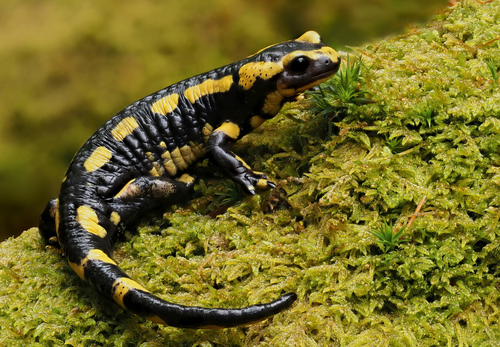
Pyrenean Brook Salamander

Pyrenean Brook Salamander

Calotriton asper

Silhouette: Francesco Cerini · PhyloPic

LCLeast ConcernNTVUENCR
Daily sighting probability ~40% · Likely
at Aigüestortes National Park

In 3 days ~80% in a week >90%

39 Verified sightings at Aigüestortes National Park From 2019 to 2026
368 In all 3 parks
September Best month
☀️🌙 Day & Night When it's spotted

About the Pyrenean Brook Salamander

The Pyrenean brook salamander or Pyrenean newt (Calotriton asper), (Aragonese: guardafuents pirenenco; Catalan: tritó pirinenc; Basque: uhandre piriniarra; Spanish: tritón pirenaico), is a largely aquatic species of salamander in the family Salamandridae. It is found in the Pyrenees of Andorra, France, and Spain. The IUCN lists it as least concern.

The Pyrenean brook salamander grows to about 16 cm (6.3 in) in length, half of which is the laterally flattened tail. The females are usually larger than the males. The body is sturdy with a flattened head and small eyes, and the limbs are short. There are no parotoid glands and the skin is covered with small, rough tubercles. The colour is very variable, the upper side usually being some shade of olive, grey, charcoal, or muddy brown, sometimes mottled with ochre, with an intermittent yellowish stripe down the spine. The underside has a row of dark splotches at either side and the centre is red, orange, or yellow. The male has a rounded cloacal swelling while the female has a conical one.

The Pyrenean brook salamander is endemic to the Pyrenees and surrounding mountains and is found at altitudes... Wikipedia →

Global Distribution

Parks Where Found

# Park Country Daily sighting probability
1 Aigüestortes National Park 🇪🇸 Spain
~40%
2 Ordesa y Monte Perdido National Park 🇪🇸 Spain
~40%
3 Pyrénées National Park 🇫🇷 France
~30%

Zoos & Centres Where Found

# Zoo / Centre Country
1 Parque Faunístico de Lacuniacha 🇪🇸 Spain In captivity

Before you go

What are the chances of seeing a Pyrenean Brook Salamander in Aigüestortes National Park?

Likely

About 40% of wildlife watchers report a Pyrenean Brook Salamander sighting in Aigüestortes National Park on a given day, based on 39 verified sightings from GBIF citizen-science data from 2019 to 2026. It is the 3rd most-seen of the 7 amphibians we can rate there. Over three days the chance rises to about 80%, and over a week to over 90%, if each day is a fresh chance.

When is the best time to see a Pyrenean Brook Salamander in Aigüestortes National Park?

September

In that month about 70% of wildlife watchers report a Pyrenean Brook Salamander in Aigüestortes National Park on a given day, against under 5% in March and April, the lowest months.

What time of day is best to see a Pyrenean Brook Salamander?

Between 8 and 11 pm

Across all the parks we cover, that three-hour window holds the most Pyrenean Brook Salamander sightings with a recorded time, and about 6 in 10 of them come between 6 am and 6 pm: it is seen both by day and at night.

Is Aigüestortes National Park the best place to see a Pyrenean Brook Salamander?

Yes

Of the 3 parks where we can rate Pyrenean Brook Salamander sightings, Aigüestortes National Park has the highest daily chance: about 40%. Next come Ordesa y Monte Perdido National Park (Spain, about 40%) and Pyrénées National Park (France, about 30%).

Which relatives of the Pyrenean Brook Salamander live in Aigüestortes National Park?

Same family: Salamandridae

The closest relatives of the Pyrenean Brook Salamander that you can see in Aigüestortes National Park (family Salamandridae, True Salamanders and Newts) are Fire Salamander (about 40%) and Palmate Newt (about 20%), with each one's daily chance of a sighting.

Where does the Pyrenean Brook Salamander sighting chance come from?

GBIF citizen-science records

It is estimated from how often the Pyrenean Brook Salamander is recorded against all the amphibians logged in Aigüestortes National Park (39 verified sightings from 2019 to 2026), calibrated against known sighting rates. Figures are rounded to the nearest 10% because citizen-science data supports honest approximations, not decimals, and months with records from fewer than five people show "—". How it works.

← Back to Aigüestortes National Park