Black-faced Hawk

Black-faced Hawk

Leucopternis melanops

Silhouette: Sheatherius · PhyloPic

LCLeast ConcernNTVUENCR
Daily sighting probability <5% · Rare
at Amacayacu National Natural Park

In 3 days <5% in a week ~10%

9 Verified sightings at Amacayacu National Natural Park From 2019 to 2026
74 In all 3 parks
May Best month
☀️ Diurnal When it's spotted

About the Black-faced Hawk

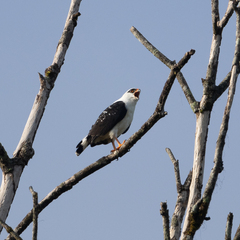
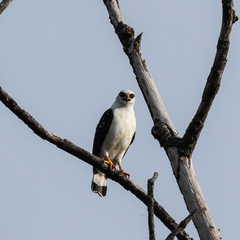
The black-faced hawk (Leucopternis melanops) is a species of bird of prey in the family Accipitridae. This low-density species has traditionally been believed to be restricted to Amazon Basin north of the Amazon River, but there are several records south of this river, in, for example, the Brazilian states of Pará and Acre, and southeastern Peru. It is closely related to the white-browed hawk and individuals showing a level of intermediacy between the two species are known, suggesting that they rarely hybridize

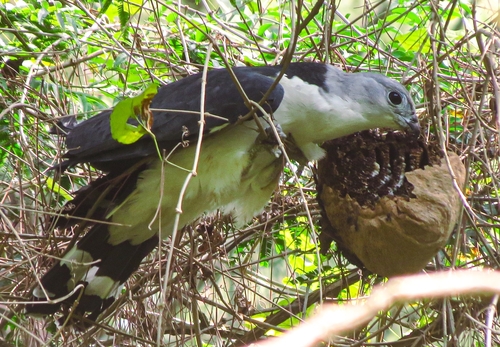
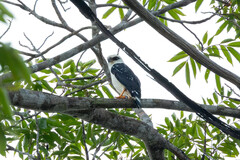
The black-faced hawk is a medium-sized hawk with black and white plumage. It has a white underbelly, a large white head streaked with some black and a characteristic black "mask". Below the black mask, it has a dark orange cere and a black tipped bill. The back of the hawk is dark all the way down to the tail with some mottling. However, a single white band sticks out near the base of the tail.

Juvenile plumage resembles adult plumage except that juveniles have thinner streaks of black on the head, two white bands instead of a single one in the tail, and brown at the tips of the feathers. The black-faced hawk adult looks very similar to the juvenile white-browed... Wikipedia →

Sounds

Call0:36

Colombia · 2023

© Jurgen Beckers · XC803244 · CC BY-NC-SA 4.0

Song0:39

Guyana · 2019

© Pritam Baruah · XC503934 · CC BY-NC-SA 4.0

?0:58

French Guiana · 2010

© Renaudier Alexandre · XC59206 · CC BY-NC-ND 2.5

Global Distribution

Parks Where Found

# Park Country Daily sighting probability
1 Brownsberg Nature Park 🇸🇷 Suriname
<5%
2 Yasuní National Park 🇪🇨 Ecuador
<5%
3 Amacayacu National Natural Park 🇨🇴 Colombia
<5%

Before you go

What are the chances of seeing a Black-faced Hawk in Amacayacu National Natural Park?

Rare

Under 5% of wildlife watchers report a Black-faced Hawk sighting in Amacayacu National Natural Park on a given day, based on 9 verified sightings from GBIF citizen-science data from 2019 to 2026. It is the 376th most-seen of the 436 birds we can rate there. Over three days the chance rises to under 5%, and over a week to about 10%, if each day is a fresh chance.

When is the best time to see a Black-faced Hawk in Amacayacu National Natural Park?

May

In that month about 10% of wildlife watchers report a Black-faced Hawk in Amacayacu National Natural Park on a given day, against under 5% in June to April, the lowest months.

What time of day is best to see a Black-faced Hawk?

Between 6 and 9 am

Across all the parks we cover, that three-hour window holds the most Black-faced Hawk sightings with a recorded time, and about 8 in 10 of them come between 6 am and 6 pm: it is a daytime animal.

Is Amacayacu National Natural Park the best place to see a Black-faced Hawk?

Among the best

Of the 3 parks where we can rate Black-faced Hawk sightings, Amacayacu National Natural Park ranks 3rd at under 5%, level with the leaders once rounded. The best odds are in Brownsberg Nature Park (Suriname, under 5%) and Yasuní National Park (Ecuador, under 5%).

Where does the Black-faced Hawk sighting chance come from?

GBIF citizen-science records

It is estimated from how often the Black-faced Hawk is recorded against all the birds logged in Amacayacu National Natural Park (9 verified sightings from 2019 to 2026), calibrated against known sighting rates. Figures are rounded to the nearest 10% because citizen-science data supports honest approximations, not decimals, and months with records from fewer than five people show "—". How it works.

← Back to Amacayacu National Natural Park