
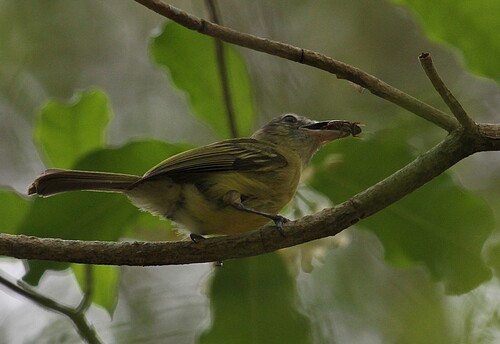
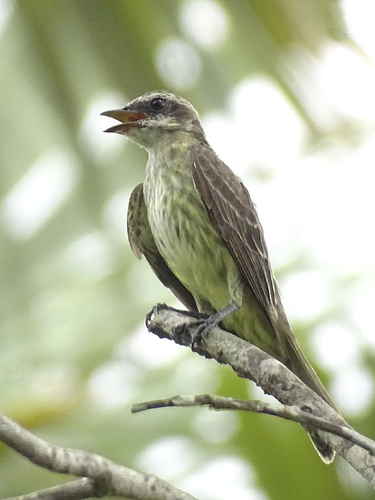
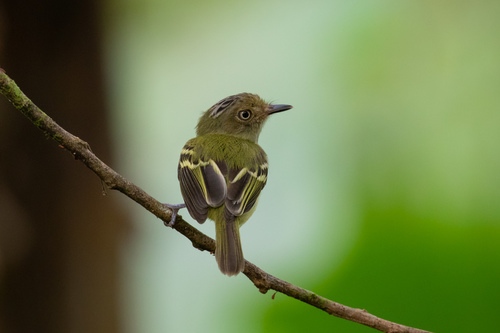
Orange-eyed Flycatcher

Orange-eyed Flycatcher

Tolmomyias traylori

Silhouette: Emily Willoughby · PhyloPic

LCLeast ConcernNTVUENCR
Daily sighting probability <5% · Rare
at Amacayacu National Natural Park

In 3 days ~10% in a week ~20%

26 Verified sightings at Amacayacu National Natural Park From 2019 to 2026
64 In all 3 parks
September Best month
☀️ Diurnal When it's spotted

About the Orange-eyed Flycatcher

The orange-eyed flatbill or orange-eyed flycatcher (Tolmomyias traylori) is a species of bird in the family Tyrannidae, the tyrant flycatchers. It is found in Colombia, Ecuador, and Peru. Though the first specimens of the orange-eyed flatbill were collected in the 1860s it was not recognized as a distinct species until the 1980s and then formally described in 1997. Its specific epithet honors Melvin Alvah Traylor Jr. "in recognition of his outstanding contributions to ornithology" and who "long ago [had] singled out as unusual the Field Museum's two specimens of the species".

The orange-eyed flatbill is monotypic. The orange-eyed flatbill is about 13.5 cm (5.3 in) long; one male weighed 11.5 g (0.41 oz). The sexes have the same plumage. Adults have a cinnamon forecrown with olive-gray tips on the feathers. They have an olive-gray crown, buff lores, a pale eye-ring, and cinnamon-buff ear coverts. Their nape, back, rump, and uppertail coverts are pale olive-green. Their wings are dusky with greenish yellow edges on the greater coverts that form two wing bars and thin olive-green edges on the flight feather edges, some of which also have... Wikipedia →

Sounds

Song1:22

Peru · 2014

© Fabrice Schmitt · XC608918 · CC BY-NC-SA 4.0

Alarm call0:48

Colombia · 2020

© Iván Lau · XC578668 · CC BY-NC-SA 4.0

Call0:20

Ecuador · 2011

© Tayler Brooks · XC77022 · CC BY-NC-ND 2.5

Global Distribution

Parks Where Found

# Park Country Daily sighting probability
1 Amacayacu National Natural Park 🇨🇴 Colombia
<5%
2 Yasuní National Park 🇪🇨 Ecuador
<5%
3 Sierra de la Macarena National Park 🇨🇴 Colombia
<5%

Before you go

What are the chances of seeing an Orange-eyed Flycatcher in Amacayacu National Natural Park?

Rare

Under 5% of wildlife watchers report an Orange-eyed Flycatcher sighting in Amacayacu National Natural Park on a given day, based on 26 verified sightings from GBIF citizen-science data from 2019 to 2026. It is the 283rd most-seen of the 436 birds we can rate there. Over three days the chance rises to about 10%, and over a week to about 20%, if each day is a fresh chance.

When is the best time to see an Orange-eyed Flycatcher in Amacayacu National Natural Park?

August and September

In those months about 20% of wildlife watchers report an Orange-eyed Flycatcher in Amacayacu National Natural Park on a given day, against under 5% in October to July, the lowest months. Those are among Amacayacu National Natural Park's driest months, with about 160 mm of rain a month against 390 mm in March.

What time of day is best to see an Orange-eyed Flycatcher?

Between 8 and 11 am

Across all the parks we cover, that three-hour window holds the most Orange-eyed Flycatcher sightings with a recorded time, and about 9 in 10 of them come between 6 am and 6 pm: it is a daytime animal.

Is Amacayacu National Natural Park the best place to see an Orange-eyed Flycatcher?

Yes

Of the 3 parks where we can rate Orange-eyed Flycatcher sightings, Amacayacu National Natural Park has the highest daily chance: under 5%. Next come Yasuní National Park (Ecuador, under 5%) and Sierra de la Macarena National Park (Colombia, under 5%).

Which relatives of the Orange-eyed Flycatcher live in Amacayacu National Natural Park?

Same genus: Tolmomyias

The closest relatives of the Orange-eyed Flycatcher that you can see in Amacayacu National Natural Park (genus Tolmomyias, Tolmomyias Flatbills) are Gray-crowned Flycatcher (about 10%) and Yellow-breasted Flycatcher (about 10%), with each one's daily chance of a sighting.

Where does the Orange-eyed Flycatcher sighting chance come from?

GBIF citizen-science records

It is estimated from how often the Orange-eyed Flycatcher is recorded against all the birds logged in Amacayacu National Natural Park (26 verified sightings from 2019 to 2026), calibrated against known sighting rates. Figures are rounded to the nearest 10% because citizen-science data supports honest approximations, not decimals, and months with records from fewer than five people show "—". How it works.

← Back to Amacayacu National Natural Park