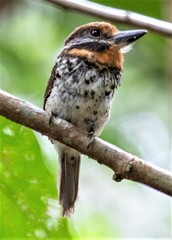
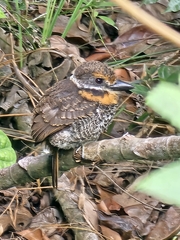
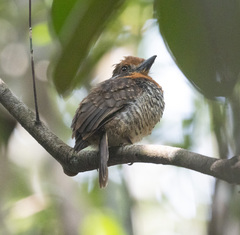
Spotted Puffbird

Spotted Puffbird

Bucco tamatia

Silhouette: Matt Wilkins (Photo by Len Blumin) · PhyloPic

Daily sighting probability ~10% · With luck
at Amacayacu National Natural Park

In 3 days ~30% in a week ~50%

66 Verified sightings at Amacayacu National Natural Park From 2019 to 2026
78 In all 2 parks
September Best month
☀️ Diurnal When it's spotted

About the Spotted Puffbird

The spotted puffbird (Bucco tamatia) is a species of puffbird in the family Bucconidae, the puffbirds, nunlets, and nunbirds. It is found in Bolivia, Brazil, Colombia, Ecuador, French Guiana, Guyana, Peru, Suriname, and Venezuela.

The spotted puffbird was described in 1648 by the German naturalist Georg Marcgrave in his Historia Naturalis Brasiliae. In his Latin text Marcgrave used the name Tamatia Brasiliensibus where tamatia was the local name for the bird in the Tupi language. Later ornithologists such as Francis Willughby in 1678 and John Ray in 1713 based their own description on that by Marcgrave. In 1780 the French polymath Comte de Buffon described and illustrated Le Tamatia from a specimen that had been collected in Cayenne, French Guiana. When the German naturalist Johann Friedrich Gmelin revised and expanded Carl Linnaeus's Systema Naturae in 1788 he included the spotted puffbird and cited the works by the earlier ornithologists. He placed the species with the other puffbirds in the genus Bucco and coined the binomial name Bucco tamatia.

The spotted puffbird has sometimes been placed in the genus Nystactes. It is closely related to the sooty-capped puffbird... Wikipedia →

Sounds

Song1:14

Colombia · 2022

© Frank Lambert · XC1033816 · CC BY-NC-ND 4.0

Canto0:11

Brazil · 2016

© Caio Brito · XC427133 · CC BY-NC-SA 4.0

Call0:29

Ecuador · 2003

© Daniel F. Lane · XC257068 · CC BY-NC-SA 4.0

Global Distribution

Parks Where Found

# Park Country Daily sighting probability
1 Amacayacu National Natural Park 🇨🇴 Colombia
~10%
2 Yasuní National Park 🇪🇨 Ecuador
<5%

Before you go

What are the chances of seeing a Spotted Puffbird in Amacayacu National Natural Park?

With luck

About 10% of wildlife watchers report a Spotted Puffbird sighting in Amacayacu National Natural Park on a given day, based on 66 verified sightings from GBIF citizen-science data from 2019 to 2026. It is the 163rd most-seen of the 436 birds we can rate there. Over three days the chance rises to about 30%, and over a week to about 50%, if each day is a fresh chance.

When is the best time to see a Spotted Puffbird in Amacayacu National Natural Park?

June, September–October and December

In those months about 20% of wildlife watchers report a Spotted Puffbird in Amacayacu National Natural Park on a given day, against under 5% in January, the lowest month.

What time of day is best to see a Spotted Puffbird?

Between 8 and 11 am

Across all the parks we cover, that three-hour window holds the most Spotted Puffbird sightings with a recorded time, and about 9 in 10 of them come between 6 am and 6 pm: it is a daytime animal.

Is Amacayacu National Natural Park the best place to see a Spotted Puffbird?

Yes

Of the 2 parks where we can rate Spotted Puffbird sightings, Amacayacu National Natural Park has the highest daily chance: about 10%. Next come Yasuní National Park (Ecuador, under 5%).

Where does the Spotted Puffbird sighting chance come from?

GBIF citizen-science records

It is estimated from how often the Spotted Puffbird is recorded against all the birds logged in Amacayacu National Natural Park (66 verified sightings from 2019 to 2026), calibrated against known sighting rates. Figures are rounded to the nearest 10% because citizen-science data supports honest approximations, not decimals, and months with records from fewer than five people show "—". How it works.

← Back to Amacayacu National Natural Park