White-plumed Antbird

White-plumed Antbird

Pithys albifrons

Silhouette: Sheatherius · PhyloPic

LCLeast ConcernNTVUENCR
Daily sighting probability <5% · Rare
at Amacayacu National Natural Park

In 3 days ~10%

12 Verified sightings at Amacayacu National Natural Park From 2019 to 2026
104 In all 3 parks
January Best month
☀️ Diurnal When it's spotted

About the White-plumed Antbird

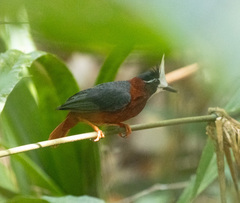
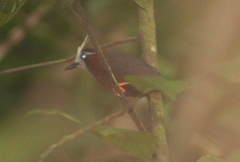
The white-plumed antbird (Pithys albifrons) is a small species of insectivorous bird in subfamily Thamnophilinae of family Thamnophilidae, the "typical antbirds". It is found in Brazil, Colombia, Ecuador, French Guiana, Guyana, Peru, Suriname, and Venezuela.

The first formal description of the white-plumed antbird was by the Swedish naturalist Carl Linnaeus in 1766 in the twelfth edition of his Systema Naturae. He introduced the binomial name Pipra albifrons. Some taxonomists have separated a third subspecies, P. a. brevibarba, from peruvianus but this treatment has found little acceptance. It shares genus Pithys with the white-masked antbird (P. castaneus). Pithys and Phaenostictus are sister genera, and the two may be distinguished by smaller length and weight, shorter tails, and louder songs in Pithys than Phaenostictus.

The white-plumed antbird is 11.5 to 12.5 cm (4.5 to 4.9 in) and weighs 18 to 23 g (0.63 to 0.81 oz). The species is monomorphic, meaning both sexes look the same. Adults of both subspecies have the eponymous... Wikipedia →

Sounds

Uncertain0:54

Colombia · 2020

© Mauricio Cuellar Ramirez (@Birding.travel) · XC609557 · CC BY-NC-SA 4.0

Call1:26

Brazil · 2018

© Cameron Rutt · XC568165 · CC BY-NC-SA 4.0

Duet0:32

Ecuador · 1998

© Mitch Lysinger · XC260820 · CC BY-NC-SA 4.0

Global Distribution

Parks Where Found

# Park Country Daily sighting probability
1 Yasuní National Park 🇪🇨 Ecuador
<5%
2 Brownsberg Nature Park 🇸🇷 Suriname
<5%
3 Amacayacu National Natural Park 🇨🇴 Colombia
<5%

Before you go

What are the chances of seeing a White-plumed Antbird in Amacayacu National Natural Park?

Rare

Under 5% of wildlife watchers report a White-plumed Antbird sighting in Amacayacu National Natural Park on a given day, based on 12 verified sightings from GBIF citizen-science data from 2019 to 2026. It is the 349th most-seen of the 436 birds we can rate there. Over three days the chance rises to about 10%, if each day is a fresh chance.

When is the best time to see a White-plumed Antbird in Amacayacu National Natural Park?

January

In that month about 10% of wildlife watchers report a White-plumed Antbird in Amacayacu National Natural Park on a given day, against under 5% in February to December, the lowest months.

What time of day is best to see a White-plumed Antbird?

Between 3 and 6 pm

Across all the parks we cover, that three-hour window holds the most White-plumed Antbird sightings with a recorded time, and about 8 in 10 of them come between 6 am and 6 pm: it is a daytime animal.

Is Amacayacu National Natural Park the best place to see a White-plumed Antbird?

Among the best

Of the 3 parks where we can rate White-plumed Antbird sightings, Amacayacu National Natural Park ranks 3rd at under 5%, level with the leaders once rounded. The best odds are in Yasuní National Park (Ecuador, under 5%) and Brownsberg Nature Park (Suriname, under 5%).

Which relatives of the White-plumed Antbird live in Amacayacu National Natural Park?

Same family: Thamnophilidae

The closest relatives of the White-plumed Antbird that you can see in Amacayacu National Natural Park (family Thamnophilidae, Typical Antbirds) are Peruvian Warbling-Antbird (about 30%), Barred Antshrike (about 20%) and Mouse-colored Antshrike (about 20%), with each one's daily chance of a sighting.

Where does the White-plumed Antbird sighting chance come from?

GBIF citizen-science records

It is estimated from how often the White-plumed Antbird is recorded against all the birds logged in Amacayacu National Natural Park (12 verified sightings from 2019 to 2026), calibrated against known sighting rates. Figures are rounded to the nearest 10% because citizen-science data supports honest approximations, not decimals, and months with records from fewer than five people show "—". How it works.

← Back to Amacayacu National Natural Park