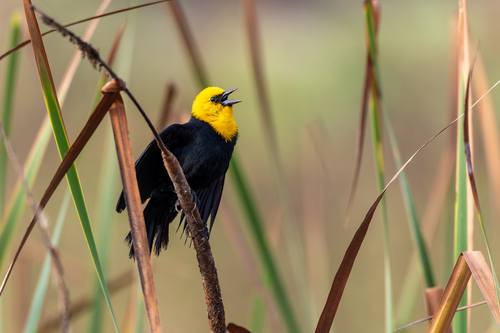
Yellow-hooded Blackbird

Yellow-hooded Blackbird

Chrysomus icterocephalus

Silhouette: Sheatherius · PhyloPic

LCLeast ConcernNTVUENCR
Daily sighting probability ~30% · Possible
at Amacayacu National Natural Park

In 3 days ~60% in a week ~90%

236 Verified sightings at Amacayacu National Natural Park From 2019 to 2026
504 In all 3 parks
February Best month
☀️ Diurnal When it's spotted

About the Yellow-hooded Blackbird

The yellow-hooded blackbird (Chrysomus icterocephalus) is a species of bird in the family Icteridae, the oropendolas, New World orioles, and New World blackbirds. It is found in Brazil, Colombia, French Guiana, Guyana, Peru, Suriname, Trinidad, and Venezuela. It has been recorded as a vagrant on Aruba, Bonaire, and Curaçao. In addition, there is a small population in extreme eastern Panama and a previously misidentified specimen from Barbados.

The yellow-hooded blackbird was formally described in 1766 with the binomial Oriolus icterocephalus. It was later reassigned to genus Agelaius and in the late twentieth century to its present genus Chrysomus, which had been erected in 1837. It shares that genus with the chestnut-capped blackbird (C. ruficapillus).

The yellow-hooded blackbird is about 17 to 19 cm (6.7 to 7.5 in) long. Males weigh an average of 35.9 g (1.3 oz) and females average 26.8 g (0.95 oz). The species is sexually dimorphic. Adult males of the nominate subspecies have a bright yellow... Wikipedia →
Sounds

Song0:08

French Guiana · 2020

© Bernard BOUSQUET · XC585883 · CC BY-NC-SA 4.0

Call0:20

Colombia · 2019

© Fernando Castro · XC513503 · CC BY-NC-SA 4.0

Song0:13

Colombia · 2019

© Dodo Colombia · XC483637 · CC BY-NC-SA 4.0

Global Distribution

Parks Where Found

# Park Country Daily sighting probability
1 Caroni Swamp 🇹🇹 Trinidad and Tobago
~40%
2 Amacayacu National Natural Park 🇨🇴 Colombia
~30%
3 Henri Pittier National Park 🇻🇪 Venezuela
<5%

Cities Where Found

# City Country Daily sighting probability
1 Bogota 🇨🇴 Colombia
~20%
2 Lima 🇵🇪 Peru
~10%
3 Barranquilla 🇨🇴 Colombia
~10%
4 Valencia 🇻🇪 Venezuela
<5%
5 Cali 🇨🇴 Colombia
<5%

Zoos & Centres Where Found

# Zoo / Centre Country
1 The Blue Planet 🇩🇰 Denmark In captivity
2 Zoobotánico Jerez 🇪🇸 Spain In captivity
3 Bronx Zoo 🇺🇸 United States In captivity
4 Memphis Zoo 🇺🇸 United States In captivity
5 Bird Paradise 🇸🇬 Singapore In captivity
6 Rainforest Wild Asia 🇸🇬 Singapore In captivity
7 Aviario Nacional de Colombia 🇨🇴 Colombia In captivity
8 National Aviary 🇺🇸 United States In captivity
9 Universeum 🇸🇪 Sweden In captivity
10 Dallas World Aquarium 🇺🇸 United States In captivity
11 Bird Kingdom 🇨🇦 Canada In captivity

Before you go

What are the chances of seeing a Yellow-hooded Blackbird in Amacayacu National Natural Park?

Possible

About 30% of wildlife watchers report a Yellow-hooded Blackbird sighting in Amacayacu National Natural Park on a given day, based on 236 verified sightings from GBIF citizen-science data from 2019 to 2026. It is the 25th most-seen of the 436 birds we can rate there. Over three days the chance rises to about 60%, and over a week to about 90%, if each day is a fresh chance.

When is the best time to see a Yellow-hooded Blackbird in Amacayacu National Natural Park?

February, June, August and October

In those months about 40% of wildlife watchers report a Yellow-hooded Blackbird in Amacayacu National Natural Park on a given day, against about 10% in January, the lowest month.

What time of day is best to see a Yellow-hooded Blackbird?

Between 8 and 11 am

Across all the parks we cover, that three-hour window holds the most Yellow-hooded Blackbird sightings with a recorded time, and about 9 in 10 of them come between 6 am and 6 pm: it is a daytime animal.

Is Amacayacu National Natural Park the best place to see a Yellow-hooded Blackbird?

2nd of 3

Of the 3 parks where we can rate Yellow-hooded Blackbird sightings, Amacayacu National Natural Park ranks 2nd at about 30%. The best odds are in Caroni Swamp (Trinidad and Tobago, about 40%).

Which relatives of the Yellow-hooded Blackbird live in Amacayacu National Natural Park?

Same family: Icteridae

The closest relatives of the Yellow-hooded Blackbird that you can see in Amacayacu National Natural Park (family Icteridae, New World Blackbirds and Orioles) are Russet-backed Oropendola (about 70%), Yellow-rumped Cacique (about 60%) and Orange-backed Oriole (about 20%), with each one's daily chance of a sighting.

Where does the Yellow-hooded Blackbird sighting chance come from?

GBIF citizen-science records

It is estimated from how often the Yellow-hooded Blackbird is recorded against all the birds logged in Amacayacu National Natural Park (236 verified sightings from 2019 to 2026), calibrated against known sighting rates. Figures are rounded to the nearest 10% because citizen-science data supports honest approximations, not decimals, and months with records from fewer than five people show "—". How it works.

← Back to Amacayacu National Natural Park