Large-tailed Dove

Large-tailed Dove

Leptotila megalura

Silhouette: Sheatherius · PhyloPic

LCLeast ConcernNTVUENCR
Daily sighting probability ~20% · Possible
at Amboró National Park

In 3 days ~60% in a week ~90%

124 Verified sightings at Amboró National Park From 2019 to 2026
124 In 1 park
September Best month
☀️ Diurnal When it's spotted

About the Large-tailed Dove

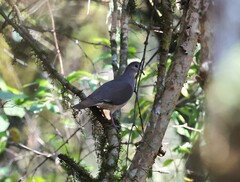
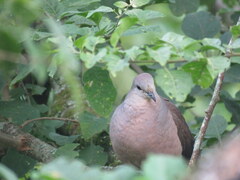
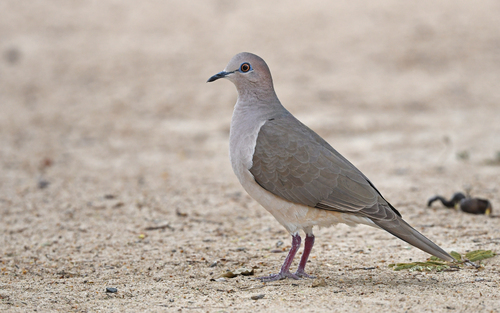
The Yungas dove (Leptotila megalura), also known as the white-faced dove or large-tailed dove, is a species of bird in the family Columbidae. It is found in Argentina and Bolivia. The Yungas dove is monotypic. However, the southern population has sometimes been suggested as a distinct subspecies. The Yungas dove and the grey-fronted dove (L. rufaxilla) are sister species.

The Yungas dove is 29 to 32 cm (11 to 13 in) long. The adult's forehead is grayish and its crown bluish gray. The eye is very dark and is surrounded by white feathers; the rest of the face is buff or pinkish buff. Its upperparts and tail are a dark ruddy brown with a purple gloss on the hindneck and upper mantle. Its breast and the sides of the neck are grayish pink lightening to white on the belly. The adult sexes are similar; the juvenile is duller and its wing coverts appear scaly.

The Yungas dove is found in the Bolivian and Southern Andean Yungas on the east slope of the Andes of Bolivia and northwestern Argentina. It inhabits humid subtropical and tropical woodlands including secondary forest. It is also found in semi-arid Prosopis... Wikipedia →

Sounds

Song0:42

Argentina · 2006

© Rosendo Manuel Fraga · XC477334 · CC BY-NC-SA 4.0

Call0:10

Argentina · 2005

© Rosendo Fraga · XC437799 · CC BY-NC-SA 4.0

Song0:26

Argentina · 2005

© Bernabe Lopez-Lanus · XC50880 · CC BY-NC-SA 3.0

Global Distribution

Parks Where Found

# Park Country Daily sighting probability
1 Amboró National Park 🇧🇴 Bolivia
~20%

More parks will be added in future updates.

Before you go

What are the chances of seeing a Large-tailed Dove in Amboró National Park?

Possible

About 20% of wildlife watchers report a Large-tailed Dove sighting in Amboró National Park on a given day, based on 124 verified sightings from GBIF citizen-science data from 2019 to 2026. It is the 58th most-seen of the 273 birds we can rate there. Over three days the chance rises to about 60%, and over a week to about 90%, if each day is a fresh chance.

When is the best time to see a Large-tailed Dove in Amboró National Park?

September

In that month about 40% of wildlife watchers report a Large-tailed Dove in Amboró National Park on a given day, against under 5% in May, the lowest month. That is one of Amboró National Park's driest months, with about 90 mm of rain against 340 mm in January. June has too few records to rate.

What time of day is best to see a Large-tailed Dove?

Between 7 and 10 am

Across all the parks we cover, that three-hour window holds the most Large-tailed Dove sightings with a recorded time, and about 8 in 10 of them come between 6 am and 6 pm: it is a daytime animal.

Where else can you see a Large-tailed Dove?

Only Amboró National Park, in our data

Amboró National Park is the only park on Wallace's Line with enough records to rate Large-tailed Dove sightings: about 20% of wildlife watchers there report one on a given day.

Where does the Large-tailed Dove sighting chance come from?

GBIF citizen-science records

It is estimated from how often the Large-tailed Dove is recorded against all the birds logged in Amboró National Park (124 verified sightings from 2019 to 2026), calibrated against known sighting rates. Figures are rounded to the nearest 10% because citizen-science data supports honest approximations, not decimals, and months with records from fewer than five people show "—". How it works.
← Back to Amboró National Park