Picuí Ground-Dove

Picuí Ground-Dove

Columbina picui

Silhouette: Sheatherius · PhyloPic

LCLeast ConcernNTVUENCR
Daily sighting probability <5% · Rare
at Amboró National Park

In 3 days <5% in a week ~10%

13 Verified sightings at Amboró National Park From 2019 to 2026
1,518 In all 11 parks
July Best month
☀️ Diurnal When it's spotted

About the Picuí Ground-Dove

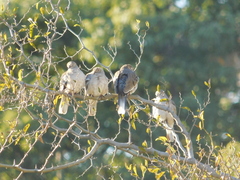
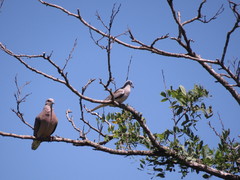
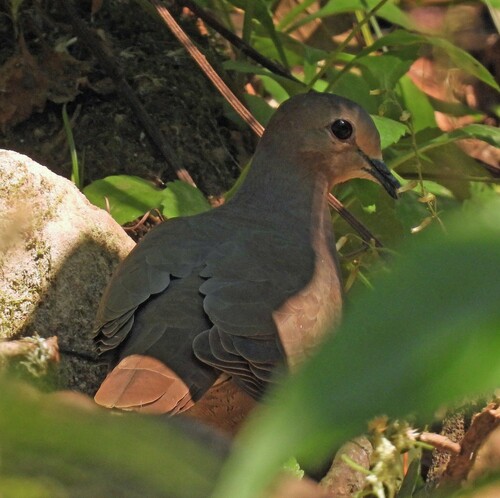
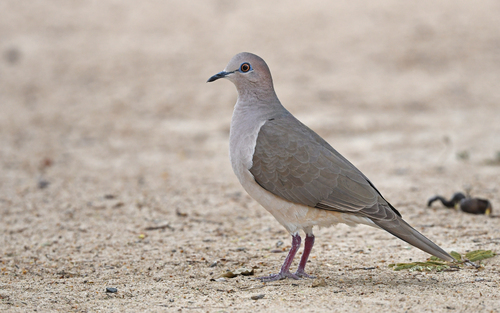
The Picui ground dove or Picui dove (Columbina picui) is a species of bird in the family Columbidae. It is found in Argentina, Bolivia, Brazil, Chile, Colombia, Paraguay, Peru, and Uruguay. The Picui ground dove and croaking ground dove (Columbina cruziana) are sometimes considered sister species.

The Picui ground dove is 18 cm (7.1 in) long and weighs 42 to 59 g (1.5 to 2.1 oz). The nominate adult male's forehead and throat are whitish with a narrow black stripe in front of the eye. Its crown and nape are gray that becomes brownish gray on the shoulders, back, rump, and central tail feathers. The folded wing appears pinkish fawn with two white bands bordered by black. The neck and breast are pinkish gray and the belly white. The adult female is duller with less pink. These differences are faint to the human eye, but there are significant differences in ultraviolet reflectance, to which birds are believed sensitive. The juvenile is duller and browner than the adults. The upperparts and wing of C. p. strepitans are grayer than the nominate's, with... Wikipedia →

Sounds

Song0:04

Brazil · 2025

© JAYRSON ARAUJO DE OLIVEIRA · XC974169 · CC BY-NC-SA 4.0

Song0:38

Brazil · 2018

© Ricardo Gagliardi · XC471100 · CC BY-NC-SA 4.0

Song0:25

Argentina · 1984

© Rosendo Manuel Fraga · XC463486 · CC BY-NC-SA 4.0

Global Distribution

Parks Where Found

# Park Country Daily sighting probability
1 El Impenetrable National Park 🇦🇷 Argentina
~50%
2 Iberá National Park 🇦🇷 Argentina
~40%
3 El Palmar National Park 🇦🇷 Argentina
~20%
4 Parque Estadual Encontro das Águas 🇧🇷 Brazil
~10%
5 Chapada Diamantina National Park 🇧🇷 Brazil
~10%
6 Emas National Park 🇧🇷 Brazil
<5%
7 Iguazú National Park 🇦🇷 Argentina
<5%
8 Amboró National Park 🇧🇴 Bolivia
<5%
9 Iguaçu National Park 🇧🇷 Brazil
<5%
10 Nahuel Huapi National Park 🇦🇷 Argentina
<5%
11 Chapada dos Guimarães National Park 🇧🇷 Brazil
<5%

Cities Where Found

# City Country Daily sighting probability
1 Mendoza 🇦🇷 Argentina
~70%
2 Natal 🇧🇷 Brazil
~60%
3 Rosario 🇦🇷 Argentina
~50%
4 Cochabamba 🇧🇴 Bolivia
~40%
5 Santa Cruz de la Sierra 🇧🇴 Bolivia
~40%
6 Montevideo 🇺🇾 Uruguay
~30%
7 Asuncion 🇵🇾 Paraguay
~30%
8 Buenos Aires 🇦🇷 Argentina
~30%
9 Santiago 🇨🇱 Chile
~30%
10 Cordoba 🇦🇷 Argentina
~20%

Zoos & Centres Where Found

# Zoo / Centre Country
1 Buin Zoo 🇨🇱 Chile In captivity
2 Agroflori Parque de las Aves 🇧🇴 Bolivia In captivity

Before you go

What are the chances of seeing a Picuí Ground-Dove in Amboró National Park?

Rare

Under 5% of wildlife watchers report a Picuí Ground-Dove sighting in Amboró National Park on a given day, based on 13 verified sightings from GBIF citizen-science data from 2019 to 2026. It is the 235th most-seen of the 273 birds we can rate there. Over three days the chance rises to under 5%, and over a week to about 10%, if each day is a fresh chance.

When is the best time to see a Picuí Ground-Dove in Amboró National Park?

July

In that month about 10% of wildlife watchers report a Picuí Ground-Dove in Amboró National Park on a given day, against under 5% in August to May, the lowest months. That is one of Amboró National Park's driest months, with about 120 mm of rain against 340 mm in January. June has too few records to rate.

What time of day is best to see a Picuí Ground-Dove?

Between 2 and 5 pm

Across all the parks we cover, that three-hour window holds the most Picuí Ground-Dove sightings with a recorded time, and nearly all of them come between 6 am and 6 pm: it is a daytime animal.

Where does the Picuí Ground-Dove sighting chance come from?

GBIF citizen-science records

It is estimated from how often the Picuí Ground-Dove is recorded against all the birds logged in Amboró National Park (13 verified sightings from 2019 to 2026), calibrated against known sighting rates. Figures are rounded to the nearest 10% because citizen-science data supports honest approximations, not decimals, and months with records from fewer than five people show "—". How it works.

← Back to Amboró National Park