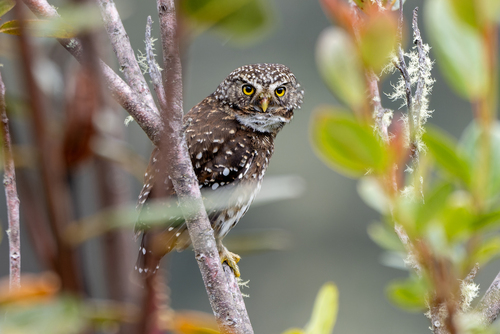
Subtropical Pygmy-Owl

Subtropical Pygmy-Owl

Glaucidium parkeri

Silhouette: Edwin Price · PhyloPic

LCLeast ConcernNTVUENCR
Daily sighting probability <5% · Rare
at Amboró National Park

In 3 days <5% in a week ~10%

6 Verified sightings at Amboró National Park From 2019 to 2026
6 In 1 park
September Best month
☀️ Diurnal When it's spotted

About the Subtropical Pygmy-Owl

The subtropical pygmy owl (Glaucidium parkeri) is a species of owl in the family Strigidae. It is found in Bolivia, Colombia, Ecuador, and Peru. The subtropical pygmy owl's specific epithet honors Theodore A. (Ted) Parker III, "who for over twenty years accumulated an unparalleled knowledge of Neotropical birds and graciously shared his vast expertise with all". It is monotypic.

The subtropical pygmy owl is about 14 to 14.5 cm (5.5 to 5.7 in) long; three males had an average weight of 61.6 g (2.17 oz). It has a widespread brown morph and a rare rufous morph. Adults of the former have a grayish-brown crown; the crown and the sides of the face have prominent white spots. Its nape, like those of most Glaucidium pygmy owls, has black "false eyes". The back and rump are dark brown and the tail blackish with spotty white bands. The underparts are white with broad dull reddish-olive brown streaks. The juvenile plumage has not been described.

The subtropical pygmy owl is found on the east slope of the Andes from far southwestern Colombia through Ecuador and Peru to central Bolivia. In elevation it ranges from 1... Wikipedia →

Sounds

Song1:05

Colombia · 2022

© Gerlando Delgado · XC722630 · CC BY-NC-SA 4.0

Call0:29

Bolivia · 2021

© Jacob Wijpkema · XC631229 · CC BY-NC-SA 4.0

Song0:17

Ecuador · 2021

© Dušan M. Brinkhuizen · XC681273 · CC BY-NC-ND 4.0

Global Distribution

Parks Where Found

# Park Country Daily sighting probability
1 Amboró National Park 🇧🇴 Bolivia
<5%

More parks will be added in future updates.

Before you go

What are the chances of seeing a Subtropical Pygmy-Owl in Amboró National Park?

Rare

Under 5% of wildlife watchers report a Subtropical Pygmy-Owl sighting in Amboró National Park on a given day, based on 6 verified sightings from GBIF citizen-science data from 2019 to 2026. It is the 235th most-seen of the 273 birds we can rate there. Over three days the chance rises to under 5%, and over a week to about 10%, if each day is a fresh chance.

When is the best time to see a Subtropical Pygmy-Owl in Amboró National Park?

Any time of year

In every month with enough records, under 5% of wildlife watchers report a Subtropical Pygmy-Owl in Amboró National Park on a given day, so our monthly data shows no clear season. June has too few records to rate.

What time of day is best to see a Subtropical Pygmy-Owl?

Between 9 am and noon

Across all the parks we cover, that three-hour window holds the most Subtropical Pygmy-Owl sightings with a recorded time, and nearly all of them come between 6 am and 6 pm: it is a daytime animal.

Where else can you see a Subtropical Pygmy-Owl?

Only Amboró National Park, in our data

Amboró National Park is the only park on Wallace's Line with enough records to rate Subtropical Pygmy-Owl sightings: under 5% of wildlife watchers there report one on a given day.

Where does the Subtropical Pygmy-Owl sighting chance come from?

GBIF citizen-science records

It is estimated from how often the Subtropical Pygmy-Owl is recorded against all the birds logged in Amboró National Park (6 verified sightings from 2019 to 2026), calibrated against known sighting rates. Figures are rounded to the nearest 10% because citizen-science data supports honest approximations, not decimals, and months with records from fewer than five people show "—". How it works.

← Back to Amboró National Park