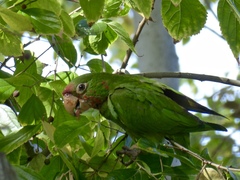
Mitred Parakeet

Mitred Parakeet

Aratinga mitrata

Silhouette: Myriam_Ramirez · PhyloPic

Daily sighting probability ~70% · Very likely
at Amboró National Park

In 3 days >90%

426 Verified sightings at Amboró National Park From 2019 to 2026
426 In 1 park
December Best month
☀️ Diurnal When it's spotted

About the Mitred Parakeet

The mitred parakeet (Psittacara mitratus), also known as the mitred conure in aviculture, is a species of bird in subfamily Arinae of the family Psittacidae, the African and New World parrots. It is native to Argentina, Bolivia, and Peru. It has been introduced to Uruguay and is established there. There are also substantial populations in the US states of California and Florida and smaller numbers in Hawaii.

The mitred parakeet was for a time placed in the genus Aratinga but from about 2013 has been in its present genus Psittacara. Its taxonomy is otherwise unsettled. The International Ornithological Committee (IOC) recognizes these three subspecies: Wikipedia →

Sounds

Recording0:21

Bolivia · 2026

© Dayan Quisbert · iNaturalist · CC BY 4.0

Recording0:18

Bolivia · 2025

© Raquel Mondino · iNaturalist · CC BY 4.0

Recording0:06

United States · 2025

© Lauren Glevanik · iNaturalist · CC BY-NC 4.0

Global Distribution

Parks Where Found

# Park Country Daily sighting probability
1 Amboró National Park 🇧🇴 Bolivia
~70%

More parks will be added in future updates.

Cities Where Found

# City Country Daily sighting probability
1 Cochabamba 🇧🇴 Bolivia
~20%
2 Arequipa 🇵🇪 Peru
~10%
3 Barcelona 🇪🇸 Spain
~10%
4 La Paz 🇧🇴 Bolivia
~10%
5 Miami 🇺🇸 United States
~10%
6 Lima 🇵🇪 Peru
~10%
7 Los Angeles 🇺🇸 United States
~10%
8 Santa Cruz de la Sierra 🇧🇴 Bolivia
<5%
9 Buenos Aires 🇦🇷 Argentina
<5%
10 San Francisco 🇺🇸 United States
<5%

Zoos & Centres Where Found

# Zoo / Centre Country
1 Zoo de Doué 🇫🇷 France In captivity
2 Biocentro Güembé 🇧🇴 Bolivia In captivity
3 Bioparque Municipal Vesty Pakos 🇧🇴 Bolivia In captivity
4 Senda Verde (Wildlife Sanctuary) 🇧🇴 Bolivia In captivity
5 Chapultepec Zoo 🇲🇽 Mexico In captivity
6 Córdoba Zoo 🇦🇷 Argentina In captivity
7 Loro Parque 🇪🇸 Spain In captivity
8 VigoNature 🇪🇸 Spain In captivity
9 Ecozoológico San Martín 🇪🇨 Ecuador In captivity
10 Granja los Pibes 🇦🇷 Argentina In captivity
11 Zoologico Mundo Andino - Tipon 🇵🇪 Peru In captivity
12 Avifauna 🇪🇸 Spain In captivity
13 Agroflori Parque de las Aves 🇧🇴 Bolivia In captivity
14 Bird Park 🇷🇺 Russia In captivity
15 Huachipa Zoo Park 🇵🇪 Peru In captivity

Before you go

What are the chances of seeing a Mitred Parakeet in Amboró National Park?

Very likely

About 70% of wildlife watchers report a Mitred Parakeet sighting in Amboró National Park on a given day, based on 426 verified sightings from GBIF citizen-science data from 2019 to 2026. It is the 5th most-seen of the 273 birds we can rate there. Over three days the chance rises to over 90%, if each day is a fresh chance.

When is the best time to see a Mitred Parakeet in Amboró National Park?

February, September–October and December

In those months about 80% of wildlife watchers report a Mitred Parakeet in Amboró National Park on a given day, against about 40% in April, the lowest month. June has too few records to rate.

What time of day is best to see a Mitred Parakeet?

Between 3 and 6 pm

Across all the parks we cover, that three-hour window holds the most Mitred Parakeet sightings with a recorded time, and about 8 in 10 of them come between 6 am and 6 pm: it is a daytime animal.

Where else can you see a Mitred Parakeet?

Only Amboró National Park, in our data

Amboró National Park is the only park on Wallace's Line with enough records to rate Mitred Parakeet sightings: about 70% of wildlife watchers there report one on a given day.

Where does the Mitred Parakeet sighting chance come from?

GBIF citizen-science records

It is estimated from how often the Mitred Parakeet is recorded against all the birds logged in Amboró National Park (426 verified sightings from 2019 to 2026), calibrated against known sighting rates. Figures are rounded to the nearest 10% because citizen-science data supports honest approximations, not decimals, and months with records from fewer than five people show "—". How it works.

← Back to Amboró National Park