Gerenuk

Gerenuk

Litocranius walleri

Silhouette: Andrew A. Farke · PhyloPic

LCNTNear ThreatenedVUENCR
Daily sighting probability ~30% · Possible
at Amboseli National Park

In 3 days ~70% in a week ~90%

36 Verified sightings at Amboseli National Park From 2019 to 2026
359 In all 6 parks
September Best month
☀️ Diurnal When it's spotted

About the Gerenuk

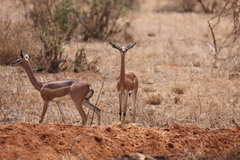
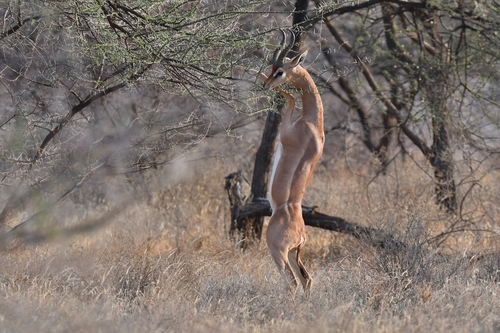
The gerenuk (Litocranius walleri), also known as the giraffe gazelle, is a long-necked, medium-sized antelope found in parts of East Africa. The sole member of the genus Litocranius, the gerenuk was first described by the naturalist Victor Brooke in 1879. It is characterised by its long, slender neck and limbs. The antelope is 80–105 centimetres (2 feet 7 inches – 3 feet 5 inches) tall, and weighs between 18 and 52 kilograms (40 and 115 pounds). Two types of colouration are clearly visible on the smooth coat: the reddish brown back or the "saddle", and the lighter flanks, fawn to buff. The horns, present only on males, are lyre-shaped. Curving backward then slightly forward, these measure 25–44 cm (10–17+1⁄2 in).

The gerenuk was first described by Victor Brooke in 1879 on the basis of three male specimens procured on "the mainland of Africa, north of the island of Zanzibar". Brooke used the scientific name Gazella walleri, on the request of Gerald Waller (who provided the specimens) to name it after his deceased brother. The type locality was later corrected by John Kirk, who originally obtained the specimens on the "coast near the River Juba in southern... Wikipedia →
Global Distribution

Parks Where Found

# Park Country Daily sighting probability
1 Tsavo East National Park 🇰🇪 Kenya
~70%
2 Samburu National Reserve 🇰🇪 Kenya
~60%
3 Meru National Park 🇰🇪 Kenya
~40%
4 Amboseli National Park 🇰🇪 Kenya
~30%
5 Tsavo West National Park 🇰🇪 Kenya
~20%
6 Mkomazi National Park 🇹🇿 Tanzania
~20%

Zoos & Centres Where Found

# Zoo / Centre Country
1 San Diego Zoo 🇺🇸 United States In captivity
2 Denver Zoo 🇺🇸 United States In captivity
3 San Diego Zoo Safari Park 🇺🇸 United States In captivity
4 Brookfield Zoo 🇺🇸 United States In captivity
5 Los Angeles Zoo 🇺🇸 United States In captivity
6 Pittsburgh Zoo & Aquarium 🇺🇸 United States In captivity
7 Erlebniswelt Tier und Natur 🇩🇪 Germany In captivity
8 Griffith Park Zoo 🇺🇸 United States In captivity
9 Kung Fu Corals 🇺🇸 United States In captivity
10 Universal City Zoo 🇺🇸 United States In captivity

Before you go

What are the chances of seeing a Gerenuk in Amboseli National Park?

Possible

About 30% of wildlife watchers report a Gerenuk sighting in Amboseli National Park on a given day, based on 36 verified sightings from GBIF citizen-science data from 2019 to 2026. It is the 18th most-seen of the 30 mammals we can rate there. Over three days the chance rises to about 70%, and over a week to about 90%, if each day is a fresh chance.

When is the best time to see a Gerenuk in Amboseli National Park?

July to September

In those months about 40% of wildlife watchers report a Gerenuk in Amboseli National Park on a given day, against under 5% in April–June and November, the lowest months. Those are among Amboseli National Park's driest months, with about 15 mm of rain a month against 220 mm in April.

What time of day is best to see a Gerenuk?

Between 2 and 5 pm

Across all the parks we cover, that three-hour window holds the most Gerenuk sightings with a recorded time, and about 8 in 10 of them come between 6 am and 6 pm: it is a daytime animal.

Which relatives of the Gerenuk live in Amboseli National Park?

Same family: Bovidae

The closest relatives of the Gerenuk that you can see in Amboseli National Park (family Bovidae, Bovids) are Blue Wildebeest (about 80%), Thomson's Gazelle (about 60%) and Grant's Gazelle (about 60%), with each one's daily chance of a sighting.

Where does the Gerenuk sighting chance come from?

GBIF citizen-science records

It is estimated from how often the Gerenuk is recorded against all the mammals logged in Amboseli National Park (36 verified sightings from 2019 to 2026), calibrated against known sighting rates. Figures are rounded to the nearest 10% because citizen-science data supports honest approximations, not decimals, and months with records from fewer than five people show "—". How it works.

← Back to Amboseli National Park